
5 Best Canny Alternatives in 2026 (Honestly Compared)
customer feedback management and product roadmap tool
Canny is genuinely good at one thing: giving users a place to vote on features and giving teams a tidy board to manage requests. But when your top-voted item has 200 upvotes and zero context, and you're still not sure if building it will actually move retention, the board stops being insight and starts being noise. This page compares five real alternatives based on what teams actually need when Canny's vote count stops being enough.
Usercall at a glance
Usercall is a self-serve AI-moderated interview platform. An AI moderator runs one-to-one voice interviews with real people, and every theme links back to the quotes behind it.
- Real people, AI moderator. Every participant is a real person. Only the interviewer is AI.
- Recruit or bring your own. We can recruit participants for you from a 4M+ panel, or you can bring your own.
- 50+ languages. Every plan includes every language.
- Concept tests. 15-30+ interviews, back in 48 to 72 hours.
Does it tell you the problem, not just the request?
Feature requests are proxies. 'Add dark mode' might mean users are working late and experiencing eye strain, or it might mean your UI looks dated on mobile. A good Canny alternative surfaces the underlying problem, through open-ended analysis, follow-up questions, or theme clustering, not just a title and a tally.
Can it analyze feedback you already have, not just new submissions?
Your richest signal is probably already sitting in NPS verbatims, support tickets, app store reviews, and churned-user emails. Look for tools that can ingest and analyze unstructured text at scale, not just capture new structured votes through a widget.
Does it scale qualitative depth, or force you to choose between depth and volume?
Traditional user interviews give you depth but cap out at a handful of conversations per sprint. Surveys scale but give you shallow data. The best alternatives let you get open-ended, conversational insight from dozens or hundreds of users simultaneously, without a researcher moderating each session.
Does it connect behavioral triggers to research, not just collect ambient feedback?
Feedback collected after churn is retrospective. Feedback collected when a user just abandoned onboarding is actionable. Look for tools that let you trigger research studies or interviews based on in-product events, so you're asking 'why' at exactly the moment the behavior happens.
Quick verdict
- ⭐ Best overall: Usercall: Stop counting votes. Start understanding the problems behind them.
- Best for product teams that need structured…: Productboard: A more structured system for translating feedback into roadmap decisions
- Best for saas product teams that want to…: Pendo: Connect in-app behavior data to the feedback users leave
- Best for teams that want to run targeted…: Typeform: Conversational surveys that get higher completion and richer open-ends
- Best for ux and product teams that want to…: Hotjar: See what users do and hear what they say, in the same platform

1. Usercall
⭐ TOP PICKStop counting votes. Start understanding the problems behind them. Self-serve from $89 a month. Your first interview is free. No sales call.
Usercall is an AI-powered user research platform that runs fully autonomous qualitative interviews and automatically analyzes any unstructured feedback. NPS comments, support tickets, app store reviews, interview transcripts, into themes, patterns, and quotes without manual tagging. Where Canny gives you a vote count and a one-line request, Usercall gives you the actual problem: why users want what they're asking for, what's driving churn, and what themes are accelerating across your entire feedback corpus. It's built for product teams, PMs, and UX researchers who need to move beyond feature prioritization by popularity and make decisions grounded in real qualitative signal at scale.
- ✓ Canny captures what users ask for but not why they're asking. Usercall's AI-moderated interviews send a link to 100 users and return 100 in-depth conversations with follow-up questions, giving you the context and reasoning behind any feedback theme without scheduling a single session.
- ✓ Canny's feedback is limited to what users actively submit through the board. Usercall's VoC analysis continuously ingests NPS verbatims, app store reviews, support tickets, and sales call transcripts and automatically clusters them into themes with confidence scores, so you have a live, always-on read on what customers actually care about across every touchpoint.

2. Productboard
A more structured system for translating feedback into roadmap decisions
Productboard is a product management platform that centralizes customer feedback, links it to features, and helps teams prioritize based on strategic objectives and customer segments. It goes significantly deeper than Canny on the roadmapping and prioritization side, letting you score features against custom drivers, segment feedback by customer type, and create public or internal roadmaps with more nuance than a vote count. It's best for mid-to-large product teams that want a formal system connecting customer input to a structured prioritization framework.
- ✓ Unlike Canny's flat vote board, Productboard lets you weight feedback by customer segment, so input from enterprise accounts or high-value churned users carries more signal than a casual request from a free-tier user.
- ✓ Productboard includes dedicated roadmap views with strategic objective linking, which Canny lacks, helping teams communicate prioritization rationale internally and externally beyond just 'this got the most votes.'

3. Pendo
Connect in-app behavior data to the feedback users leave
Pendo is a product experience platform that combines in-app analytics, session data, NPS surveys, and in-app guides in one platform. Unlike Canny, which is passive, waiting for users to visit a board and submit. Pendo actively captures behavioral data and lets teams trigger surveys or feedback prompts based on what users actually do in the product. It's best suited for product and growth teams at software companies that want to correlate feature usage data with customer sentiment without stitching together separate analytics and feedback tools.
- ✓ Canny relies on users proactively visiting a feedback board. Pendo triggers NPS and micro-surveys in-app based on actual user behavior, capturing feedback at the moment of experience rather than after the fact.
- ✓ Pendo's product analytics show you feature adoption, retention curves, and user paths, giving quantitative context to feedback that Canny's vote board simply doesn't have.
4. Typeform
Conversational surveys that get higher completion and richer open-ends
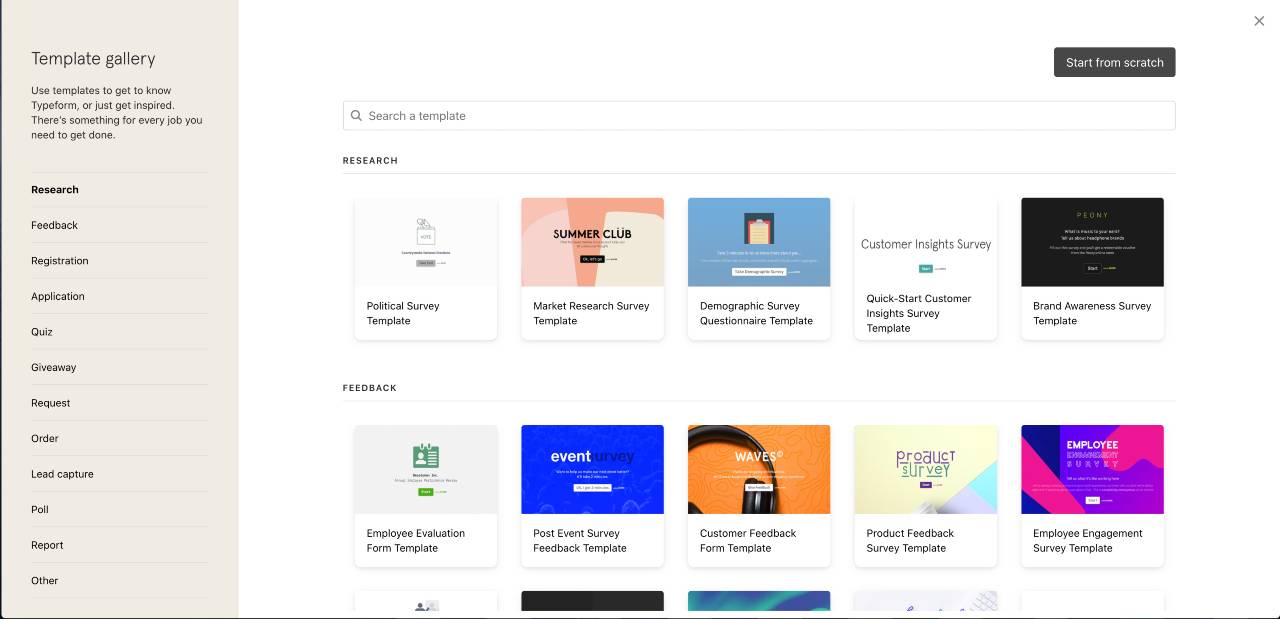
Typeform is a form and survey builder known for its conversational, one-question-at-a-time interface that consistently drives higher completion rates than traditional survey tools. While it doesn't do roadmap management or feedback board features, it's a practical Canny alternative for teams whose real need is collecting structured and open-ended feedback directly from users in a format that doesn't feel like a corporate survey. It's best for teams that want to run targeted feedback collection campaigns, post-onboarding, post-churn, post-NPS, and need a polished, user-friendly experience.
- ✓ Unlike Canny's board which depends on self-selected users opting in, Typeform lets you proactively reach specific user segments with tailored surveys, giving you control over who you're hearing from, not just who happened to visit the feedback page.
- ✓ Typeform's open-ended fields get meaningfully higher completion rates than traditional form builders, making it easier to collect qualitative verbatims at scale compared to Canny's rigid request submission format.

5. Hotjar
See what users do and hear what they say, in the same platform
Hotjar combines heatmaps, session recordings, and on-site surveys and interviews in a single product, giving teams both behavioral evidence and direct feedback from users. While it's not a roadmap or prioritization tool, it addresses a core gap in Canny: understanding what users are actually doing on your product, not just what they're asking for. It's best for product and UX teams at growth-stage companies who want to close the loop between user behavior and user voice without enterprise pricing.
- ✓ Canny tells you what users request but nothing about how they actually navigate your product. Hotjar's session recordings and heatmaps show you where users struggle, rage-click, or drop off, giving behavioral evidence that contextualizes any feedback you collect.
- ✓ Hotjar's on-site micro-surveys and user interview features let you capture feedback in-context while users are actively engaged with your product, rather than asking them to seek out a separate feedback board.
Want a direct comparison? Read our Usercall vs Canny breakdown, feature-by-feature analysis with pricing and a clear verdict on which tool fits your workflow.
| Feature | Usercall AI | Canny |
|---|---|---|
| Research Rigor & Methodology | ||
| AI Automated Coding & Themes | ✅ Yes | ❌ No |
| Editable codes for iterative refinement | ✅ Yes | ❌ No |
| Multi-source analysis: interviews, tickets & reviews | ✅ Yes | ❌ No |
| Adaptive, AI-decided follow-up depth (not a fixed follow-up count) | ✅ Yes | ❌ No |
| Evidence-backed analysis, themes traceable to exact quotes | ✅ Yes | ❌ No |
| Detailed AI summaries per theme | ✅ Yes | ❌ No |
| AI Chat with Your Data | ✅ Yes | ❌ No |
| Voice of Customer (VoC) analysis | ✅ Yes | ✅ Yes |
| Research | ||
| In-product AI-moderated Interviews | ✅ Yes | ❌ No |
| In-product research triggers (e.g. post-purchase insights) | ✅ Yes | ❌ No |
| Visual stimulus / concept testing (show images or prototypes during interview) | ✅ Yes | ❌ No |
| Self-Serve & Pricing | ||
| Self-serve, no sales call required | ✅ Yes | ✅ Yes |
| Free to try / transparent pricing | ✅ Yes | ✅ Yes |
| Pay-as-you-go | Pay-as-you-go | Free. Pro is $79 a month billed yearly, or $99 month-to-month, for 100 tracked users. |
| Platform | ||
| Ideal For | Product Teams, PMs, UX Managers, Startups, Market Researchers | Product managers centralizing and prioritizing user feature requests |
What is the best Canny alternative for understanding why users request features?
Usercall is the strongest option here, it runs AI-moderated interviews that ask follow-up questions and dig into the reasoning behind requests, giving you the problem context that a feature vote never will. For teams that want to move from 'what users ask for' to 'what problem they're actually trying to solve,' that qualitative depth is the key gap Canny doesn't fill.
Can I analyze my existing NPS and support feedback without a new submission tool?
Yes. Usercall's qualitative analysis feature lets you upload any unstructured text (NPS verbatims, support tickets, app store reviews, transcripts) and automatically codes it into themes, sub-themes, and patterns without manual tagging. This means you can get structured insight from feedback you already have, rather than waiting for users to submit new requests through a board.
Is Canny good enough if I only need basic feature request tracking?
For early-stage teams that just need a lightweight, public place for users to submit and vote on requests, Canny's free tier is genuinely functional and easy to set up. The ceiling shows up when you need to make hard prioritization calls, at that point, vote counts without context can mislead as much as they inform.
What's the difference between Canny and tools like Productboard or Usercall?
Canny is primarily a feedback collection and voting tool, it's great at aggregating requests but doesn't help you understand the problems behind them or analyze feedback from outside its own board. Productboard adds structured prioritization frameworks and strategic roadmapping on top of that collection; Usercall goes a different direction, using AI interviews and automated qualitative analysis to surface the 'why' behind any feedback signal, including sources Canny never touches like support tickets or app store reviews.