
Consumer Insight Consultancy: Why Most Fail to Change Decisions (and How to Pick One That Actually Does)
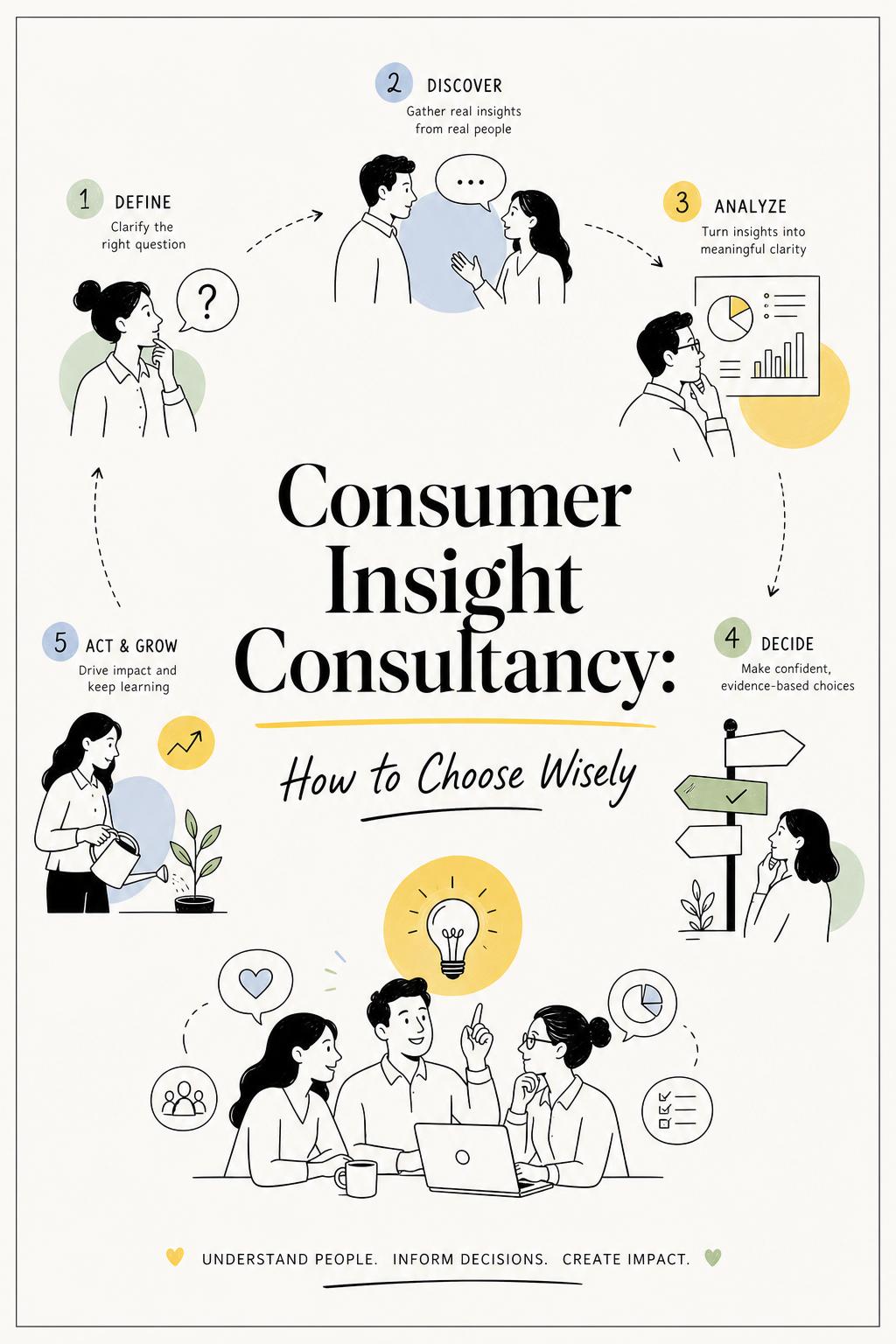
I have sat in too many debriefs where a consumer insight consultancy presents 60 slides of “learnings,” everyone nods, and nothing actually changes. The data is solid. The quotes are compelling. The themes sound right. And yet—no decision moves. No roadmap shifts. No messaging gets rewritten. That is the quiet failure mode of this industry: insight without consequence.
If you are searching for a consumer insight consultancy, you are not buying research. You are buying decision confidence. And most firms, frankly, are not set up to deliver that. They deliver clarity at the surface level, but not at the level where tradeoffs get made.
The difference between a good and a great consultancy is simple: one tells you what customers say; the other changes what your business does next.
The real reason companies hire a consumer insight consultancy
It is rarely because they lack data. It is because their existing data is pointing in different directions.
Product sees drop-offs. Marketing sees weak engagement. Sales hears pricing objections. Leadership wants growth but cannot agree on where it should come from. The organization is stuck in interpretation, not collection.
This is where a consultancy should step in—not to gather more input, but to resolve ambiguity.
In one project I led for a mid-market SaaS company, the executive team was split across three competing narratives for declining activation: onboarding friction, wrong ICP, or pricing mismatch. Each team had evidence. None of it lined up. Instead of running generic “user interviews,” we structured the research around decision moments: why users signed up, what they expected in the first session, and what specifically caused hesitation.
We found that activation issues were not about usability at all. Users understood the product—but could not map it to a clear outcome fast enough to justify continued effort. That insight shifted the fix from UI optimization to outcome framing and onboarding sequencing. Activation increased 18% in six weeks. Same product, different interpretation.
That is the bar a consumer insight consultancy should meet.
Why most consumer insight consultancies underdeliver
The uncomfortable truth: many consultancies optimize for process, not impact. They follow a familiar playbook—interviews, coding, themes, deck—regardless of the decision at hand.
Here is where that breaks down:
- They confuse volume with validity. More interviews do not fix poorly framed questions. If the lens is wrong, the findings will be too.
- They over-rely on what people say. Customers rationalize. They post-justify. They rarely articulate the real constraint driving their behavior.
- They generalize too quickly. “Users want simplicity” sounds useful until you realize it means ten different things across contexts.
- They avoid sharp conclusions. Many reports are designed to keep stakeholders aligned, not to force a decision.
- They separate insight from execution. Findings are not translated into specific product, pricing, or messaging changes.
I once inherited a project where a consultancy had identified “trust” as the core barrier to purchase. True, but useless. Trust in what? At what moment? Relative to which alternative? Without that specificity, the company spent months polishing brand assets instead of fixing the actual breakdown—unclear refund policies during checkout.
Vague insights are expensive because they feel actionable but are not.
What high-impact consultancies do differently
The best consumer insight consultancies operate less like vendors and more like decision partners. They are opinionated. They are precise. And they are willing to challenge the client’s framing early.
Here is what separates them:
They start with the decision, not the deliverable
Before any method is chosen, they define the exact decision the research needs to inform—and what being wrong would cost. This creates focus and forces prioritization.
They design for contrast, not consensus
Instead of averaging across users, they look for meaningful differences: converters vs non-converters, switchers vs loyalists, high-LTV vs low-LTV. Insight emerges from tension, not agreement.
They analyze behavior under constraint
People do not make decisions in ideal conditions. Good research examines what happens when time, budget, risk, and internal pressure are present.
They translate insight into change
They do not stop at “what.” They push into “so what” and “now what”—with clear implications for teams across the business.
They make evidence reusable
Instead of a one-off report, they leave behind structured insight that teams can revisit, validate, and build on.
In a pricing study I ran, we avoided asking “what would you pay?” entirely. Instead, we reconstructed real purchase scenarios—what alternatives were considered, what internal approvals were needed, what risk thresholds existed. That revealed that buyers were not price-sensitive in absolute terms—they were risk-sensitive in relative terms. The winning move was not lowering price, but reframing the offer to reduce perceived downside.
That kind of shift does not come from standard questionnaires.
A simple framework to evaluate a consumer insight consultancy
If you are comparing firms, do not get distracted by methodology slides. Use this instead:
If a consultancy cannot demonstrate all four, you are likely paying for activity, not impact.
The shift from projects to continuous insight
The traditional consultancy model is episodic: run a study, deliver a report, move on. That model struggles in fast-moving product environments where user behavior shifts weekly.
The stronger approach today blends consultancy thinking with continuous insight capture—especially at key behavioral moments.
This is where modern tooling changes the equation:
- Usercall: Built for research-grade qualitative analysis at scale, with AI-moderated interviews and deep researcher controls. Particularly powerful for triggering user intercepts at critical product moments—like churn, drop-off, or conversion—so teams can understand the “why” behind metrics in real time, not weeks later.
- Survey tools: Good for quantifying trends, but limited in uncovering hidden decision drivers.
- Analytics platforms: Essential for identifying what is happening, but silent on why it is happening.
The smartest teams combine both: they bring in consultancies for high-stakes strategic questions, and use continuous insight workflows to stay close to user behavior between those moments.
In one growth project, we embedded intercept interviews at the exact point where users abandoned a pricing page. Within days, patterns emerged: not confusion, but hesitation tied to internal approval thresholds. That insight would have been invisible in a quarterly research cycle.
What you should actually expect as deliverables
A polished deck is not the goal. A changed decision is.
Strong consumer insight consultancy work should produce:
- A clear decision narrative: What is happening, why it matters, and what to do next.
- Behavioral segmentation: Groups defined by how they decide, not just who they are.
- Core tradeoffs: The tensions customers are actively managing.
- Functional implications: Specific changes for product, marketing, and growth teams.
- Traceable evidence: Access to the underlying data, not just summarized outputs.
If you cannot point to a concrete decision that changed because of the work, the engagement did not deliver enough value.
When you should—and should not—hire a consultancy
Hire a consumer insight consultancy when:
- The decision is high-risk or irreversible
- Internal teams are misaligned on the problem
- You suspect your current framing is wrong
- The stakes justify external perspective and rigor
Do not hire one when:
- The problem is already well-defined and tactical
- Your team has direct, frequent access to users
- You need speed over depth
Early in my career, I took on a broad “customer understanding” brief that sounded important but lacked a real decision anchor. We delivered thorough work—and it went nowhere. Since then, I have treated vague briefs as a red flag. If the decision is unclear, the outcome will be too.
The bottom line
A consumer insight consultancy should not just help you understand your customer better. It should help you make sharper, riskier, more confident decisions.
If you remember one thing, make it this: insight is only valuable when it forces a choice. Everything else is just well-organized information.
Choose accordingly.
If you're still narrowing your options, it's worth comparing consultancies against a broader set of vetted firms before you commit. Our guide to the Top 30 US Market Research Firms breaks down who's actually built for decision-driving work versus who just delivers reports. And if you want insights without the agency overhead, Usercall lets you run structured customer conversations yourself, in days instead of months.
Related: how to vet a consumer insight research agency · why customer research services often fall short