
Inductive vs Deductive Coding in Qualitative Research
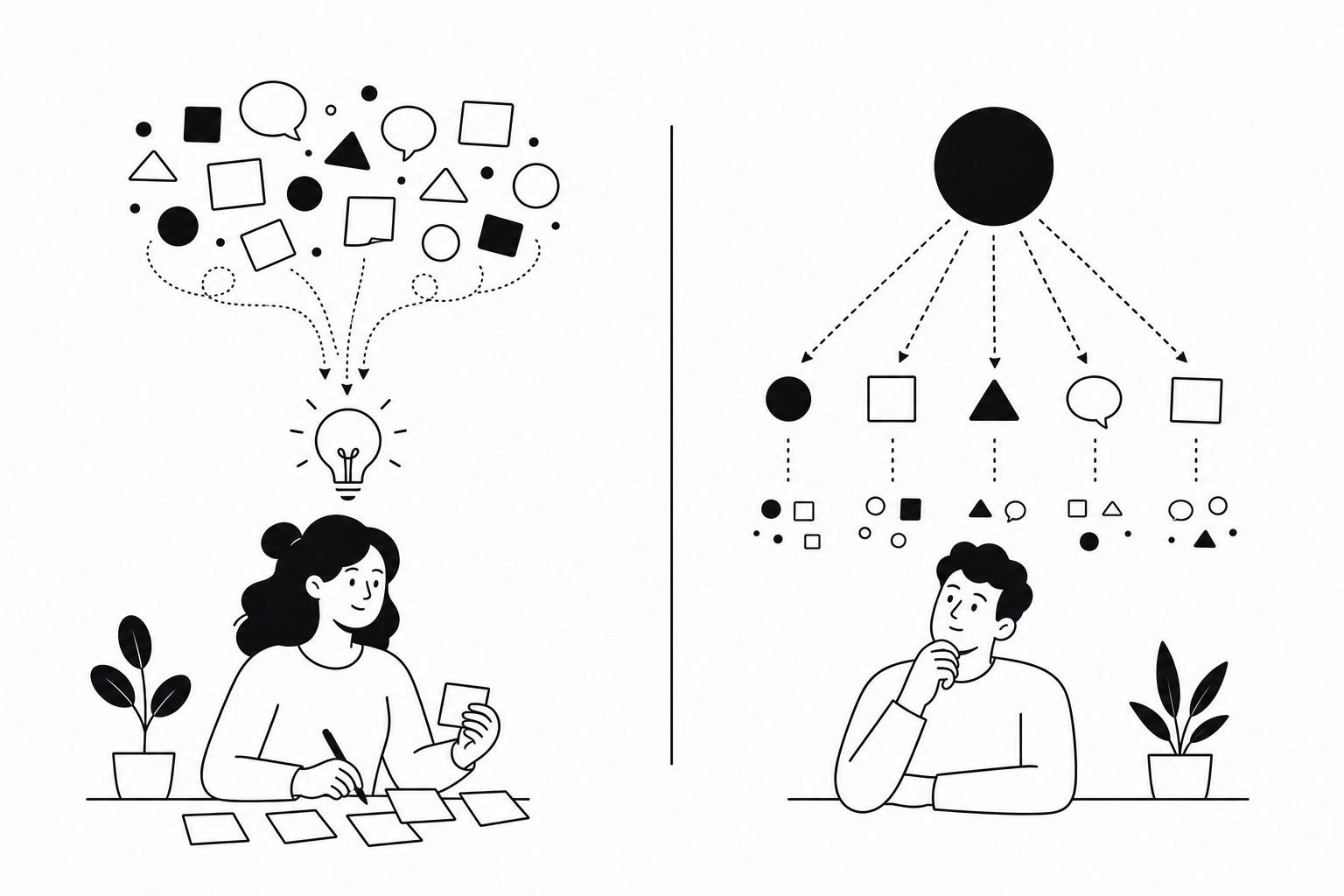
Most teams don’t choose between inductive and deductive coding based on research logic. They choose based on panic. If leadership already has a hypothesis, they force deductive codes onto messy interviews. If the team wants to feel “open-minded,” they go fully inductive and drown in 200 tags that say almost the same thing. Neither failure is about the coding method itself. It’s about using the wrong method for the question, the stage, and the decision riding on the research.
After more than a decade of coding interviews, support transcripts, diary studies, and usability sessions, I’ve stopped treating inductive vs deductive coding as a philosophical debate. It’s an operational choice. Are you trying to discover what you missed, or test whether a known framework holds up? Most teams need both, but not at the same time and not in equal measure.
Why “just stay open to the data” fails
Pure inductive coding is wildly overrated when teams already know something about the problem. Researchers often present induction as the more rigorous, unbiased choice. In practice, it becomes an excuse for loose analysis, inconsistent labels, and hours of recoding because nobody agreed on what counts as a meaningful pattern.
I saw this on a 12-person product team working on a B2B onboarding flow for finance admins. We ran 28 semi-structured interviews and tried a fully inductive pass because stakeholders didn’t want us to “lead the witness.” Two researchers ended up with 146 codes, including separate tags for “confusion,” “uncertainty,” “hesitation,” and “lack of clarity.” The outcome wasn’t richer insight. It was semantic clutter.
Pure deductive coding fails just as often. When teams lock into a predefined framework too early, they code only what they expected to hear. That creates false confidence, especially in product orgs where the categories come from funnel metrics, feature requests, or last quarter’s OKRs rather than user reality.
On another team, a growth group with 5 PMs and 2 analysts forced every interview excerpt into “activation,” “retention,” or “pricing friction.” We missed a huge issue: prospects didn’t understand who the product was for. That problem didn’t fit the framework, so it stayed invisible until win-loss interviews made it impossible to ignore.
Inductive vs deductive coding is really about where your categories come from
Inductive coding starts from the data. You read transcripts, notes, or recordings and create codes based on what participants actually say, do, or imply. The categories emerge during analysis rather than being imposed in advance.
Deductive coding starts from a predefined structure. That structure might come from a research question, prior studies, a behavioral model, a jobs-to-be-done framework, a survey instrument, or known product hypotheses. You enter analysis with an initial set of codes and test the data against them.
The practical difference is simple. With inductive coding, you ask, “What is here that we didn’t anticipate?” With deductive coding, you ask, “Do these data support, challenge, or refine what we already believe?”
Neither approach is inherently better. They serve different jobs at different moments. If you’re exploring a new user segment, ambiguous problem space, or unexplained behavior, inductive coding usually gives you more signal. If you’re evaluating a concept, comparing responses against a known framework, or answering a narrow decision question, deductive coding is faster and often sharper.
This is also why coding approach should follow method. If your data source is broad and exploratory, like open-ended discovery interviews or ethnographic notes, inductive coding makes sense. If your study is structured around specific assumptions, a deductive frame is often the right starting point. If you’re still choosing methods, this guide to qualitative data collection methods is the place I’d start.
Use inductive coding when the real risk is premature certainty
Inductive coding works best when your biggest danger is being too sure too early. Early-stage product discovery, new market entry, poorly understood churn, and vague dissatisfaction are classic cases. You need enough openness to catch issues nobody put on the discussion guide.
Signs inductive coding is the better fit
- You’re studying a new audience or workflow with weak prior knowledge.
- Your research question is broad, exploratory, or diagnostic.
- Stakeholders keep jumping to solution ideas before the problem is clear.
- The data are rich, varied, and likely to contain unexpected patterns.
- You need language from users, not just validation of internal categories.
The mistake is assuming inductive means starting from zero. It doesn’t. Good inductive coding still needs discipline. I usually begin with a narrow coding lens tied to the research objective, then let subcodes emerge. That keeps the analysis open without turning it into a word-cloud exercise.
On a consumer subscription app, my team ran 35 churn interviews with only one stable assumption: cancellation wasn’t mostly about price. We coded inductively across emotional triggers, failed routines, and trust breakdowns. The surprise was that users weren’t “forgetting value”; they felt the product had become repetitive after week three. That insight changed the roadmap. A deductive pricing-focused frame would have buried it.
Use deductive coding when speed and comparability matter more than surprise
Deductive coding is the smarter choice when you need consistency across a known decision frame. That includes concept tests, message testing, benchmark studies, and follow-up research on a problem you’ve already scoped.
Signs deductive coding is the better fit
- You already have a model, hypothesis set, or codebook worth testing.
- You need to compare findings across segments, waves, or markets.
- The study is tightly tied to a business decision with fixed criteria.
- You’re working under time pressure and can’t afford exploratory sprawl.
- Multiple researchers need to code the same way with minimal drift.
Deductive coding is not lazy. It’s only weak when the starting framework is weak. If your initial codes are grounded in prior research, product behavior, or a coherent theoretical lens, deduction can dramatically improve speed and alignment.
This is where a solid codebook matters. Define each code, what belongs inside it, what gets excluded, and what a borderline case looks like. If your team skips that step, deductive coding becomes arbitrary fast. I’ve written more on that here: how to create a codebook for qualitative research.
It also helps to use tools that support structured review without flattening the data. I like systems that let me start with researcher-defined categories, audit excerpts quickly, and then expand where the framework breaks. That’s one reason Usercall is useful in practice: I can run AI-moderated interviews with tight researcher controls, then analyze responses at scale without losing the conversational depth that makes coding meaningful in the first place.
The best analysis usually combines both, but in sequence
The strongest qualitative coding is often abductive in practice: start with one mode, then deliberately borrow from the other. The problem is that teams blend inductive and deductive coding sloppily and call it “hybrid.” That usually means they added a few new tags midway through analysis with no logic behind the change.
The combination works when the sequence is intentional. I usually recommend deductive-then-inductive or inductive-then-deductive depending on the risk profile of the study.
Two hybrid sequences that actually work
- Start deductive, then open inductively. Use this when you have a clear framework but want to catch outliers, unmet assumptions, or new themes that don’t fit.
- Start inductive, then consolidate deductively. Use this when the problem space is fuzzy but you eventually need a stable code set for comparison, reporting, or scale.
For example, if I’m analyzing onboarding interviews tied to a known funnel, I may begin with deductive buckets like expectation mismatch, setup friction, role confusion, and value realization. Then I do a second pass inductively on the excerpts inside each bucket to surface nuance. That’s how you avoid both framework blindness and coding chaos.
This matters even more when you’re working at volume. If you’re reviewing dozens or hundreds of interviews, manually improvising your coding logic is a terrible idea. You need structure, but you also need a way to preserve emergent patterns. If your team is evaluating tooling, this breakdown of computer programs for qualitative data analysis will save you some pain.
The right choice depends on the decision, not the doctrine
If the team needs discovery, choose inductive coding. If the team needs evaluation, choose deductive coding. If the team needs both, separate the jobs. That sounds obvious, but most analysis breaks because researchers try to force one coding style to answer every question at once.
I use a simple test. If I’d be embarrassed to hand stakeholders a predefined framework before reading the data, I go inductive first. If I’d be embarrassed to show up without a framework because the decision criteria are already clear, I go deductive first.
And if you’re doing thematic analysis, don’t confuse coding approach with analysis method. You can do thematic analysis inductively or deductively. You can also use grounded theory in ways that demand more rigorous emergence from the data. If that distinction is muddy for your team, read grounded theory vs thematic analysis.
The best researchers I know are not loyal to inductive or deductive coding. They’re loyal to inference quality. Good coding is not about proving you were open-minded or systematic. It’s about producing findings that are sharp enough to change a decision.
If you need to run qualitative research without adding weeks of scheduling, moderation, and coding overhead, Usercall is the tool I’d use. It runs AI-moderated user interviews that collect research-grade qualitative insights at scale, with deep researcher controls and the ability to intercept users at critical product moments so you can understand the why behind the metric.
Once you've picked a coding approach, the right tool can make applying it far less tedious. Our review of the top 5 qualitative data analysis tools that actually work shows which platforms support both inductive and deductive coding well, and Usercall is free to try if you want to test it on your own data.
Related: 7 coding techniques that turn interviews into decisions · how to create a codebook · in vivo coding step-by-step process