
MAXQDA Pricing 2026: Academic License About $278 a Year
If you’re researching MAXQDA pricing, you’re likely comparing it against NVivo, ATLAS.ti, Dedoose, or newer AI-native tools like UserCall.
MAXQDA remains one of the most respected platforms for rigorous qualitative and mixed-methods analysis, especially in academic and institutional settings. But in 2026, the real pricing question has shifted.
It’s no longer just “What does the license cost?”
It’s “How much do add-ons, seats, transcription, and researcher time actually cost over a real project?”
How MAXQDA Pricing Works in 2026
Comparing MAXQDA to other options? Our MAXQDA alternatives guide covers the top qualitative analysis tools by capability, workflow, and cost.
MAXQDA uses a license-based model with optional add-ons, rather than a single all-inclusive subscription. Pricing varies based on:
- License type (Academic, Commercial, Enterprise)
- Subscription length (annual vs multi-year)
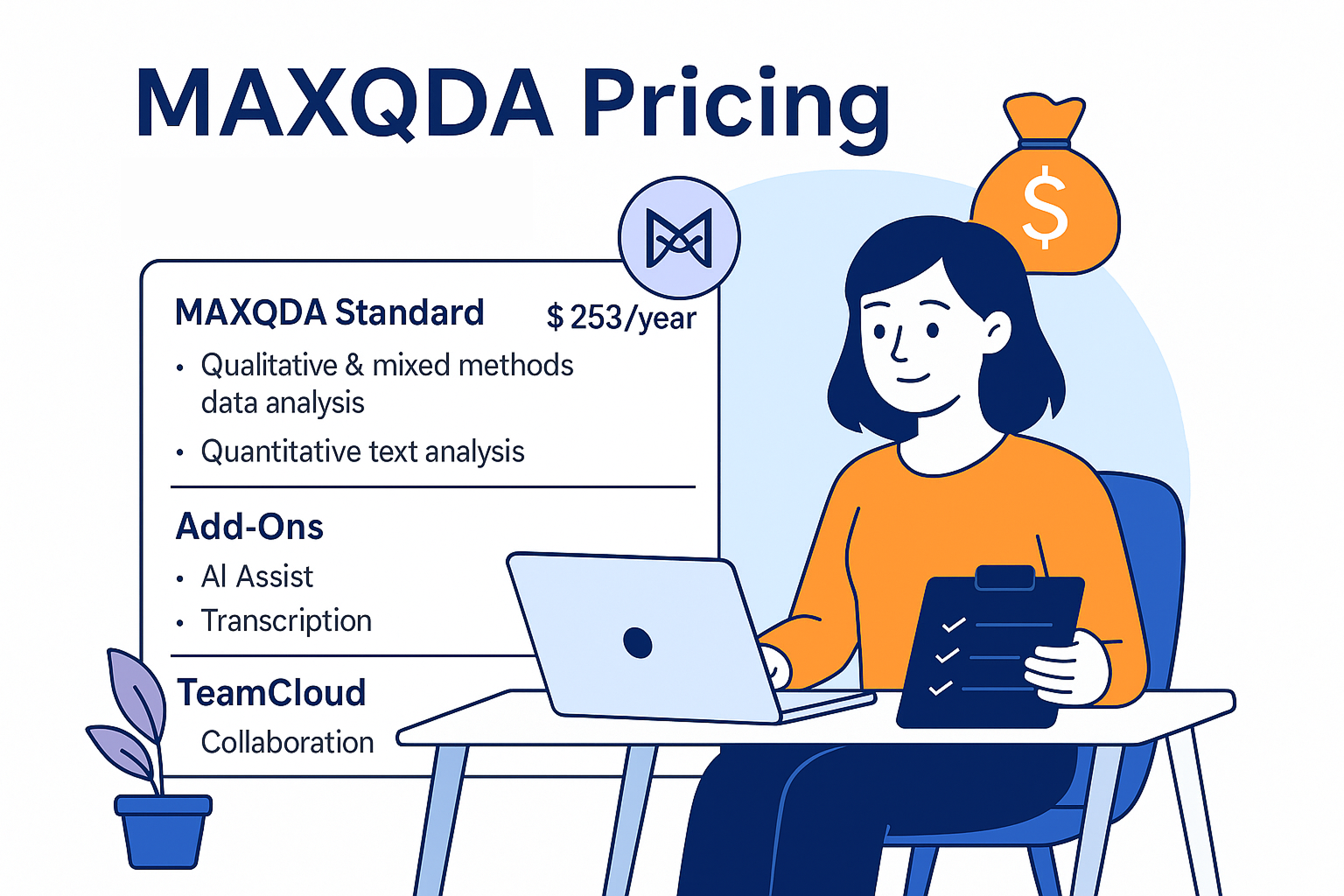
- Optional add-ons (AI Assist, transcription, cloud collaboration)
- Number of seats or network licenses
For most readers searching “MAXQDA pricing,” Academic licenses are the reference point, as they are the most transparent and commonly published.
MAXQDA Academic License Costs (Most Common)
Academic users can choose between time-based licenses that reduce cost the longer you commit.
Annual Subscription (Academic)
| Plan | Typical Cost (USD) | Best For |
|---|---|---|
| MAXQDA | ~$278 per year | Qualitative + mixed methods analysis |
| MAXQDA Analytics Pro | Higher (varies) | Adds full statistical analysis module |
| Network License | Custom quote | Shared licenses across teams or labs |
| 20+ Seats | Custom quote | Departments or institutions |
What this pricing optimizes for
- Methodological depth
- Longitudinal research
- Manual, researcher-controlled coding
What it does not optimize for
- Fast turnaround projects
- High interview volume
- Low-friction collaboration
Multi-year licenses (3-year or 5-year) lower the annualized cost, but require upfront commitment.
MAXQDA Add-Ons (Where Costs Increase)
MAXQDA’s base license is powerful, but many teams end up paying more once real-world workflows are considered.
1. AI Assist
- AI Assist Free: Included with all licenses (limited prompts)
- AI Assist Premium: Paid upgrade for frequent or large-scale AI usage
AI Assist helps with summaries and suggestions, but it does not replace manual coding or synthesis.
2. MAXQDA Transcription
Each license includes 60 minutes of free transcription, which is enough for testing, not production research.
Additional transcription is purchased in bundles:
| Package | Use Case |
|---|---|
| 2 hours | Very light usage |
| 5 hours | Small studies |
| 10 hours | Regular interviewing |
| 20 hours | Ongoing research |
Costs vary by package, but for interview-heavy studies, transcription becomes a recurring expense.
3. MAXQDA TeamCloud
TeamCloud is a paid annual add-on that enables collaboration.
- Includes ~25GB cloud storage
- Supports 1 team lead + up to 4 collaborators
- Designed for shared coding environments
Without TeamCloud or network licenses, MAXQDA is effectively a single-user desktop tool.
What MAXQDA Pricing Includes (and What It Doesn’t)
Included
- Deep qualitative coding and retrieval
- Mixed methods and quantitative text analysis
- Visual tools, code systems, and memos
- Strong academic documentation and support
Not Included by Default
- Unlimited transcription
- Automated first-pass coding
- AI-generated themes at scale
- Flat, team-wide pricing
MAXQDA is priced around analytical power, not workflow automation.
Why MAXQDA Pricing Feels Different in 2026
In 2026, researchers increasingly compare MAXQDA not just to other desktop QDA tools, but to AI-native qualitative platforms.
The difference is not just cost. It’s where the work happens.
- MAXQDA assumes researchers will still:
- Transcribe
- Code
- Synthesize manually
- AI-first tools like UserCall:
- Include transcription by default
- Auto-generate themes and summaries
- Reduce coding and synthesis time by a large margin
This shifts the cost from licenses to researcher hours.
Many teams now adopt a hybrid approach:
- MAXQDA for theory-driven, publication-grade analysis
- AI-native tools for discovery, concept testing, and fast insight cycles
In practice, MAXQDA prices the analysis tool, while AI-native platforms price the insight outcome.
Is MAXQDA Worth the Cost?
MAXQDA is one of the leading tools for qualitative research, especially if you need a balance of text analysis, mixed methods, and team collaboration. The downside? Costs can add up quickly once you start adding transcription hours, AI Assist upgrades, or multiple seats for teams.
For individual researchers, the $278/year academic license is manageable. But for research teams or non-academic organizations, MAXQDA pricing can get expensive.
Alternative: UserCall
If your primary need is qualitative interviewing with fast synthesis, AI-native platforms like UserCall take a different approach. Instead of charging separately for transcription, AI assistance, and seats, they bundle data collection and analysis into a flat monthly model.
| Tool | Pricing Model | Best For |
|---|---|---|
| MAXQDA | $278+/year per license + add-ons | Deep qualitative + mixed methods research |
| UserCall | $89–199/month (flat rate) | Scalable, AI-driven with full controls for qualitative & thematic analysis and AI interviews |
Final Thoughts
Quick Verdict:
✅ Worth it if: You need rigorous manual coding, mixed methods, and academic defensibility
⚠️ Less ideal if: You run frequent interviews or need fast turnaround
💸 Hidden cost: Transcription + researcher hours
🚀 Faster alternative: AI-native tools with built-in synthesis
MAXQDA pricing starts at $278/year for academics and scales up depending on add-ons and team needs. For researchers who need comprehensive mixed methods analysis and customizable coding frameworks, MAXQDA is a strong investment.
But if you want faster, more automated insights without managing licenses, add-ons, and transcription costs, modern AI-first tools like UserCall might be more efficient and budget-friendly.
MAXQDA Pricing FAQs
How much does MAXQDA cost in 2026?
MAXQDA pricing depends on license type (Academic vs Commercial vs Enterprise) and term length (annual vs multi-year). Academic annual pricing is often the most visible benchmark, with commercial and enterprise pricing typically higher and sometimes quote-based.
Is MAXQDA priced per user or per team?
MAXQDA is primarily priced per license (per user/seat). Team or lab use usually requires multiple seats, a network license, or TeamCloud depending on how you collaborate.
What’s included in a MAXQDA license?
A standard license includes core qualitative coding, retrieval, memos, and visualization, plus mixed-methods capabilities (and quantitative text analysis features depending on edition).
What costs extra with MAXQDA?
Costs commonly increase with add-ons like AI Assist Premium usage, transcription bundles beyond included minutes, TeamCloud for collaboration, and additional seats or network licensing for teams.
Does MAXQDA include transcription?
MAXQDA often includes a small amount of transcription to start (good for testing), but ongoing transcription for interview-heavy research is usually purchased separately in bundles.
Does MAXQDA include AI-generated themes and automated coding?
MAXQDA offers AI assistance for summaries and suggestions, but most workflows still rely on manual coding and researcher-led synthesis. It’s not typically an end-to-end “auto-theme everything” workflow.
Is MAXQDA worth the price in 2026?
MAXQDA is usually worth it when you need rigorous manual coding, mixed-methods depth, and defensible methodology. It can feel expensive when your real bottleneck is time: transcription, coding hours, and collaboration overhead.
When should you consider an AI-first alternative instead of MAXQDA?
If you run frequent interviews, need faster turnaround, or want built-in transcription + automated first-pass theming, AI-first platforms can be more cost-effective because they reduce researcher hours and operational work.
Before you finalize your budget, see how MAXQDA's total cost stacks up against other tools in our ATLAS.ti vs NVivo vs UserCall comparison—or try UserCall to see what a pricing model built for modern research teams actually looks like.
Frequently Asked Questions
How much does MAXQDA cost in 2026?
MAXQDA's academic license starts at approximately $278 per year. Higher-tier plans like MAXQDA Analytics Pro cost more and vary by configuration. Commercial and enterprise pricing is customized. Multi-year commitments (3- or 5-year) lower the annualized cost but require upfront payment. Add-ons for transcription, AI, and collaboration increase the total.
Does MAXQDA offer a free version or free trial?
MAXQDA does not offer a permanent free version, but all licenses include a limited free tier of AI Assist and 60 minutes of free transcription. The free transcription is sufficient for testing but not for production research involving multiple interviews or ongoing data collection.
What add-ons cost extra with MAXQDA?
Three add-ons significantly increase MAXQDA's total cost: AI Assist Premium for large-scale AI usage, transcription bundles beyond the included 60 free minutes, and TeamCloud, a paid annual add-on enabling collaboration for one team lead and up to four collaborators with approximately 25GB of cloud storage.
What is MAXQDA TeamCloud and how much does it cost?
MAXQDA TeamCloud is a paid annual add-on that enables shared coding environments. It supports one team lead and up to four collaborators with roughly 25GB of cloud storage. Without TeamCloud or a network license, MAXQDA functions as a single-user desktop tool, making collaboration unavailable by default.
How does MAXQDA pricing compare to NVivo and ATLAS.ti?
MAXQDA's academic license starts around $278 per year, positioning it as a competitively priced desktop QDA tool alongside NVivo and ATLAS.ti. All three use license-based models with add-on costs. The meaningful 2026 comparison is increasingly against AI-native tools like UserCall, which include transcription and automated synthesis by default.
What are the biggest limitations of MAXQDA's pricing model?
MAXQDA's pricing does not include unlimited transcription, automated first-pass coding, AI-generated themes at scale, or flat team-wide pricing. Transcription bundles become a recurring expense for interview-heavy studies, and collaboration requires a separate TeamCloud purchase, making total costs significantly higher than the base license alone.
Is MAXQDA worth the cost for qualitative research in 2026?
MAXQDA delivers strong value for theory-driven, publication-grade qualitative and mixed-methods research, particularly in academic settings. However, teams running high interview volumes or fast insight cycles often adopt a hybrid approach, using MAXQDA for rigorous analysis while relying on AI-native tools to reduce transcription and coding time.
Before you finalize your budget, it's worth comparing MAXQDA against the other major platforms to make sure you're not paying for features you won't use. Our guide to ATLAS.ti vs NVivo vs Usercall covers how these tools stack up on cost, capability, and fit. If your work centers on interviews, Usercall offers a leaner, AI-first alternative worth considering.
For a wider view of how qualitative research tools price their plans and add-ons, check our guide to competitor pricing pages. If you'd rather skip manual coding sessions altogether, Usercall can transcribe and analyze interviews automatically — a faster path than layering add-ons onto a MAXQDA license.
Related: Dedoose pricing by user count · NVivo subscription costs · ATLAS.ti desktop vs cloud pricing