
 Table of Contents
If you are searching for thematic analysis vs grounded theory, chances are you are not looking for textbook definitions. You are trying to decide which method will survive real-world constraints like limited time, messy data, stakeholders who want answers now, and projects that did not start with a perfectly clean research question.
As a researcher, I have seen teams get stuck not because they chose the “wrong” method, but because they misunderstood what each method demands in practice. This guide cuts through the confusion and helps you choose deliberately, not defensively.
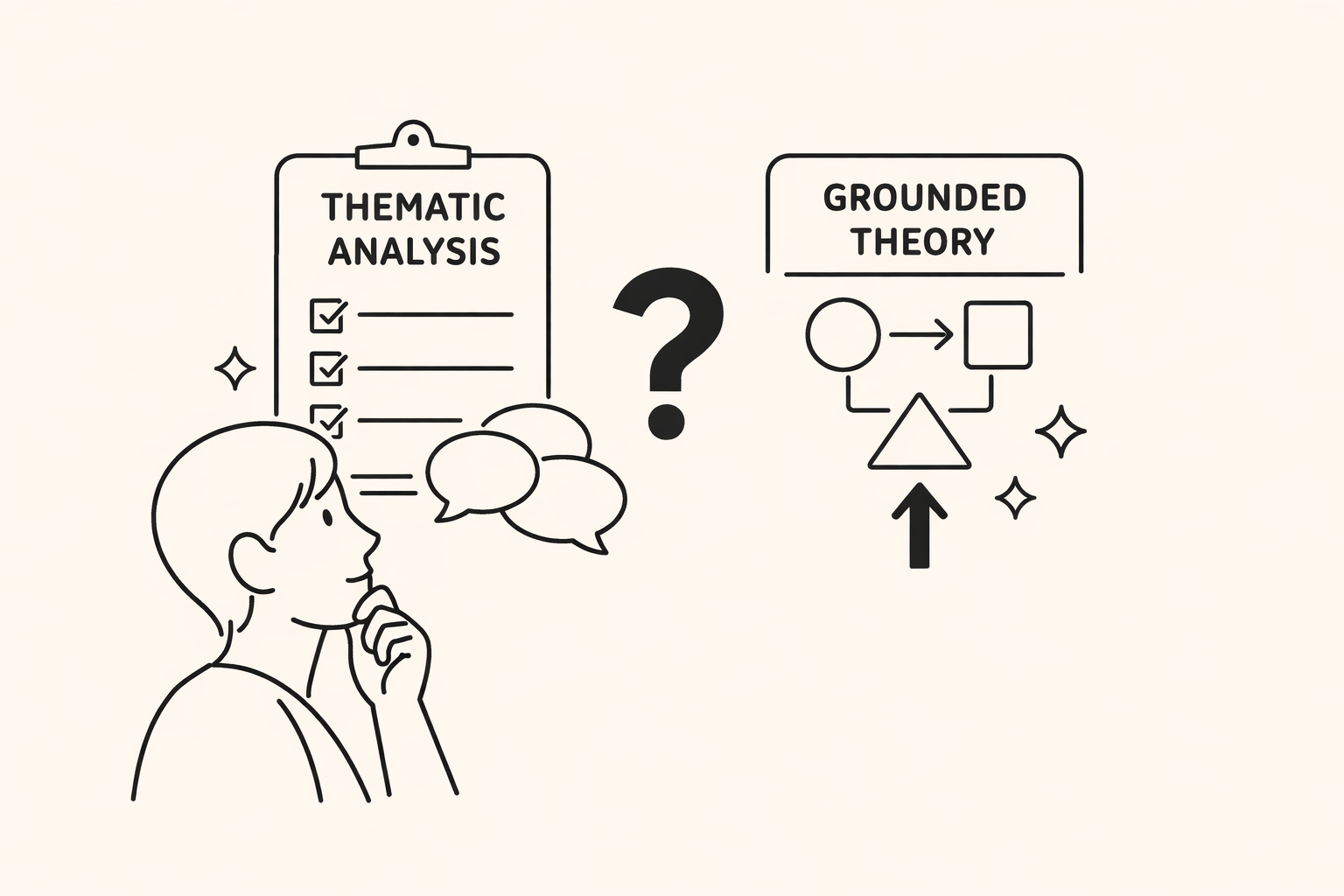
At a high level, thematic analysis and grounded theory answer very different kinds of research needs.
Both are rigorous. Both are qualitative. But they differ sharply in mindset, workflow, and what “done” actually looks like.
Thematic analysis is a flexible method for identifying, organizing, and interpreting patterns across qualitative data.
You work with interviews, open-ended survey responses, notes, or recordings, and systematically code them to surface recurring ideas, meanings, or experiences. Those patterns become themes, and themes become insight.
In practice, thematic analysis is how most professional research teams operate, even when they do not label it as such.
Grounded theory is not just “deep qualitative analysis.” It is a full methodological approach aimed at generating new theory that explains a social process, behavior, or phenomenon.
It requires you to enter the field without predefined hypotheses and to let theory emerge through constant comparison, memo writing, and iterative data collection.
This is not just a coding technique. It is a research posture.
If your project does not aim to produce theory, grounded theory is usually overkill.
Here is the simplest way to think about it:
Thematic analysis describes patterns. Grounded theory explains processes.
If you need to understand what people are saying and why it matters, thematic analysis is usually sufficient.
If you need to explain how and why a phenomenon operates over time, grounded theory may be appropriate.
| Dimension | Thematic Analysis | Grounded Theory |
|---|---|---|
| Primary goal | Identify and interpret patterns | Generate new theory |
| Starting point | Can use existing frameworks or questions | No predefined theory |
| Flexibility | High | Low to moderate |
| Data collection | Usually completed first | Ongoing and iterative |
| Time investment | Moderate | High |
| Best for | Applied research, UX, product, CX | Academic and theory-building research |
Choose thematic analysis if:
Real example:
In a multi-market concept test with dozens of interviews, thematic analysis allowed us to identify consistent friction points across regions while still preserving nuance in local language and context. Grounded theory would have slowed the project without adding proportional value.
Choose grounded theory if:
Real example:
A doctoral project examining how early-stage founders make ethical decisions under pressure is a classic grounded theory use case. The goal is not themes. It is theory.
Many projects labeled “grounded theory” are actually thematic analyses with inductive coding. That is not a failure. It is just mislabeling.
If the deliverable is a roadmap, product decision, or messaging strategy, grounded theory usually creates more friction than insight.
Thematic analysis is not “lighter” or less serious. When done well, it is systematic, transparent, and analytically deep.
Yes, but with clarity.
You can:
What you should not do is claim grounded theory unless you follow its full logic and constraints.
Most professional teams benefit from thematic analysis informed by grounded theory techniques, not full grounded theory studies.
Modern AI tools now handle transcription, first-pass coding, and pattern detection at scale. This shifts where human judgment matters.
In practice, AI amplifies thematic analysis far more than grounded theory. That alone influences which method is realistic for most teams today.
Ask yourself one honest question:
Are you trying to explain a phenomenon, or are you trying to make a decision?
Choosing the right method is not about prestige. It is about alignment between your research goal, constraints, and the kind of insight you actually need.
If you're still weighing your broader analysis options beyond these two methods, our roundup of 12 proven qualitative data analysis methods gives you the full picture. Ready to put your chosen method into practice with real user conversations? Usercall helps you capture and structure interview data so analysis — whether thematic or grounded — becomes significantly faster.
Thematic analysis identifies and interprets patterns across qualitative data, while grounded theory builds entirely new explanatory theory from the ground up. Thematic analysis describes what people are saying and why it matters. Grounded theory explains how and why a phenomenon operates over time through iterative data collection and constant comparison.
Use thematic analysis when you already have data and need insight quickly, when stakeholders need clear themes and practical implications, or when working in applied fields like UX, product, or market research. It is also the better choice when your project scope is fixed and data collection is already complete.
Yes. Grounded theory demands significantly more time and methodological rigor. It requires simultaneous data collection and analysis, theoretical sampling that evolves as concepts emerge, multi-phase coding, and continued fieldwork until theoretical saturation is reached. Thematic analysis has moderate time investment and adapts more easily to real-world project constraints.
Thematic analysis works for both academic and applied research. It can operate deductively, inductively, or both, making it flexible across contexts. However, grounded theory is generally better suited when the explicit goal is producing new conceptual models or process theories that explain a social phenomenon from scratch.
Thematic analysis produces theme frameworks, insight summaries, experience maps, opportunity areas, and narrative synthesis for stakeholders. Grounded theory produces conceptual models, process theories, and core category sets that explain how a phenomenon works. Thematic outputs are more actionable for business decisions; grounded theory outputs are more suited to academic contribution.
Grounded theory requires entering the field with no predefined hypotheses, conducting data collection and analysis simultaneously, using theoretical sampling that shifts as concepts emerge, and stopping only at theoretical saturation. Thematic analysis allows researchers to start with existing frameworks, complete data collection first, and work within a fixed project scope.
In most applied research settings, yes. Grounded theory is designed specifically to generate new theory, so if your project aims to surface insights rather than build explanatory theory, it is usually unnecessary. Most professional research teams already operate using thematic analysis principles, even when they do not formally label the approach.
Choosing between thematic analysis and grounded theory is one decision — but it sits inside a much larger set of method choices every qualitative researcher has to make. See how both fit into the full landscape in our breakdown of 12 qualitative data analysis methods and how to choose the right one. If you're running interviews as your primary data source, Usercall can handle collection and first-pass analysis so you can focus on the interpretation.
Choosing the right analysis method matters less if you're not asking questions that generate rich, codable data in the first place. Check out How to Write Qualitative Research Questions: 45+ Examples to strengthen your interview or survey design before you dive into coding.
Related: 12 qualitative data analysis methods that actually work · qualitative data analysis guide · another take on grounded theory vs thematic analysis
