
 Table of Contents
The fastest way to waste a quarter of research budget is to pretend a fintech onboarding test, a patient intake interview, and a B2B admin workflow study are basically the same thing. They are not. Industry changes the research itself—who you can recruit, what people will say out loud, what you’re allowed to record, and how confidently you can generalize what you hear.
I’ve seen strong product teams miss this because they copy methods from whatever company they worked at last. That works right up until a healthcare participant refuses screen sharing, a finance user won’t discuss balances on video, or a B2B buyer dominates the roadmap while the daily user quietly hates the workflow.
The common failure is method transfer without context. Teams borrow a research playbook from another industry and assume the same interview guide, incentive, sample, and synthesis process will hold up. It won’t.
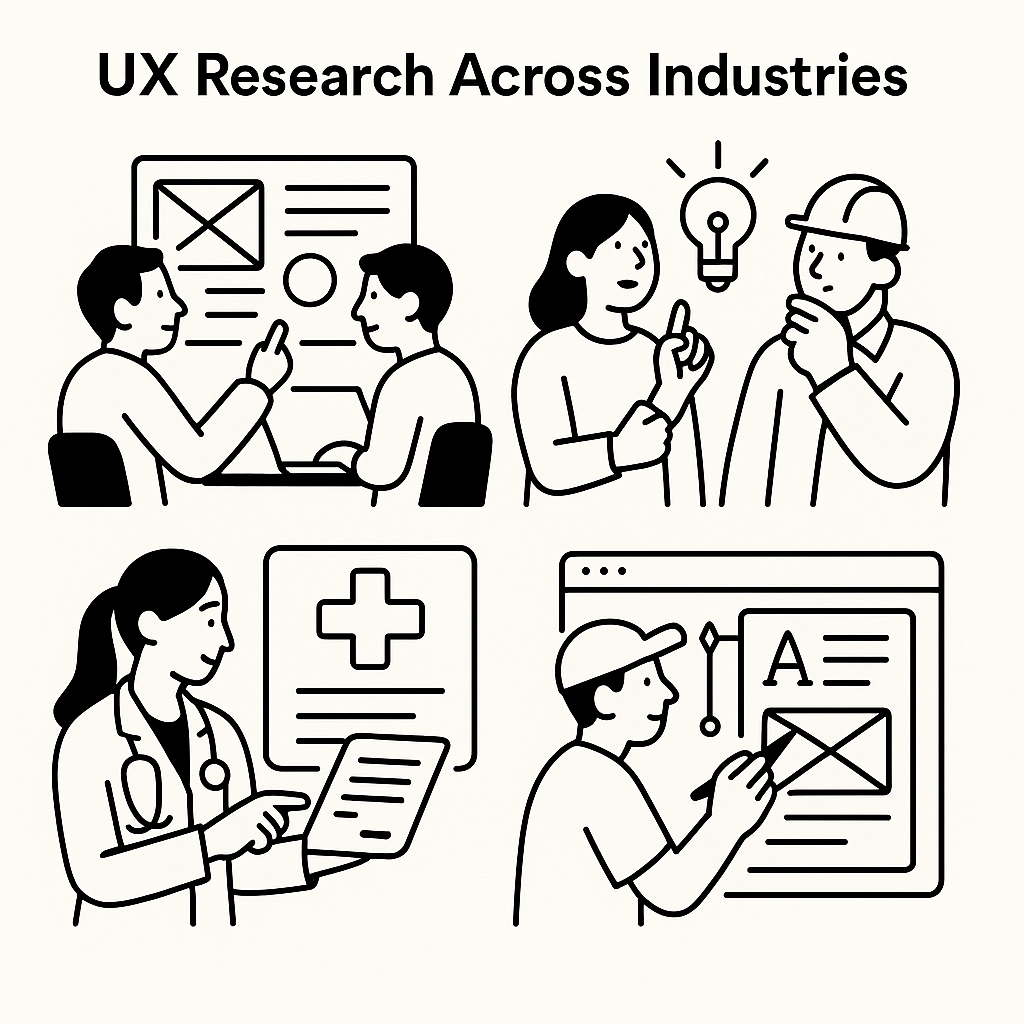
The practical differences are brutal. In fintech, users edit themselves because money is identity and risk. In healthtech, consent and privacy concerns narrow what you can observe directly. In B2B SaaS, the person signing the contract often isn’t the one suffering through the UI. In consumer apps, interviews alone underweight behavior because scale patterns matter more than polished explanations.
A few years ago, I worked with a 14-person product team on a payroll and benefits platform. We reused a clean moderated onboarding test format that had worked beautifully in a prosumer SaaS product. It fell apart in week one because participants would not narrate their real anxieties around bank linking and tax setup on a live call, and the team mistakenly concluded the flow was fine. The method didn’t fail because the moderator was weak; it failed because the topic changed the behavior.
Vertical-specific UX research for product teams starts with four design decisions. If you adapt these deliberately, you can keep the core discipline of qualitative research while changing the execution.
Most teams only adapt recruiting. That’s not enough. I’ve seen teams recruit perfectly matched participants and still learn the wrong thing because their discussion guide invited social desirability, or because they synthesized patient and provider pain points into one tidy but useless “journey.”
This is where tools matter. When I need scale without losing rigor, I like Usercall because it lets me run AI-moderated interviews with researcher-level controls, then analyze responses in a way that still respects qualitative nuance. It’s especially useful when I need to trigger user intercepts at key product moments—failed activation, churn-risk behavior, checkout drop-off—to capture the “why” behind the metric rather than waiting for a scheduled interview cycle.
In regulated or sensitive contexts, participant comfort is part of data quality. If people feel exposed, they sanitize their answers, skip details, or abandon the session entirely. Teams often misread that as “low friction.” It’s usually just low disclosure.
For fintech, I segment by financial situation and task sensitivity before I segment by persona. A first-time investor talking about portfolio setup is different from a small-business owner reconciling cash flow. Asking both to walk through “banking habits” in one study produces vague, overgeneralized insight.
On sensitive financial workflows, I avoid pushing for literal screen walkthroughs unless the participant has already confirmed comfort. I’ll often use scenario reconstruction instead: “Tell me about the last time you moved money and hesitated.” That gets me the emotional and decision data without forcing exposure. For a deeper breakdown, I’d point teams to Fintech User Experience Research.
Healthtech has a different trap: teams recruit “patients” as if that’s a coherent segment. It isn’t. Condition stage, caregiver involvement, care setting, and digital literacy all change the method. I once ran research for a 22-person care navigation team where half the target users were post-discharge patients and half were family caregivers. The original plan combined them in one interview stream to move faster. We split them after five sessions because caregivers discussed coordination failures clearly, while patients focused on fatigue and confusion. That single change gave the team two different workflow fixes instead of one mushy insight deck.
Health-related research also changes consent and note-taking. If participants are worried about privacy, they may reject recordings or avoid specifics. In those studies, I tighten the guide, reduce unnecessary personal detail, and synthesize around moments of breakdown rather than full biographies. Teams working through care workflows should also read Patient Journey Mapping.
The biggest B2B mistake is mixing procurement insight with product usability insight. They matter, but they are not interchangeable. The economic buyer evaluates risk, integration, and ROI. The daily user evaluates speed, clarity, and whether the system makes them look competent at work.
That means I rarely run a single discussion guide across all stakeholders. In B2B SaaS, I usually create separate tracks for buyer, admin, manager, and frontline user. If budget is tight, I would rather reduce sample size and keep role separation than blend roles and pretend the themes are consistent.
Recruiting also gets harder because “qualified” often means company size, tech stack, maturity, and job responsibility all at once. A RevOps manager at a 40-person startup and one at a 4,000-person enterprise may both hold the same title and have almost nothing in common operationally. B2B sampling errors are usually organizational, not demographic.
I learned this the hard way with a workflow automation product used by operations teams. We had an 11-person product org and a CEO pressing for “ten quick customer calls.” Half the participants were champions who bought the product; half were admins forced to maintain it. The buyers loved flexibility. The admins described the same flexibility as endless cleanup work. We only saw the pattern once we synthesized by role instead of account. If B2B is your core motion, start with B2B Customer Research.
This is also where intercept-based research is underused. If an admin hits a configuration error after inviting five teammates, that’s the exact moment to ask what they expected and what broke. Usercall is strong here because you can trigger AI-moderated outreach at those product moments and surface operational pain that stakeholders may never mention in a quarterly check-in interview.
Startup teams should bias toward fast directional learning, while consumer teams should bias toward pattern validation from behavior. Both fail when they imitate the other.
In startups, founder-led research is often the right move early, despite what research purists say. The problem isn’t that founders talk to users. The problem is that they hear confirmation as insight. I want startup interviews to be narrow, frequent, and tied to a concrete decision: which user to prioritize, which workflow to simplify, which message actually lands.
For startups, I usually recommend 5 to 7 interviews per micro-segment, done in one week, followed by immediate product or messaging changes. Long synthesis cycles kill momentum. Teams still shaping a market should review Startup Market Research.
Consumer and D2C products have the opposite issue. There’s no shortage of users, but there’s too much noise. If you only run interviews, you’ll overfit to articulate users who enjoy giving feedback. If you only watch dashboards, you’ll know where people drop and learn nothing about motivation, trust, or expectation mismatch.
On a subscription consumer app with roughly 400,000 monthly active users, we saw a steep drop between trial start and first value moment. The team wanted classic concept testing. I pushed for event-triggered qualitative intercepts instead, targeted to three moments: abandoned setup, repeated feature exploration, and failed payment retry. Within ten days, we learned the issue wasn’t pricing objection; it was that users couldn’t tell whether progress had been saved. That changed the roadmap from discount experiments to state visibility and reassurance messaging.
The goal is not one research process for every vertical. The goal is one decision framework that adapts on purpose. That’s how experienced product teams keep quality high without reinventing research every quarter.
If you do this well, ux research for product teams becomes more comparable across industries precisely because the methods are less uniform. You stop asking every participant the same safe questions and start designing studies that fit the real constraints of the market you’re in.
The teams I trust most aren’t the ones with the prettiest templates. They’re the ones who know when a usability test is enough, when a triggered interview is smarter, when consent changes the guide, and when one “user segment” is really three different jobs-to-be-done wearing the same label.
If you need to scale qualitative research without flattening it into survey mush, I recommend Usercall. Usercall runs AI-moderated user interviews with deep researcher controls, helps teams analyze qualitative data at scale, and lets you intercept users at key product moments to uncover the why behind the metrics—without the overhead of an agency.
Every vertical bends UX research methods in its own way — regulatory constraints, buyer complexity, or trust thresholds all shape how you should run a study. For the underlying argument on why one interview guide can't serve every industry, check out Industry Specific Research: Why Your Generic Interview Guide Is Failing You. If you're adapting your process for a new vertical, Usercall's AI interviewer can help you run consistent, scalable studies no matter the domain.
Related: financial product teams researching user trust and risk · mapping the patient journey in healthcare products · running B2B interviews that shape the roadmap
