
AI Focus Groups: What They Are, How They Work, and Why Teams Are Switching
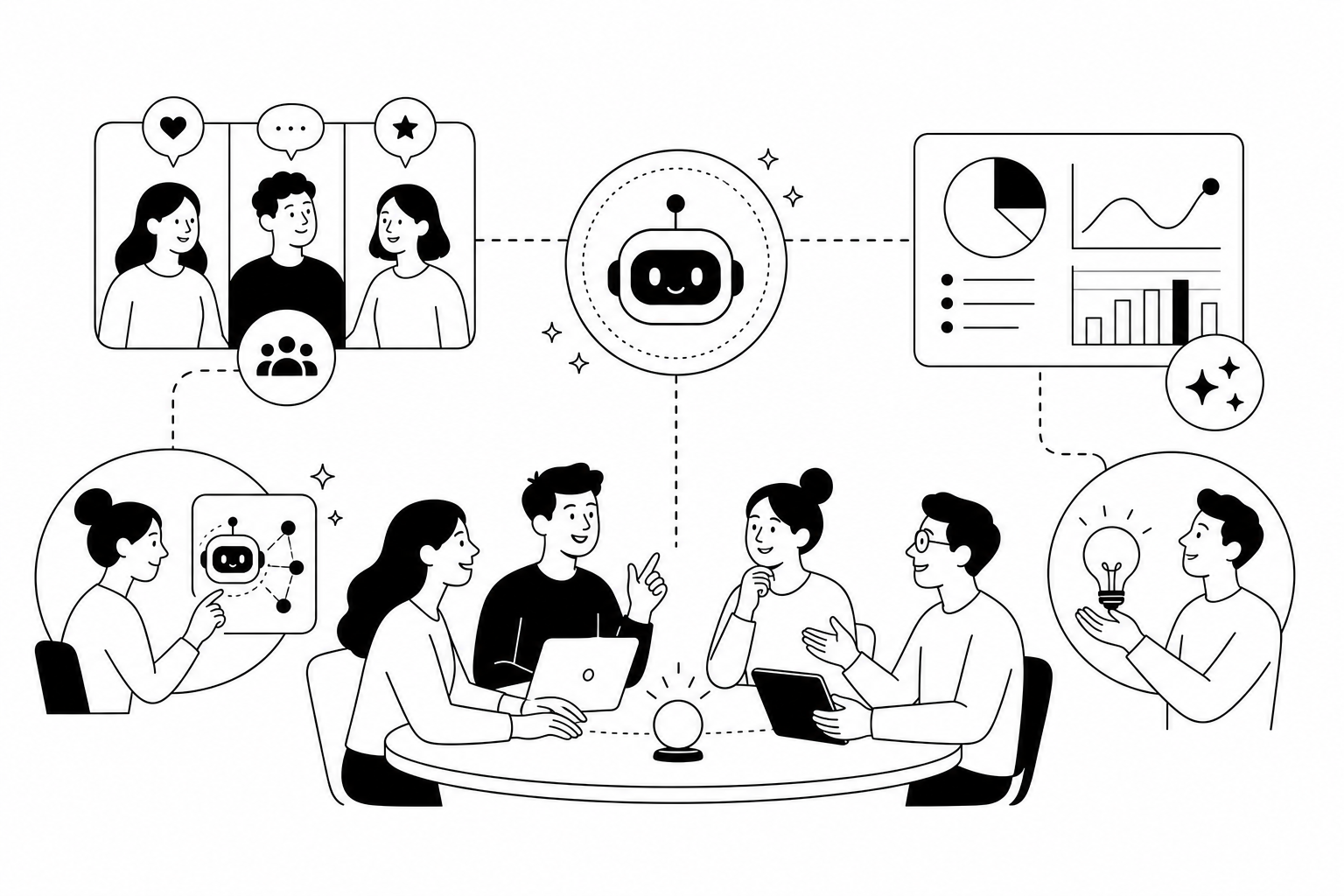
Most teams asking for an AI focus group are trying to fix the wrong problem. They think the issue is speed or cost, but the real failure is that traditional focus groups often produce polished group opinions instead of the messy individual truth that actually drives product decisions. I’ve spent more than a decade running qual programs, and I’d say this bluntly: if you want to know why users hesitate, churn, or ignore a feature, a room full of people reacting to each other is usually the least reliable way to get there.
Why Traditional Focus Groups Fail for Product and Customer Insight
Traditional focus groups are built for performative consensus, not behavioral truth. The loudest person sets the tone, the cautious people soften their opinions, and half the room starts optimizing for what sounds reasonable in public. That’s fine if you’re testing ad reactions at a high level. It’s terrible if you need to understand friction in onboarding, pricing confusion, or why activation dropped 12% after a release.
The bigger problem is that teams confuse efficiency with validity. Eight people on one call feels efficient because stakeholders get a tidy transcript and a highlight reel. But the data is contaminated from minute three, when one participant frames the issue and everyone else starts reacting to that frame instead of reporting their own experience.
I saw this firsthand with a 14-person B2B SaaS product team testing a new reporting workflow. They ran two standard focus groups with existing customers and came away convinced users wanted “more flexibility.” When I re-ran the study as 18 one-on-one interviews, the real issue was much narrower: users were afraid of breaking scheduled exports tied to executive dashboards. The group setting created a vague request; individual interviews surfaced a specific risk.
This is why I usually push teams toward methods that preserve independent thinking. If you want the deeper comparison, this breakdown of user interviews vs focus groups gets into why group dynamics distort what people say.
An AI Focus Group Usually Isn’t a Better Focus Group — It’s a Better Interview System
The best “AI focus group” products don’t replicate group discussion. They replace it with scalable, structured one-to-one conversations. That distinction matters. If you simply automate a bad method, you get bad insight faster.
What teams actually want is this: recruit the right users, ask adaptive follow-up questions, capture nuance consistently, and analyze patterns across dozens or hundreds of conversations without a month of researcher time. That is much closer to AI-moderated interviewing than to a classic focus group.
In practice, an AI focus group works by guiding each participant through the same research objective with individualized probing. The system can ask, “What were you trying to do?” then follow with, “What made that confusing?” or “What did you expect to happen next?” based on the participant’s answer. You keep consistency at the study level without forcing sameness in every conversation.
That’s the part many teams miss. Group discussion creates social pressure. AI-moderated individual interviews remove that pressure while still giving you scale. For product, UX, and growth work, that’s usually a much better trade.
When I recommend Usercall, this is the use case I mean: AI-moderated interviews with strong researcher controls, not a chatbot vaguely “talking to users.” You define the research goal, shape the prompts, control the audience, and then analyze research-grade qualitative data at scale. If you want the “why” behind a metric spike or dip, you can also trigger user intercepts at key product moments and collect feedback when the experience is still fresh.
How AI Focus Groups Actually Work When They’re Done Well
- Start with a narrow decision, not a broad topic. “Why are trial users abandoning setup step three?” is usable. “How do users feel about onboarding?” is not.
- Recruit around the behavior that matters. Separate new users from power users. Split by plan type, use case, or lifecycle stage. Mixed audiences create muddy patterns.
- Use a semi-structured guide with adaptive probes. The base questions stay stable, but follow-ups should respond to what the participant actually says.
- Collect conversations independently. This is where AI earns its keep: 40 to 100 interviews in parallel, each with enough probing depth to uncover mechanism, not just sentiment.
- Analyze for patterns, contradictions, and segments. Good analysis doesn’t just count themes. It asks which theme appears for whom, under what conditions, and with what downstream effect.
- Audit the outputs before socializing conclusions. AI summaries can sound authoritative while quietly flattening important differences.
I learned that last point the hard way on a fintech study with a five-person insights team and 62 interview transcripts. We were investigating why small-business owners dropped off before linking accounts. The first-pass AI synthesis said “security concerns” was the main barrier. After audit, the better answer was that users interpreted the bank-login step as a commitment point before they had seen enough value. Security came up, but premature commitment anxiety was the driver. That changed both the onboarding copy and the product sequence.
If your team is leaning on AI analysis, read why AI qualitative analysis can be wrong in a very convincing way. I agree with the core premise: fast synthesis is useful, but unaudited synthesis is risky.
The Real Advantage Is Scale Without Losing the “Why” Behind Behavior
The best reason to use an AI focus group approach is not lower cost. It’s higher coverage of real user context. Traditional qual forces ugly tradeoffs: either talk to 8 people deeply or survey 800 people shallowly. AI-moderated interviewing gives you a middle lane that most teams have been missing.
That matters when the business problem sits between quant and qual. Analytics might tell you that completion fell from 46% to 31% after a redesign. Session replay might show where people paused. Neither tells you whether users felt mistrust, confusion, cognitive overload, or simple indifference. You need language from users themselves.
I worked with a consumer subscription app where activation had stalled for six weeks. The growth team had Mixpanel, event funnels, and heatmaps, but they were still arguing about cause. We deployed an intercept study immediately after the paywall and collected 73 AI-moderated interviews in four days. The answer wasn’t price sensitivity, which the team had assumed. It was uncertainty about what happened after purchase: users didn’t understand whether they were buying a plan, starting a trial, or entering a billing cycle they’d struggle to cancel. One well-timed intercept surfaced more useful insight than three weeks of dashboard debate.
This is where Usercall is especially strong. If a metric moves and you need the why behind it, intercept users at the moment of friction, run AI-moderated interviews with researcher-defined controls, and review patterns across a much larger sample than a standard qual sprint allows.
Most Teams Should Stop Chasing “Focus Groups” and Choose the Right Method for the Decision
“AI focus group” is a popular term, but it’s often the wrong frame for the job. You don’t need a fashionable method name. You need a method that matches the decision, the risk, and the type of truth you’re trying to uncover.
If the goal is message testing in a social context, a group discussion may still help. If the goal is uncovering hesitation, unmet expectations, product friction, or decision triggers, independent interviews usually outperform groups. If the goal is broad measurement, use a survey. If the goal is explanation, use qual. If the goal is both, sequence them instead of forcing one method to do everything.
Too many teams ask for a focus group because it sounds familiar to stakeholders. I’d rather teach stakeholders a better model than hand them a weak answer wrapped in a familiar format. The strongest research teams I know are ruthless about method fit.
For a broader view, I’d point teams to how to choose the right qualitative data collection method and market research methods that actually drive decisions. Both are useful if you’re trying to get past default-method thinking.
The Practical Takeaway: Use AI to Scale Interviews, Not to Recreate Bad Research Habits
The smartest teams switching to AI focus groups are not modernizing focus groups. They’re abandoning group-dependent insight in favor of scalable one-to-one research. That’s the real shift.
If you remember one thing, make it this: speed only matters if the method still preserves honesty, context, and causal detail. In most product and customer research, that means fewer group conversations and more independent interviews, run with enough structure to compare patterns and enough flexibility to probe what matters.
That’s why I’m bullish on AI-moderated interviewing and skeptical of anything that promises “focus groups, but automated.” The win is not that AI can imitate an old format. The win is that it can finally make rigorous qualitative research fast enough for real product cycles.
Run the week on concept testing: 15 to 30 AI-moderated interviews, with quotes back in 48 to 72 hours.
AI focus groups are just one format built on the same underlying technology as AI moderated interviews—understanding how that moderation actually works will help you pick the right method for your research question. Check out our guide to AI moderated interviews for the full picture, or try Usercall to run your next study.
Related: Concept testing questions · Concept testing research · CPG packaging · Concept testing examples
Related: AI moderated interviews vs. focus groups for concept testing · AI market research at scale · how teams get AI customer insights right