
 Table of Contents
Most customer research tools don’t fail because they’re inaccurate. They fail because they produce tidy artifacts instead of hard insight. I’ve sat in too many debriefs where the team had 3,000 survey responses, 600 NPS comments, a heatmap, three dashboards, and still couldn’t answer the only question that mattered: why did good prospects hesitate right before conversion?
The ugly truth is that a lot of “customer research tools” are really measurement tools, feedback buckets, or transcription machines. Useful, yes. But if you need to change roadmap priorities, reposition a product, or fix a leaky onboarding flow, more data usually makes teams more confident and less correct.
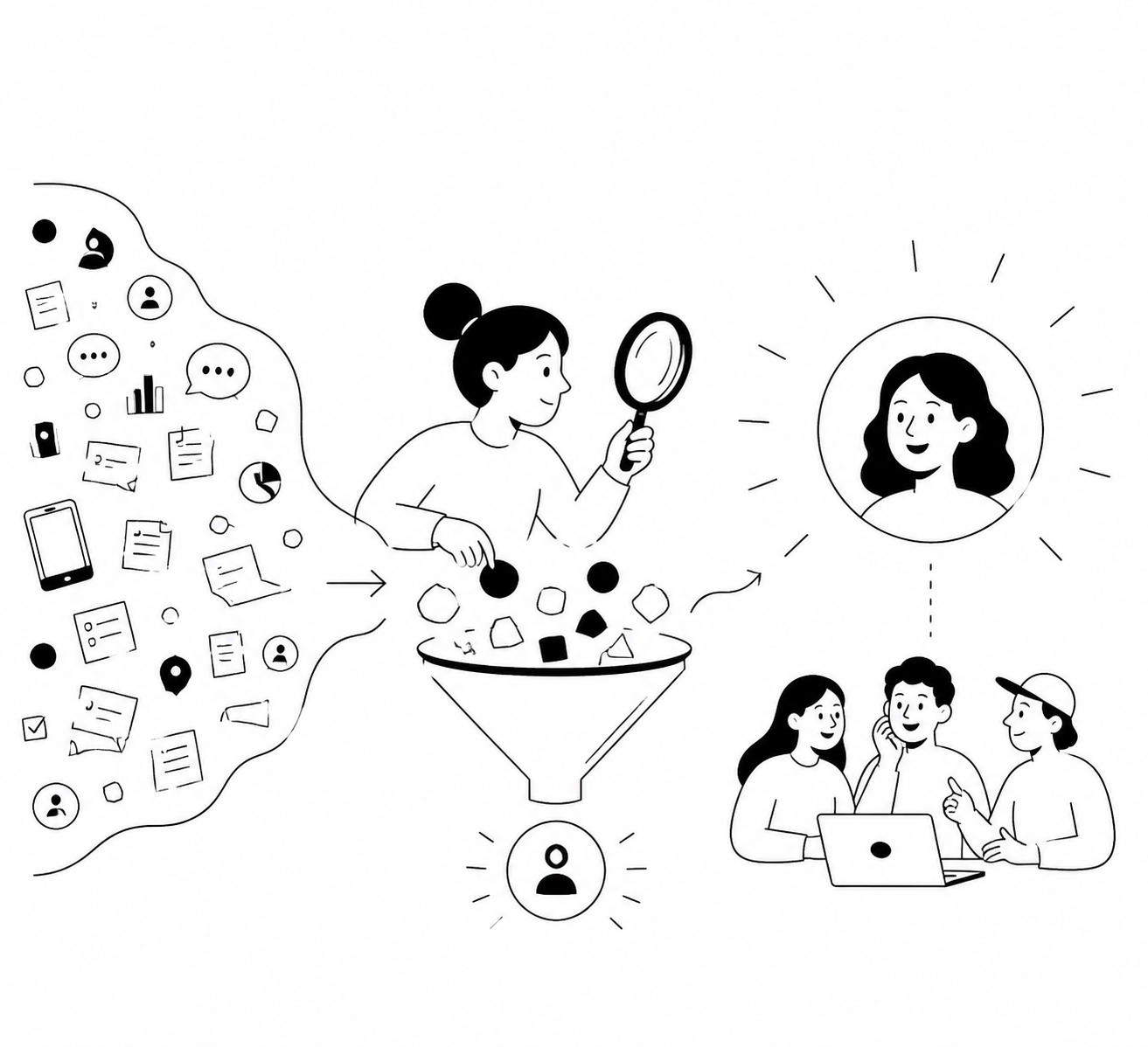
The common failure mode is simple: teams buy tools that collect signals, not tools that explain behavior. Analytics tells you where people dropped. Surveys tell you what they’re willing to type. Session replay shows what happened on screen. None of those reliably surface the belief, fear, tradeoff, or moment of confusion behind the behavior.
I learned this the hard way on a 14-person B2B SaaS team selling workflow software to operations managers. We had Mixpanel, Hotjar, Gong, NPS, and a survey tool running at once. Conversion from trial to paid fell 11%, and every system gave us a different theory. After 18 interviews, the real issue was embarrassingly specific: buyers loved the product, but frontline evaluators thought setup would make them look incompetent if they needed help internally.
No dashboard was ever going to tell us that. Insight lives in the emotional and organizational context around a decision, and most tools flatten that context away.
This is why I separate customer research tools into two camps: tools that count behavior and tools that reveal meaning. You need both, but most teams overspend on the first and underinvest in the second. If you’re trying to pick among broader online market research platforms, that distinction matters more than any feature list.
The fastest way to waste a quarter is to ask one tool to answer every question. Surveys are terrible at discovering unknown unknowns. Interview tools are inefficient for sizing prevalence. VOC software is useful for pattern detection but weak at unpacking motive. The best stack is deliberately uneven.
The trick is sequencing them. Start with a behavioral trigger, then use qualitative methods to explain it, then use quant to estimate how widespread it is. Teams that reverse that order usually end up validating the wrong hypothesis at scale.
For voice-of-customer work, I’m especially skeptical of tools that promise “automatic themes” as if tagging text is the same thing as insight. If your team is leaning heavily on support tickets or feedback repositories, read this breakdown of why most voice of customer tools stall before decisions get made.
Most AI research products are either too shallow or too chaotic. They ask generic follow-ups, miss contradiction, and produce summaries that sound polished while stripping away the exact detail researchers need. That’s not research. That’s autocomplete with a transcript.
But the category is getting interesting because a few tools now let researchers keep control over the interview logic. That’s the line I care about. If I can define the probes, branching, sampling rules, and analysis lens, AI becomes leverage rather than noise.
I’m bullish on Usercall for exactly that reason. It runs AI-moderated interviews with deep researcher controls, which means I can deploy a structured conversation at scale without giving up rigor. The real advantage isn’t just speed. It’s that I can trigger user intercepts at key product moments—after abandonment, activation, downgrade intent, failed setup—and capture the “why” while the decision is still fresh.
On a consumer fintech product, I worked with a growth team of 22 people that had a 38% drop-off between identity verification and first deposit. Legal constraints meant we couldn’t always get live interviews booked fast enough. An AI-moderated intercept would have solved the core problem: reach people in the moment of friction, not two weeks later when memory has collapsed into vague opinion.
That same principle matters in concept work too. If you’re testing positioning, flows, or value props, the quality of the prompt matters more than the software brand. Weak tools hide weak questions. Strong research design doesn’t. This is exactly why I push teams to tighten their concept testing questions before they obsess over platform features.
If I had to build a customer research stack from scratch for a product team under pressure, I wouldn’t start with a giant platform suite. I’d build a tight system around decision moments. Research works best when it is attached to a live customer behavior, not a quarterly ritual.
This approach is leaner than most research teams expect. It also produces better decisions because each method earns its role. Analytics identifies the moment. Qual explains it. Quant sizes it. That order matters.
On a PLG collaboration tool, I watched a team waste six weeks on a 27-question churn survey sent to 4,800 users. Response rate was 6.4%, and the top-coded reason was “missing features.” We then did 12 structured interviews with recently churned admins and found the real issue: they couldn’t prove team adoption internally within 30 days, so procurement blocked renewal. One insight, from a dozen conversations, beat a few hundred survey answers.
I’m not anti-consultancy and I’m not anti-platform. I’m anti-abdication. Teams get into trouble when they assume a vendor’s taxonomy, dashboard, or deck can replace their own judgment about what decisions need to change.
That’s why so many “consumer insights” engagements sound smart and change nothing. The findings are broad, the categories are safe, and no one has tied the research to a live product or commercial decision. If you’re considering outside support, this guide on choosing a consumer insight consultancy is the advice I wish more teams heard before signing.
The best tools—and the best partners—don’t just summarize what customers said. They help you isolate the few decision-shaping truths that create action. That usually means fewer charts, more raw evidence, and a much harder point of view.
If your customer research tool can’t capture what someone was trying to do, what they feared, what tradeoff they were making, and what nearly changed their mind, it’s not surfacing insight. It’s archiving reaction. Useful for reporting, weak for strategy.
The standard I use is brutal but practical: did this tool help us make a better decision this month? Not “did it collect feedback.” Not “did it create themes.” Did it change what we built, said, fixed, or prioritized? If the answer is no, the tool may be working exactly as designed—and still failing your team.
Related: Online Market Research Platforms · Voice of Customer Tools · Consumer Insight Consultancy · Concept Testing Questions
If you want customer research that gets past dashboards and into real decision-making, I’d look at Usercall. It runs AI-moderated user interviews that collect qualitative insights at scale, with the depth of a real conversation and without the overhead of a research agency.
