
 Table of Contents
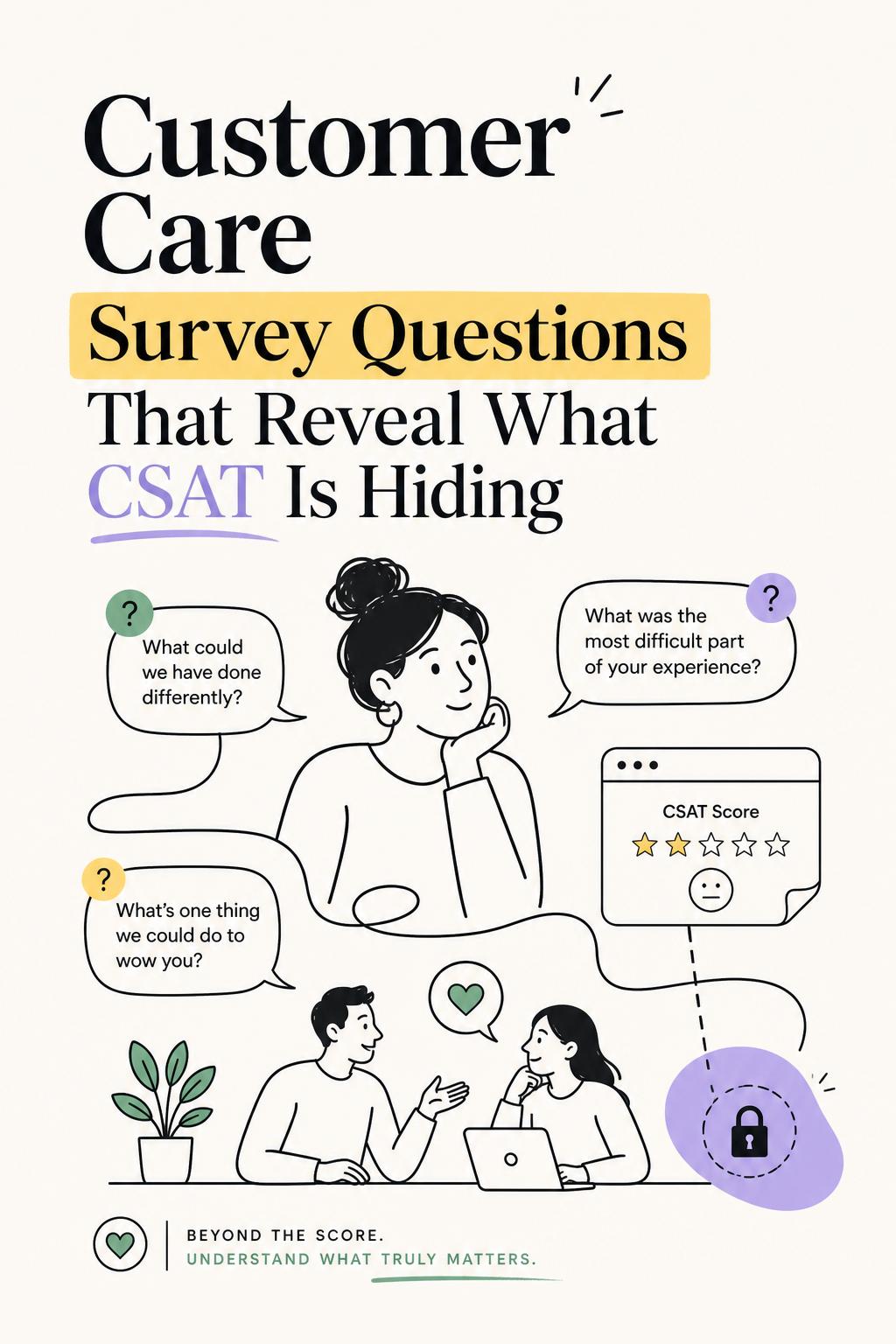
Here’s the uncomfortable reality: most customer care surveys are measuring politeness, not performance. I’ve sat in too many readouts where a team celebrates a 4.3 CSAT while repeat contacts are climbing, handle times are bloated, and customers are quietly losing trust. The survey said things were “good.” The business outcomes said otherwise. That gap isn’t a data problem—it’s a question design problem.
If you’re searching for customer care survey questions, you don’t need more questions. You need sharper ones. The kind that expose where effort spikes, where resolution quietly fails, and where customers stop believing you—even if they were nice about it in the rating.
The standard template is predictable: a satisfaction score, maybe a question about agent friendliness, and an open text box that gets skimmed for quotes. It’s efficient—and deeply misleading.
Here’s what goes wrong in practice:
In one project with a B2B SaaS company, leadership believed low scores were due to “inconsistent agent tone.” When we rewrote the survey to isolate effort and resolution confidence, we found something else: 38% of customers who reported “satisfied” also said they weren’t confident the issue was actually fixed. The real problem wasn’t tone—it was patchwork solutions and unclear next steps.
If your survey doesn’t map to how support actually works, your data won’t either. Every customer care experience operates across four layers:
Most surveys over-index on interaction and ignore the rest. That’s how you end up with “friendly but ineffective” support teams.
These are not meant to be used all at once. The goal is precision, not volume. Choose based on what decision you need to make.
Most teams underestimate how much damage happens before an agent even joins the conversation.
Customers rarely complain about friendliness. They complain about confusion.
This is where most “good” support experiences quietly fail.
Keep these for trend tracking—but don’t confuse them with insight.
The biggest mistake I see is starting with questions instead of decisions. A better workflow:
This last point is where most teams leave insight on the table. When you intercept users right after a failed self-serve attempt or a second contact on the same issue, you get dramatically better data. Tools like Usercall enable this kind of research: AI-moderated interviews and research-grade qualitative analysis triggered at key product or support moments, with enough control to go deep instead of collecting surface-level feedback.
Anecdote 1: In a telecom study, we found customers didn’t mind long wait times as much as uncertainty. When we added one question—“What were you unsure about during this experience?”—responses consistently pointed to silence during transfers. Fixing communication during dead air improved satisfaction more than reducing wait time.
Anecdote 2: In an e-commerce support audit, 22% of “resolved” tickets led to a repeat contact within 72 hours. The survey had been asking “Was your issue resolved?” but not “Are you confident it will stay resolved?” That one change exposed a major gap between technical closure and customer belief.
Anecdote 3: For a fintech product, we introduced a prompt: “What made this feel secure or insecure?” It revealed that scripted responses during sensitive issues (like account locks) felt robotic and alarming. Rewriting just three messages increased trust scores significantly without changing any backend process.
Averages hide problems. Segmentation reveals them.
Break your data by:
Then look for patterns like these:
Customer care surveys shouldn’t exist to confirm that your team is polite. They should expose where your system breaks under real conditions.
If your survey isn’t helping you reduce repeat contacts, increase resolution confidence, or identify structural issues, it’s not doing its job.
The best customer care survey questions make customers slightly uncomfortable—in a good way. They prompt reflection, not just reaction. And in doing so, they give you something rare: feedback you can actually act on.
Because the goal isn’t better scores. It’s fewer problems in the first place.
CSAT tells you how someone felt, but not why—these questions help close that gap. For more examples organized by use case, journey stage, and what the answers actually mean, see our customer satisfaction survey questions guide. Usercall takes this further by conducting these questions as spoken conversations, surfacing the effort and friction customers won't type out in a form.
Related: customer service survey questions that reveal what CSAT hides · 27 customer service survey questions that reveal what's broken · the hidden mistakes tanking your CSAT survey
