
 Table of Contents
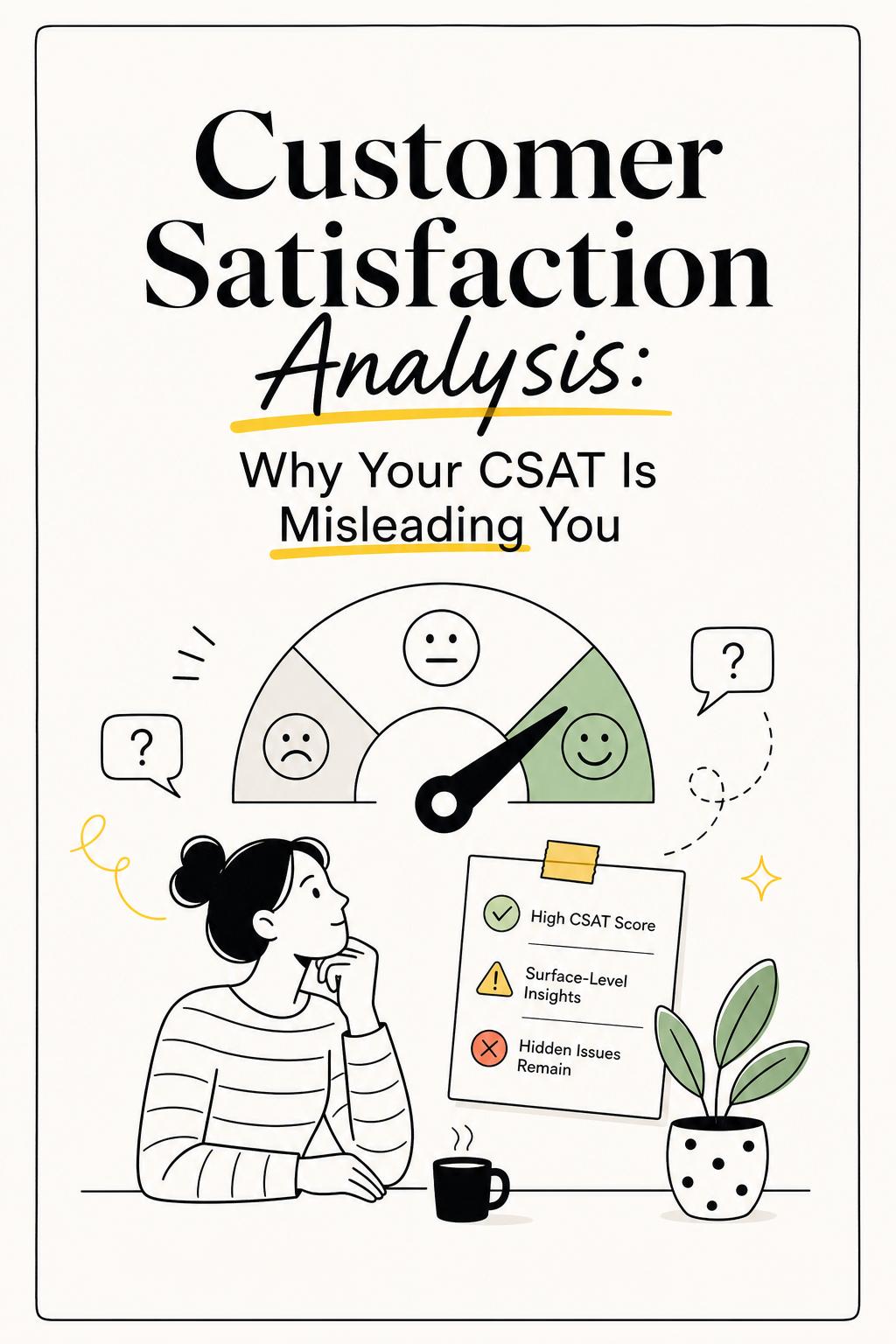
Your customer satisfaction analysis is probably telling you a comforting story—and that’s exactly the problem.
I’ve sat in too many exec reviews where a team proudly reports “CSAT is up 6%” while churn quietly ticks upward in the background. No one notices the contradiction because the dashboard looks clean. The numbers feel objective. But satisfaction scores, on their own, are one of the easiest ways to create false confidence in a business.
The uncomfortable truth: most customer satisfaction analysis isn’t wrong—it’s incomplete in ways that actively mislead decisions. It tells you what customers said, stripped of the context that explains what they actually meant and what they’ll do next.
If you’re serious about using customer satisfaction analysis to drive product, UX, or growth decisions, you need to stop treating it like a reporting exercise—and start treating it like a diagnostic system.
Most teams think they’re doing customer satisfaction analysis. In reality, they’re doing score tracking.
They collect CSAT, NPS, or CES. They slice by segment. They build trend lines. Then they stop.
This approach fails because it collapses complex experiences into a single number, erasing the very signals you need to act.
Here’s where it breaks down in practice:
I worked with a SaaS company where support CSAT was consistently above 90%. Leadership assumed customer satisfaction was strong. But when we looked at product usage, we found customers were submitting 3–4 tickets per week just to complete basic workflows. Support was great. The product experience was not. The satisfaction score reflected politeness—not product quality.
This is the core issue: customer satisfaction analysis often measures the wrong layer of the experience.
If you want your analysis to mean anything, you need to separate satisfaction into distinct layers. Most teams don’t—and that’s why their insights stall.
There are three fundamentally different types of satisfaction:
These layers frequently contradict each other—and those contradictions are where the real insights live.
For example, I once analyzed onboarding satisfaction for a B2B platform where end users rated the experience an 8.7, while admins rated it a 5.8. The average looked fine. But the business was bleeding expansion revenue.
Why? Admins carried all the setup burden. End users only saw the polished result. The “satisfaction” signal depended entirely on who you asked.
If your customer satisfaction analysis doesn’t explicitly model these layers and roles, you’re averaging away your most important problems.
High-quality customer satisfaction analysis answers one question: what is causing this experience, and what happens if we change it?
To get there, you need to connect three things most teams keep separate:
This is where modern tooling changes the game. Platforms like UserCall allow you to intercept users at critical product moments—like drop-offs, failed actions, or feature abandonment—and run AI-moderated interviews immediately. Instead of guessing why a metric moved, you capture explanation at the exact moment it matters, then analyze it with research-grade qualitative workflows.
That shift—from delayed surveys to in-the-moment understanding—is what turns customer satisfaction analysis into a decision engine.
Here’s the workflow I use when I need to move from vague signals to clear decisions.
Map where satisfaction actually matters for your business. Not every touchpoint is equal.
Focus on moments that shape retention, expansion, or activation:
These are not just UX steps—they are decision points where customers reassess whether your product is worth it.
Instead of generic surveys, trigger feedback at these exact moments. Pair each response with behavioral data:
This turns a static score into an analyzable event.
Most teams stop at tagging feedback into themes like “usability” or “pricing.” That’s not enough.
You need to identify root causes:
Different causes require different fixes. Without this layer, your analysis leads to generic, low-impact changes.
Not all dissatisfaction is worth fixing immediately. Focus on issues that combine:
This avoids wasting time on visible but low-impact problems.
A product team I worked with saw declining CSAT in their onboarding flow. Their initial reaction was to simplify UI and improve tooltips.
But deeper analysis told a different story:
The fix wasn’t UI polish. It was restructuring onboarding into smaller milestones, adding role-specific guidance, and triggering support proactively at integration points.
CSAT improved—but more importantly, activation rates increased by 22%.
That’s the difference between measuring satisfaction and understanding it.
Surveys are inherently limited. Customers simplify. Նրանք rationalize. They avoid saying things that feel difficult or ambiguous.
In one study I ran, customers repeatedly cited “pricing concerns” in surveys. But in follow-up interviews, the real issue emerged: তারা couldn’t demonstrate ROI internally. The problem wasn’t cost—it was lack of proof.
If we had taken survey responses at face value, we would have adjusted pricing. Instead, we built better reporting and value communication. Retention improved without touching price.
This is why qualitative depth is not optional in customer satisfaction analysis. It is the only way to uncover what customers cannot or will not articulate in a form.
The old model—periodic surveys and static dashboards—is too slow and too shallow for modern products.
The new model is continuous, contextual, and integrated:
This approach doesn’t just tell you how customers feel. It tells you why—and what to do about it.
If your customer satisfaction analysis ends with a score, you’re leaving most of its value on the table.
The goal isn’t to improve CSAT. The goal is to understand which experiences drive trust, which create friction, and which silently erode your business.
When you get this right, the questions change:
That’s when customer satisfaction analysis becomes more than a metric. It becomes a strategic advantage.
If you're rethinking how you measure satisfaction, start with the questions themselves — our guide to customer satisfaction survey questions breaks down 50+ examples by use case and stage, including what each answer actually tells you. And if you want to move beyond static scores entirely, Usercall runs voice-based conversations that surface the 'why' behind every CSAT number automatically.
Related: why your CSAT survey is lying to you · building a customer satisfaction index that predicts churn · the framework for analyzing satisfaction survey data
