
Methods of Data Collection in Qualitative Research: What Actually Works (and What Wastes Your Time)
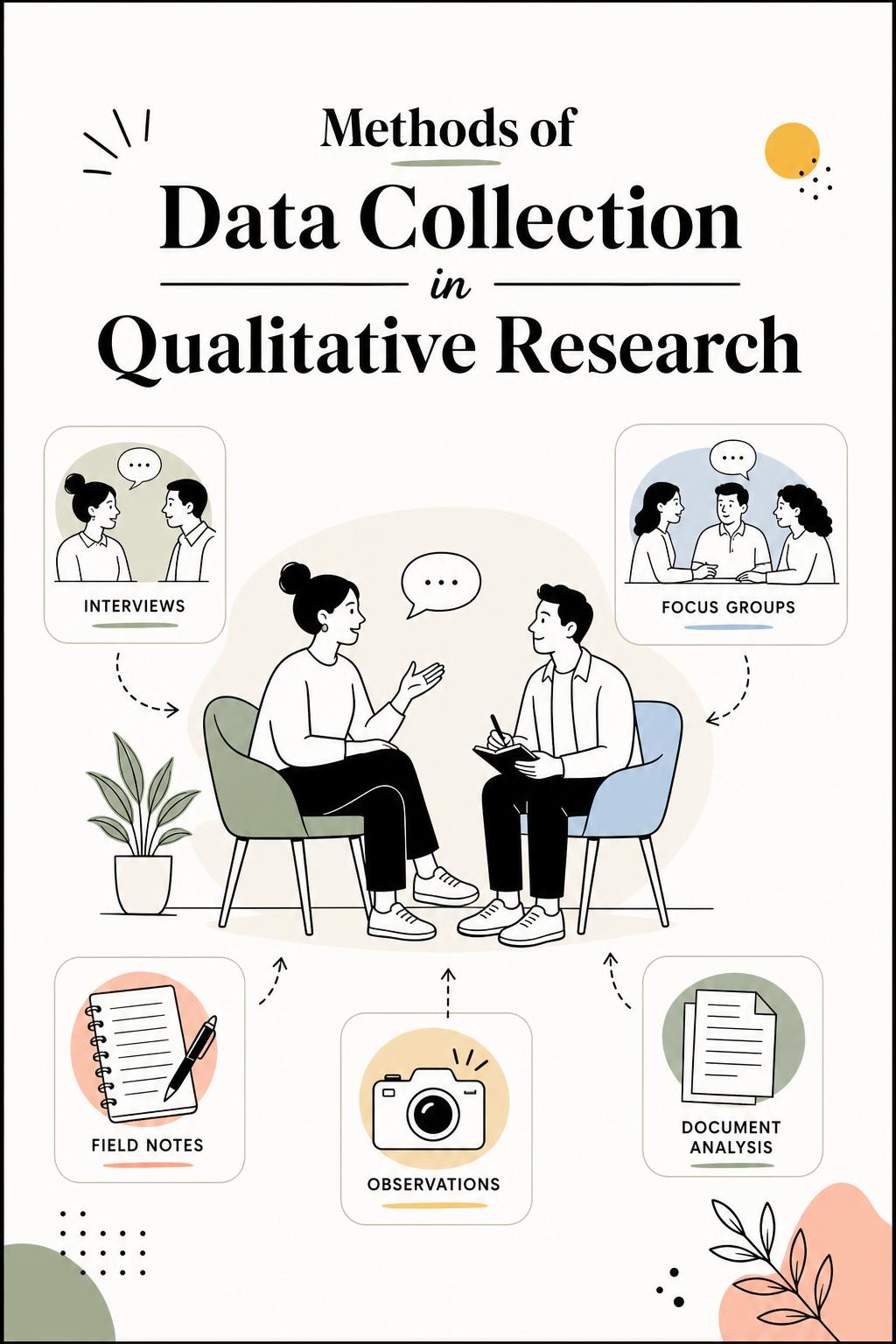
I’ve lost count of how many teams told me, “We already did qualitative research,” when what they really meant was: we ran five interviews, pulled a few quotes, and moved on. Then the product shipped—and failed for reasons that were completely predictable if they had chosen the right data collection method.
This is the uncomfortable truth: most qualitative research doesn’t break because of bad analysis. It breaks at the moment you choose how to collect the data. Pick the wrong method, and everything downstream looks polished but wrong. You’ll get articulate answers, clean themes, and total false confidence.
If you’re searching for methods of data collection in qualitative research, you don’t need another generic list. You need to understand which methods distort reality, which reveal it, and how to choose based on the kind of mistake you can’t afford to make.
The Core Problem: Every Method Produces a Different Version of Truth
Here’s the part most guides gloss over: qualitative methods are not interchangeable. Each one systematically hides something.
Interviews hide real behavior. Observation hides internal reasoning. Surveys hide context. Focus groups hide individual truth.
So the job is not to pick “a method.” It’s to pick the method that exposes what your users are most likely to get wrong, forget, or edit.
In practice, qualitative data gets distorted in four predictable ways:
- Recall bias: people reconstruct events instead of remembering them
- Behavior mismatch: what people say ≠ what they do
- Context loss: environmental constraints disappear in retelling
- Social filtering: people edit themselves to sound reasonable
The method you choose should directly counter one of these. If it doesn’t, you’re collecting convenient data—not accurate data.
1. Interviews: High Insight, High Risk of Fiction
Interviews are the most popular qualitative data collection method—and the most misused.
They’re excellent for understanding motivations, perceptions, and decision narratives. If you want to know why a user chose your product, how they justify it internally, or what they believe their workflow looks like, interviews work.
But here’s the problem: interviews are storytelling environments. People clean up their thinking. They remove hesitation. They fill in gaps. They turn messy behavior into coherent narratives.
I once ran a study on churn for a SaaS product where users confidently explained they left because of pricing. Clean, simple, believable. But when we paired interviews with product usage timelines, a different story emerged: most churn events followed a failed team onboarding attempt within 72 hours. Pricing wasn’t the cause—it was the easiest explanation.
Interviews told us what users believed. Behavioral data told us what actually happened.
Use interviews when you need:
- Motivations and perceived tradeoffs
- Language and mental models
- Sensitive or complex decision processes
Do not rely on them for actual behavior, especially under time pressure or habit.
2. Observation: The Fastest Way to Break Your Assumptions
Observation is the most underused and highest-leverage qualitative method. It forces you to confront what people actually do, not what they say they do.
This includes usability testing, contextual inquiry, and live workflow observation.
The reason teams avoid it is simple: it’s inconvenient. It takes longer. It produces messy data. It’s harder to summarize. But that mess is where reality lives.
In one project, a team believed users weren’t adopting a feature because it was “too complex.” During observation sessions, we saw something else entirely: users never even reached the feature. They got stuck three steps earlier due to a permission setting buried in admin controls. No amount of simplification would have solved that.
Observation is best when:
- You suspect a gap between stated and actual behavior
- The workflow involves multiple steps or people
- Context (tools, environment, interruptions) matters
The tradeoff is scale. But qualitative research is not about sample size—it’s about uncovering mechanisms.
3. Diary Studies: When Timing Changes Everything
Diary studies are one of the most powerful—and overlooked—methods of data collection in qualitative research.
Instead of asking users to recall past behavior, you capture experiences as they happen or shortly after. This is critical for journeys that unfold over time: onboarding, habit formation, trust building, or recurring friction.
In a study I ran on product adoption, interviews suggested users felt “generally positive” during the first week. Diary entries told a completely different story: sharp frustration spikes on day 2 and day 5, both tied to unclear feedback from the system. Those moments never showed up in retrospective interviews.
That changed the roadmap from “improve overall onboarding” to “fix two critical moments of uncertainty.”
Diary studies work best when:
- The experience spans multiple sessions or days
- Critical events are unpredictable or hard to observe live
- You need emotional context tied to specific moments
The mistake teams make is designing vague diaries. Good diary studies are event-triggered, not open-ended.
4. Focus Groups: Useful for Perception, Dangerous for Truth
Focus groups are often misunderstood. They are not a shortcut to multiple interviews—they are a different method entirely.
Focus groups generate socially constructed data. Participants influence each other. Opinions shift. Confidence inflates. Some voices dominate.
That makes them poor for understanding individual behavior or usability issues. But they’re valuable for understanding shared perception, messaging resonance, and social norms.
If your goal is to understand how a concept lands collectively or how language spreads, focus groups can work. If your goal is to understand what someone actually struggles with alone at their desk, they’re the wrong tool.
5. Ethnographic and Contextual Research: Where Real Problems Hide
Some user problems don’t live in the product—they live in the system around it. That’s where ethnographic and contextual methods come in.
These approaches focus on users in their natural environments, capturing routines, constraints, and interactions that shape behavior.
I worked on a logistics platform where users repeatedly “misused” a feature. Interviews framed it as confusion. But field research showed the real issue: the feature contradicted how teams were evaluated internally. Using it correctly actually made their performance look worse. No UI fix would solve that.
This is the kind of insight you only get when you step outside the product and into the real world.
Use these methods when:
- Behavior is shaped by organizational or environmental constraints
- You’re dealing with complex workflows or systems
- Surface-level fixes haven’t worked
The tradeoff is effort—but this is where the highest-value insights often live.
6. Open-Ended Surveys and Feedback: High Volume, Low Depth
Open-text responses from surveys, NPS, and feedback forms are often treated as “qualitative research.” That’s only partially true.
They’re useful for spotting patterns across large samples—but they lack depth, context, and the ability to probe.
The biggest mistake teams make is over-interpreting them. A single comment feels concrete, but you don’t know what led to it, what was left unsaid, or how representative it is.
This is where modern tooling changes the game. Platforms like Usercall allow teams to combine large-scale qualitative signals with targeted follow-up—triggering AI-moderated interviews or intercepting users at critical product moments. That means you’re not just collecting feedback after the fact—you’re capturing insight at the moment friction actually happens, with the ability to probe deeper.
Use open-text data to identify where to investigate—not as the final answer.
7. Artifact and Behavioral Trace Analysis: The Most Ignored Goldmine
One of the most overlooked methods of data collection in qualitative research is analyzing artifacts: support tickets, chat logs, internal docs, user-generated workarounds, and behavioral traces.
This data is brutally honest. It captures moments where users had to solve a problem—not just describe one.
In one case, analyzing support tickets revealed a recurring pattern: users weren’t confused about how to use a feature—they were confused about when to use it. That distinction never surfaced in interviews.
The limitation is lack of context. You see the problem, but not always the surrounding conditions. Pair it with interviews or observation for full clarity.
A Practical Framework: How to Choose the Right Method
Here’s the decision framework I use across every research project:
- Define the decision clearly — not “understand users,” but “identify why activation drops after step 3.”
- Identify the biggest risk of distortion — memory, behavior, context, or social pressure.
- Select the method that neutralizes that risk — not the one that’s fastest.
- Combine methods when stakes are high — interviews + observation + artifacts often outperform any single method.
- Get as close to the moment as possible — insight decays fast with time.
This is the difference between research that informs and research that actually changes decisions.
Choosing the Right Method: A Quick Matrix
| Research Goal | Best Method(s) | Why It Works |
|---|---|---|
| Understand emotional triggers | In-depth interviews, diary studies | Capture depth and emotion |
| Compare user reactions to concepts | Focus groups | Observe reactions and group dynamics |
| See real-world behaviors | Observation | Avoid self-report bias |
| Get fast insights from a large base | Open-ended surveys + AI analysis | Scalable and cost-effective |
| Explore change over time | Diary studies | Track evolution, not just snapshots |
The Bottom Line
If you treat qualitative methods as interchangeable, you will get clean, convincing, and wrong answers.
Each method captures a different layer of reality. The skill is knowing what each one misses—and choosing based on the mistake you cannot afford to make.
If behavior matters, observe it. If timing matters, capture it in the moment. If context matters, step into it. And if your current research feels too neat, too consistent, or too easy to explain—you’re probably looking at a version of reality that’s already been edited.
That’s not insight. That’s a story.
Choosing the right method is only half the battle—what you ask determines the quality of what you learn. Check out our guide on how to write qualitative research questions for 45+ examples you can adapt to surveys, interviews, and user studies. Usercall makes it easy to run these methods with AI-led interviews that scale without losing depth.
Related: 11 most powerful methods of qualitative data collection · data collection techniques in qualitative research