
 Table of Contents
I’ve seen a company increase their Net Promoter Score by 12 points—and lose customers faster than ever. That’s the uncomfortable truth nobody wants to admit: the net promoter question can make you feel informed while actively hiding what matters. The problem isn’t the question itself. It’s how teams use it like a performance metric instead of what it really is—a crude signal that demands investigation.
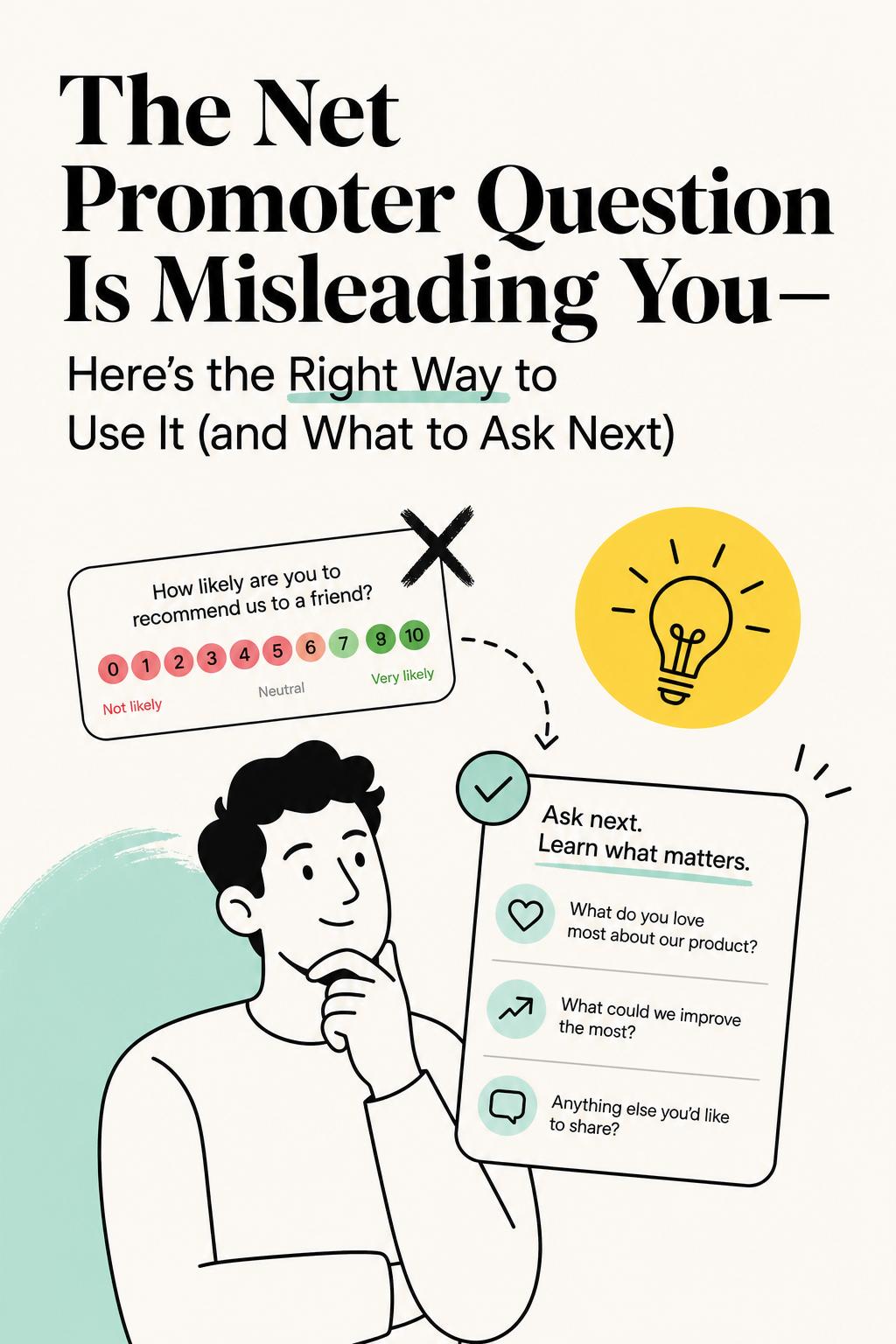
If you’re searching for the “right” net promoter question, you’re already asking the wrong thing. The wording has been standardized for years. The real difference between teams that learn from NPS and teams that get misled by it comes down to when they ask it, what they ask next, and how they interpret the answers.
The canonical net promoter question is straightforward:
How likely are you to recommend our product, service, or company to a friend or colleague?
Users respond on a 0–10 scale, which gets grouped into:
This simplicity is exactly why teams over-trust it. One question. One number. Easy to track, easy to report.
But here’s the issue: you’re asking people to predict their own future behavior in a hypothetical scenario. That’s not the same as measuring loyalty. It’s measuring a mix of satisfaction, confidence, social risk, and context.
In B2B especially, I’ve interviewed dozens of “promoters” who would never actually recommend the product. Not because they didn’t like it—but because recommending tools at work can backfire politically. The score says “loyal.” Reality says “cautious.”
The biggest mistake I see is treating the net promoter question like a KPI instead of a research entry point. Teams optimize the number without understanding the drivers.
Here’s how that failure shows up in practice:
I worked with a SaaS team that was convinced their declining NPS meant product quality issues. Engineering spent a quarter chasing bugs that weren’t actually driving dissatisfaction. When we ran targeted follow-up interviews, the real issue surfaced: customers didn’t trust the reporting accuracy. The product worked—but users didn’t feel confident presenting its outputs to stakeholders. That’s not a bug. That’s a credibility gap.
No NPS dashboard would have told you that.
The net promoter question is not a conclusion. It’s a segmentation tool. Its job is to sort your users into groups that require different investigation strategies.
Once you see it this way, the workflow becomes clearer:
This is where most teams fall short—they stop at step one or two.
In high-performing research teams, NPS responses trigger deeper workflows. Tools like Usercall enable this by combining AI-moderated interviews with researcher-level control and the ability to intercept users at key product moments. That means you’re not just collecting scores—you’re capturing context exactly when it matters, then analyzing it at scale without losing nuance.
If you remember one thing, make it this: the second question matters more than the first.
The most effective baseline follow-up is:
What is the primary reason for your score?
But that’s just the starting point. The real leverage comes from adapting based on response type:
In one project, we analyzed over 2,000 NPS responses for a mid-market SaaS company. Promoters consistently used vague language—“easy,” “good,” “helpful.” Useless for strategy. But when we followed up with interviews, a pattern emerged: teams were saving 6–8 hours per week on manual reporting. That became the core value proposition in sales and onboarding.
Without that second layer, “easy to use” would have remained a shallow, non-actionable insight.
When you ask the net promoter question matters more than how you phrase it.
NPS responses are highly sensitive to recency bias. Users answer based on what just happened—not their overall relationship with your product.
Strong timing strategies include:
One of the clearest examples I’ve seen: a company triggered NPS surveys after support interactions. Scores were consistently low. Leadership assumed support quality was poor.
It wasn’t. Users were frustrated because they needed support in the first place. When we moved the survey to post-resolution and post-success moments, scores increased—but more importantly, the reasons changed completely. That’s when the real insights started showing up.
To interpret the net promoter question correctly, you need to understand what drives responses. I use a three-layer model:
This explains why two users with identical experiences can give different scores. One trusts the product enough to stake their reputation on it. The other doesn’t.
That distinction is critical. Because recommendation is a reputational act, not just a satisfaction signal.
Most teams ignore passives. That’s a mistake.
Passives are often where your highest-leverage insights live. They’re not unhappy—but they’re not convinced.
In my experience, passives usually point to one of four issues:
In a B2B analytics platform I worked on, passives made up nearly 50% of users. Leadership ignored them because churn was low. But interviews revealed something important: users relied on the tool but kept evaluating alternatives. They weren’t leaving—but they weren’t locked in either.
That insight led to a focused effort on improving onboarding and surfacing advanced features earlier. Within two quarters, passive users shifted toward promoters—not because the product changed dramatically, but because users finally understood its full value.
The teams that get real value from the net promoter question treat it as part of a broader insight system—not a standalone metric.
That system typically includes:
This is where modern tooling changes the game. Platforms like Usercall allow teams to run AI-moderated interviews triggered by NPS responses, analyze qualitative data at scale, and tie feedback directly to product usage moments. Instead of guessing why scores change, you can observe and validate the drivers in near real time.
The net promoter question isn’t going away—and it shouldn’t. It’s fast, simple, and directionally useful.
But if you treat it as the answer, you will make worse decisions, not better ones.
The real value comes from what happens after the score:
Why did the user answer that way? What just happened in their experience? What would need to change for that number to move—and would it actually matter if it did?
Those are research questions. And they’re the difference between teams that report NPS and teams that actually understand their users.
Use the net promoter question—but don’t stop there. That’s where the real work begins.
NPS is just one data point—pairing it with the right follow-up questions is what turns a score into an actionable insight. For more examples of questions that pair well with NPS across different moments in the customer journey, check out our guide to customer satisfaction survey questions. Usercall can also run your NPS follow-up as a live conversation, so you get the actual reasoning behind every score, not just a number.
Related: why the NPS score question misleads most teams · 5 critical mistakes to fix before trusting your NPS · turning a broken net promoter survey into real insight
