
Asynchronous Focus Groups: How to Get Deeper Insights Than Live Sessions
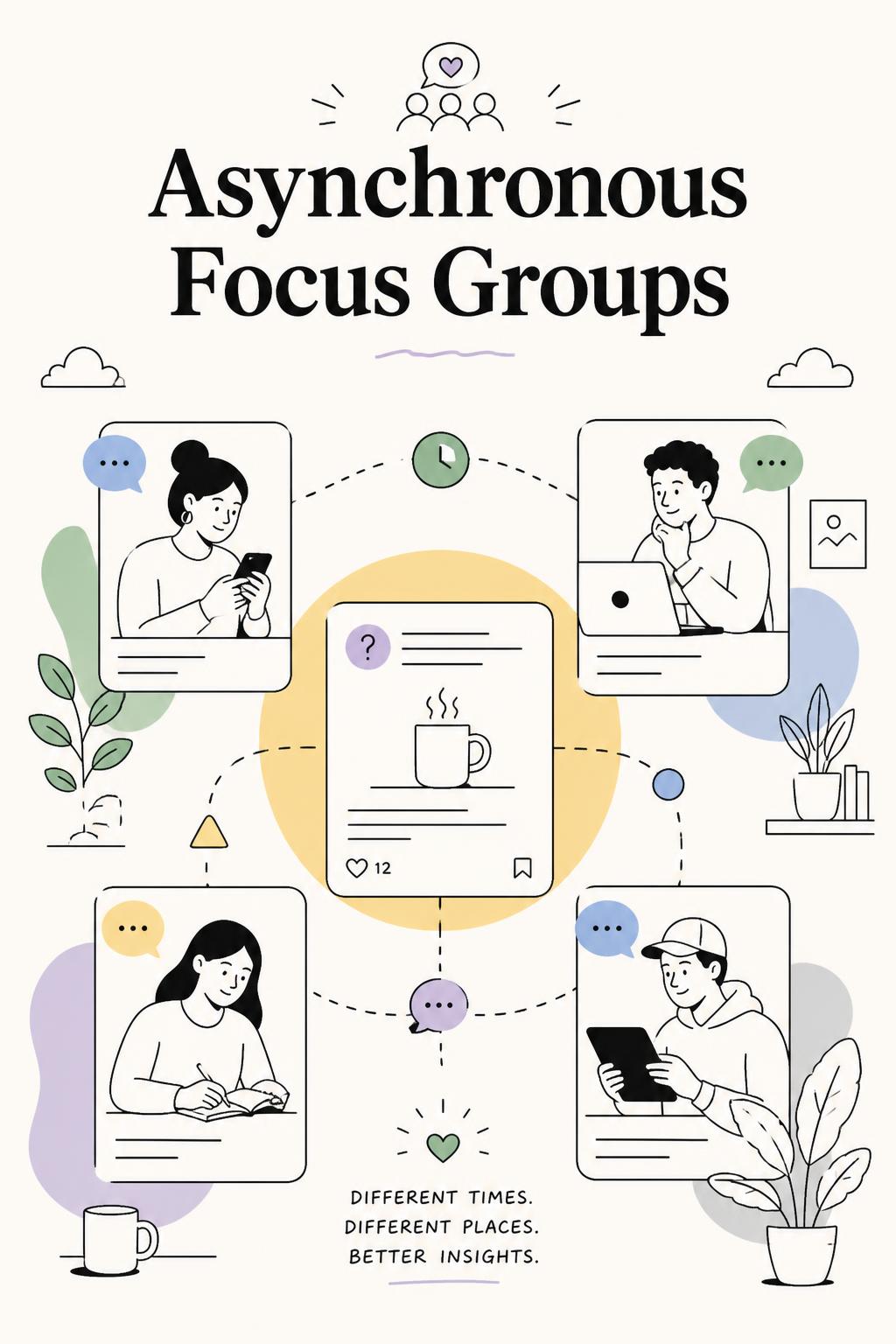
The focus group answer your stakeholders love is usually the answer you should trust least. Put six customers on a live call, reveal a polished concept, and someone will say, “I’d definitely use that.” Others nod. The product team hears validation. Then adoption stalls because nobody asked the question that matters: what would this replace, what could go wrong, and who has to approve it?
I have watched this happen repeatedly in B2B research. Live sessions reward confidence, speed, and agreeable opinions—not careful judgment. An asynchronous focus group gives participants time to think, check their real workflow, consult their calendar or documentation, and return with an answer grounded in how work actually happens. That does not make asynchronous research automatically better. It makes it more capable of exposing the inconvenient details that live focus groups often smooth over.
My position is simple: use asynchronous focus groups when your team needs to understand considered decisions, real constraints, and disagreement across participants. Do not use them as a slow survey or a low-cost replacement for a moderated interview. The method works only when the discussion is designed to create evidence, not comments.
What an asynchronous focus group is—and what it is not
An asynchronous focus group is a moderated qualitative discussion where participants contribute over several hours or days instead of attending one scheduled session. They respond to prompts, review concepts or prototypes, complete contextual tasks, and react to selected peer perspectives on their own time.
The important word is moderated. A questionnaire with an open text box is not an asynchronous focus group. Neither is an online community where researchers post a vague question and wait for engagement. A real asynchronous group has an intentional sequence: independent reaction first, evidence from real behavior second, and peer discussion only after the researcher understands where the meaningful differences are.
That sequence makes the method particularly valuable for complex product decisions. It works well when participants need to reflect on an unfamiliar AI feature, document a current workaround, compare alternatives, or explain a purchasing process involving multiple stakeholders. It is also one of the best ways to include global participants, busy professionals, caregivers, and frontline workers who cannot reasonably join a 90-minute video call in the middle of their day.
Why traditional focus groups and weak async studies fail
Traditional focus groups have a structural bias: they make thinking visible only when it happens quickly and verbally. The participant who can articulate an opinion first becomes the unofficial reference point for the group. Quieter participants may agree publicly while privately holding the more useful view. This is especially damaging when testing innovation, because early concepts are easy to praise in the abstract and difficult to evaluate against real-world risk.
Unfortunately, many asynchronous focus groups fail for the opposite reason. Researchers remove the pressure of the live room, then remove the rigor too. They ask 15 generic questions at once, provide no meaningful task, and let participants read every response before writing their own. The result is a collection of short, socially safe answers: “Looks useful,” “I like the design,” and “I would probably try it.” That is not qualitative depth. It is a survey with better grammar.
- Live focus groups fail when speed becomes status. The fastest speaker can shape the group before others have processed the question.
- Unstructured async studies fail when effort has no purpose. Participants will not write thoughtful responses unless a prompt gives them a concrete job to do.
- Both methods fail when they seek agreement too early. Consensus is often the result of social pressure, not evidence that customers share the same need.
The better approach is to protect independent thinking before introducing social influence. In research, disagreement is not noise to eliminate. It is often the clue that reveals which customer conditions change the decision.
The three-stage model for better asynchronous focus groups
I use a simple model: reaction, reality, and reconciliation. It prevents the most common source of bad focus group insight: participants explaining a preference without connecting it to actual behavior.
- Reaction: Collect each participant’s private first impression before they can see peer responses. Ask what they notice, what they assume the product does, and what makes them hesitate.
- Reality: Ask participants to connect their response to a recent experience. Have them describe the last time they solved this problem, the tools involved, the workaround they used, and the cost of getting it wrong.
- Reconciliation: Show selected contrasting viewpoints and ask participants to explain the difference. The goal is not to force agreement; it is to identify the conditions behind opposing reactions.
Consider an asynchronous focus group for a new AI-generated reporting feature. A weak prompt asks, “Would you use AI summaries?” A stronger first-stage prompt asks, “What would you need to verify before sharing an AI-generated summary with your leadership team?” The reality stage asks participants to reconstruct the last report they prepared and identify the part that required the most checking. Only then should they see competing comments from peers: one participant who values speed and another who fears an untraceable error.
Now the team can distinguish between three very different problems: lack of trust in model accuracy, lack of visibility into source data, or lack of a meaningful job for the feature. Those problems require different product decisions. Generic positive sentiment solves none of them.
How to structure an asynchronous focus group in five days
For most product, UX, and market research questions, a five-day asynchronous focus group with 12 to 20 participants is enough. Smaller groups can work for highly specialized audiences; larger groups are useful when you need to compare distinct customer segments. The mistake is trying to squeeze an entire research program into one activity. Each day should advance one specific uncertainty.
- Day 1: Reconstruct the current behavior. Ask for a recent, specific example of the problem. Focus on triggers, steps, workarounds, people involved, and consequences.
- Day 2: Capture independent concept reactions. Share a concept, prototype, or message. Hide peer responses until each participant has contributed.
- Day 3: Create a contextual task. Ask participants to try a prototype, compare it with their current process, or upload a redacted artifact that illustrates the problem.
- Day 4: Introduce productive disagreement. Present two or three contrasting participant views. Probe the contextual reasons behind each position.
- Day 5: Test a real tradeoff. Ask what participants would give up, change, approve, pay for, or reject. Preference becomes more credible when it has a cost.
Keep each activity to five to ten minutes. If a participant needs more than that, the task should be optional and appropriately incentivized. A thoughtful five-day study is more valuable than a bloated two-week community where response quality declines after day three.
Recruit for tension, not superficial balance
Many teams recruit asynchronous focus groups as though representativeness means matching broad demographics. That is rarely what creates useful qualitative variation. Recruit people whose working conditions make different answers plausible.
For a project management platform, that might mean experienced administrators and reluctant end users, teams with formal governance and teams working from spreadsheets, buyers and daily practitioners, or companies with different compliance requirements. You are not trying to make every participant identical enough to agree. You are trying to understand why reasonable customers reach different conclusions.
In one study I led for an operations software company, we recruited 18 managers across North America and Europe. The client wanted only customers with high product engagement because they assumed those people would provide the richest feedback. I insisted that six recent automation-feature drop-offs be included. Those participants revealed the actual problem: the automation was not distrusted because it made errors; it was abandoned because managers had no exception-review workflow when something looked unusual. The team had planned to rewrite feature education. Instead, it prioritized an exception queue and approval controls. That was a product decision made possible by recruiting friction, not satisfaction.
Moderate for evidence, not participation volume
A skilled async moderator does not respond to every comment with “tell me more.” That wastes participant energy and produces repetitive data. The moderator should look for contradiction, specificity, change over time, and hidden decision criteria.
Useful probes are narrow. Ask, “Which step would this eliminate?” “What would need to be true before your manager approved this?” “You called it risky—risky for your workload, your reputation, or compliance?” “What happened the last time this process failed?” These questions move participants from attitude to evidence.
In a three-day financial-services study, one participant described an AI recommendation concept as “too risky.” The product team initially interpreted that as an accuracy concern. I followed up within hours and learned that she trusted the underlying recommendation; her concern was that she could not show a compliance reviewer where the recommendation came from. The insight was not “improve trust.” It was “make evidence traceable at the point of review.” Those are radically different roadmaps.
Research-grade AI qualitative tools such as Usercall can help teams handle this moderation and analysis at scale, particularly when responses include written feedback, voice notes, and video. Its AI-moderated interviews and deep researcher controls are useful when teams need consistent follow-ups without giving up research judgment. It can also support user intercepts at key product analytics moments—such as feature abandonment, failed activation, or repeated error events—so teams can understand the why behind a metric instead of guessing from dashboards.
Analyze decisions as conditional rules
Do not end an asynchronous focus group with a theme list. “Trust,” “ease of use,” and “integration” are labels, not findings. Every software team can produce those words after a week of customer feedback.
Instead, write findings as conditional rules that explain when a behavior changes. For example: “Participants accept AI-generated recommendations when they can inspect the underlying source data, but reject them when the recommendation triggers an irreversible action.” Or: “Managers value the dashboard when it replaces manual reporting, while practitioners reject it when it appears to measure activity without explaining workload.”
These findings are actionable because they describe a boundary. They tell the product team what to build, tell marketing what promise is credible, and tell researchers what to validate next.
When asynchronous focus groups are the wrong choice
Do not use an asynchronous focus group when you need to observe real-time usability behavior, diagnose accessibility barriers, or capture an immediate emotional response to a high-stakes event. A live usability test or one-to-one interview is better for those jobs. Async also fails when nobody has the time to moderate it actively.
Use it when the real decision unfolds over time: when buyers need to reflect, when workflows involve several people, when participants need to check reality before responding, or when your team suspects the first answer will be too polished. The real advantage of an asynchronous focus group is not convenience. It is that it gives customers enough time to stop performing certainty and start explaining how decisions are actually made.