
Market Research and Focus Groups: Stop Paying for Polite Answers
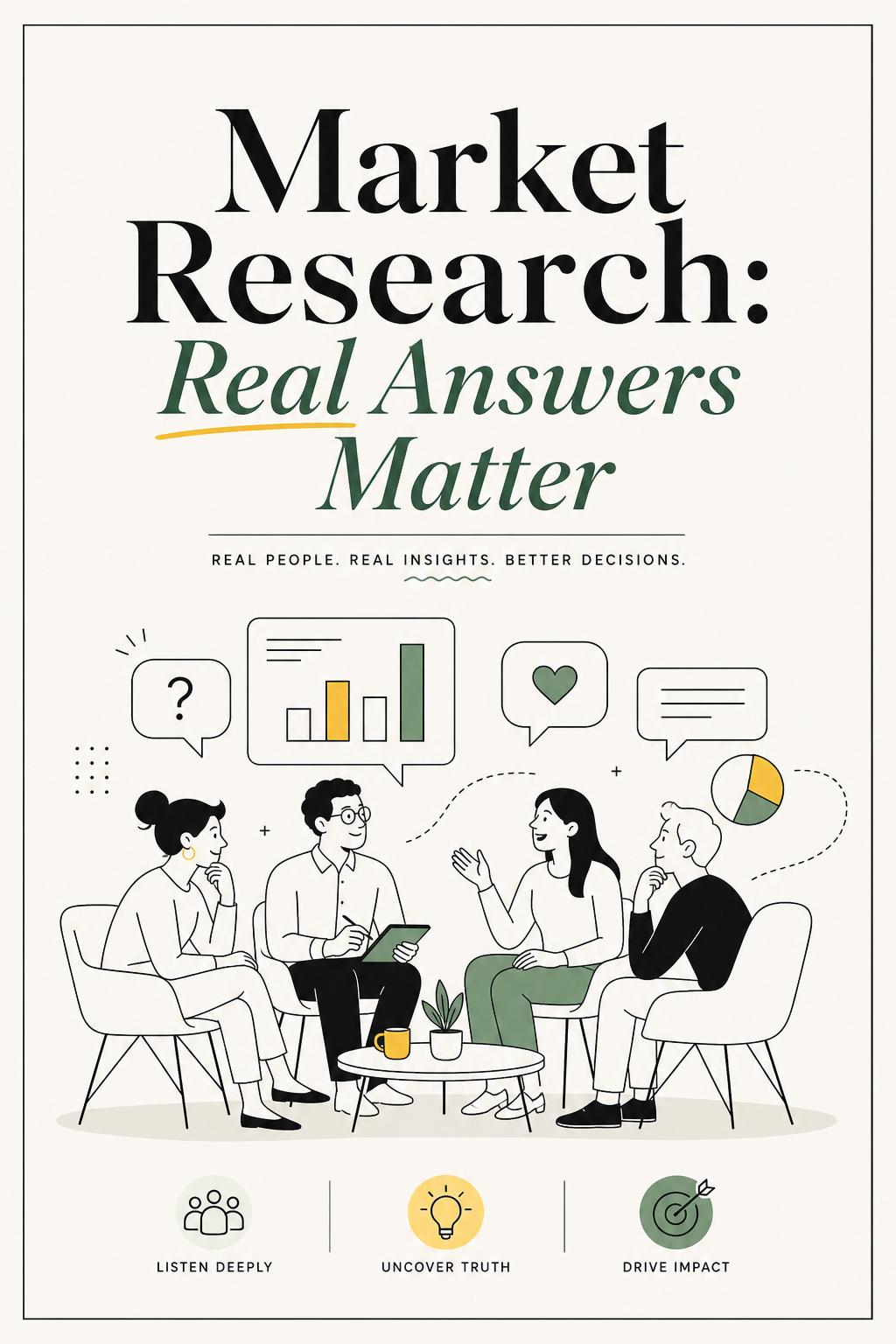
The most dangerous sentence in a focus group is: “Everyone liked it.”
I have seen teams spend $50,000 on market research and focus groups, hear unanimous enthusiasm for a new product concept, and treat that enthusiasm as permission to build. Six months later, the launch misses its target. Participants did not deceive anyone. They simply behaved like people in a group: they were polite, avoided sounding negative, and reacted to an idea with no money, deadline, reputation, or internal approval process at stake.
That is the central mistake: teams confuse social approval with market demand. A focus group is not a miniature version of the market. It is a deliberately artificial environment that can expose language, anxieties, norms, and objections—if you know how to use it. Used badly, it produces a tidy deck of quotes that confirms what the team hoped to hear. Used well, it reveals why a seemingly strong product, message, or experience will fail when it encounters real-life constraints.
My view is blunt: market research and focus groups should never be used to ask customers what to build. They should be used to identify the conditions under which customers will reject, delay, distrust, or champion a decision. That shift makes focus groups far more valuable for product managers, UX leaders, market researchers, and business teams.
Why Most Market Research and Focus Groups Fail
The classic focus group format is built for the wrong outcome. Participants sit around a table, react to concepts, discuss preferences, and answer broad questions such as, “What do you like about this?” The result is often articulate feedback with almost no predictive value.
Common approaches fail because people are poor forecasters of their own behavior—especially in front of strangers. They can accurately describe a frustrating experience from last Tuesday. They cannot reliably tell you whether they would pay for a hypothetical solution next quarter.
Four recurring problems make traditional focus groups especially risky:
- Consensus pressure: Once a confident participant frames an idea as useful or obvious, others often soften their disagreement rather than challenge it.
- Hypothetical intent: “I would use that” means very little unless you understand what the participant uses now, what switching costs exist, and who must approve the change.
- Feature bait: Showing polished concepts too early pulls participants into commenting on colors, labels, and functions before researchers understand the actual problem.
- False equality of feedback: A passing preference and a recurring, costly adoption barrier are treated as equally important because both appear as quotes in the report.
The answer is not to abandon focus groups. The answer is to stop running them as opinion panels. The best groups are designed to surface friction between what people say they value and what they actually do when time, money, status, and risk are involved.
The Real Job of a Focus Group
Focus groups are most useful when the question involves shared language or social dynamics. They can reveal how a category is understood, what claims sound credible, which words trigger distrust, how people justify a decision to others, and what objections emerge when participants compare experiences.
They are particularly valuable for testing positioning, early-stage concepts, category entry, brand perceptions, shared workplace behaviors, and buying committee dynamics. They are weak for measuring market size, pricing elasticity, conversion probability, or precise feature demand.
Consider a team researching a new AI analytics platform for operations managers. Individual interviews may reveal that users want faster reporting. A group discussion can uncover the deeper reality: participants may worry that automated insights will make them accountable for problems they previously had plausible deniability about. That is not a usability issue. It is a political-risk issue.
If the team responds by building more automation, it may worsen resistance. If it responds with transparent data sources, review workflows, editable recommendations, and messaging that frames AI as decision support rather than surveillance, it has a real path to adoption.
The most valuable focus group insight is rarely, “People liked concept B.” It is more likely: “People want the outcome promised by concept B, but they will not trust it unless they can explain its logic to their manager.” That is an actionable tension.
Start With a Business Decision, Not a List of Questions
Weak research begins with a discussion guide. Strong research begins with a decision that the organization is prepared to make differently.
Before recruiting a single participant, write one sentence: “After this research, we need to decide whether to ______.” If the blank cannot be filled with a real decision—choose a message, prioritize a segment, change an onboarding flow, enter a category, or abandon a concept—the study is probably premature.
Then use this five-part decision framework:
- Define the decision: State the specific choice, not the general topic. “Choose the primary positioning territory” is stronger than “learn what customers think.”
- Name the uncertainty: Identify what is genuinely unknown. Is the message unclear, untrustworthy, irrelevant, or too risky to act on?
- Set the stakes: Explain what happens if the team gets it wrong. This forces prioritization and prevents low-value curiosity research.
- Identify disconfirming evidence: Decide what participants could say that would make you change direction.
- Specify the proof needed: Determine whether you need language, behavioral evidence, usability evidence, or quantified validation after the group.
This framework does something most research plans fail to do: it turns findings into decision criteria. It also prevents stakeholders from cherry-picking quotes that support a roadmap already set in stone.
Recruit Around Behavior and Stakes, Not Demographics Alone
“We need a mix of users” is not a recruitment strategy. It is how teams end up with a room full of participants who have little meaningful context in common.
Demographic variation can matter, but behavior is usually the stronger predictor of useful insight. Recruit people based on their relationship to the decision you are researching. For a financial product, recruit recent switchers, people actively comparing options, and customers who considered switching but stayed put. For a B2B platform, recruit people who own the workflow, people who influence the purchase, and people who must live with implementation.
In one study I ran for a workflow software company, the client initially wanted one mixed group of executives, managers, and frontline users. I pushed back. A director who controlled budget would have dominated the session, while frontline users would have tailored their answers to sound operationally competent. We separated the groups. The frontline group revealed that they were maintaining an unofficial spreadsheet because the official system made exceptions too visible. That workaround was the real product problem; it never surfaced in the executive discussion.
Recruiting should also account for status. If participants are likely to judge each other, they will perform. Keep groups relatively similar in power and context when you need candor. Put contrasting segments together only when comparison itself is the research objective.
Moderate for Concrete Evidence, Not Interesting Opinions
A skilled moderator does not reward broad statements. They turn them into evidence.
When a participant says, “I need more control,” do not ask, “What kind of control?” Ask for the last time that need appeared: “What were you trying to do? What happened? What did you do instead? Who was affected? What was the cost of getting it wrong?”
This is the core moderation sequence I use:
- Trigger: What specific event created the need?
- Current behavior: What did the person actually do, including workarounds?
- Tradeoff: What did that workaround cost in time, money, confidence, or credibility?
- Barrier: Why has the problem not been solved already?
- Threshold: What would need to be true for the participant to change behavior?
I used this sequence during research for a consumer subscription service where participants insisted they wanted “better personalization.” The product team was ready to invest in a recommendation engine. We asked participants to show us the last three subscription emails they ignored and reconstruct what they were doing when those emails arrived. The issue was timing, not personalization. The emails came after customers had already made the relevant decision elsewhere. The team shifted effort toward behavior-triggered messages and reactivation improved in subsequent testing.
In group settings, invite disagreement on purpose. Ask, “Who has had the opposite experience?” “What would make this fail in your organization?” and “What would you say to a colleague who wanted to buy this?” Disagreement is not a moderation problem. It is often the moment when the group stops performing and starts revealing reality.
Analyze Decision Tensions, Not Just Themes
Most research reports organize findings into themes: pricing, features, onboarding, trust. That is tidy, but it often strips away the tradeoffs that explain behavior.
A better analysis model captures the tension inside each theme. For every finding, document the stated need, the real-world trigger, the current workaround, the perceived risk of changing, and the consequence if nothing changes.
For example, participants may say they need integrations. But deeper analysis may show that they only mention integrations after seeing a competitor comparison. Their actual pain is spending two hours every Friday compiling status updates. The right response may be scheduled reporting or a simpler export—not an expensive integration roadmap.
Research-grade AI qualitative analysis can make this work faster without turning nuanced evidence into generic summaries. Usercall is built for research teams that need AI-native qualitative analysis and AI-moderated interviews while retaining deep researcher controls over objectives, probes, recruitment criteria, and insight review. It can also support user intercepts at key product analytics moments—such as repeated feature abandonment, downgrade, churn, or unusually high usage—so teams can understand the why behind the metric instead of inventing explanations from dashboard data.
Use Focus Groups as One Layer of Evidence
Focus groups should influence decisions, but they should not carry the entire burden of proof. A group can tell you why an idea feels credible, threatening, confusing, aspirational, or socially acceptable. It cannot tell you with confidence how many people will buy, what they will pay, or whether they will complete a critical workflow alone.
The strongest market research and focus group programs use a sequence: identify behavioral signals in product data and customer feedback, conduct individual interviews to understand personal context, use focus groups to test language and social dynamics, then validate the highest-stakes assumptions through usability testing, surveys, experiments, or live product behavior.
Do not pay for polite answers. Use focus groups to find the uncomfortable objections that customers will not volunteer in a survey—and the conditions that would make those objections disappear. That is the difference between research that fills a slide deck and research that changes what your team builds, says, and does next.
If polite feedback keeps sneaking into your research and skewing decisions, it helps to understand the root causes across the whole method—not just one study. Read our full breakdown in Focus Group Research: Why It Keeps Failing Teams (And What Actually Works) for the complete picture, or try Usercall to run AI-moderated interviews that surface real objections instead of agreeable nods.
Related: why most groups mislead teams · why nods don't equal demand · what market research focus groups get right