
 Table of Contents
I’ve lost count of how many teams proudly present “deep consumer insights” while their conversion rate quietly tanks. The deck is polished. The segments are sharp. The messaging tests well. And yet—people still don’t buy. Not at the shelf. Not on the product page. Not in the cart. That gap isn’t bad execution. It’s a category error. You’re studying the consumer—and expecting it to explain the shopper.
This is where most research programs go wrong. They generate rich understanding of people in theory, but almost no clarity on decisions in context. And in growth terms, only one of those actually pays.
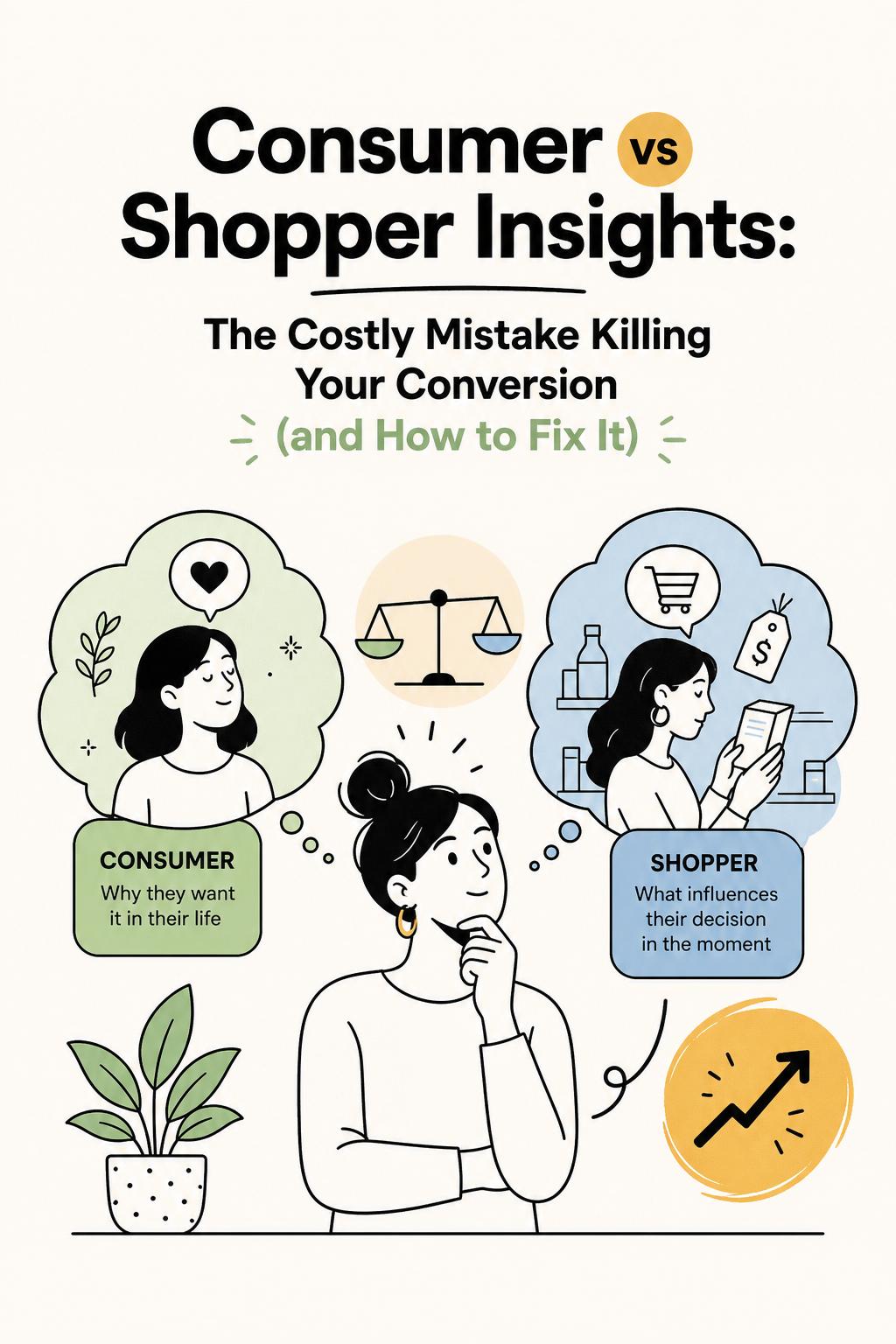
Here’s the blunt truth: consumer insights explain why people care. Shopper insights explain why they choose. If you don’t separate those, you end up optimizing the wrong layer of the problem.
Consumer insights live upstream. They help you understand identity, motivations, needs, beliefs, and category perception. Shopper insights live at the moment of truth—when someone is comparing options, weighing risk, and deciding what to buy under real constraints.
And those constraints change everything.
A user might genuinely believe in your product’s value. But in a crowded category page, with 12 alternatives, unclear differentiation, and subtle pricing differences, belief doesn’t drive action—clarity does. Confidence does. Cognitive ease does.
If your research doesn’t capture that shift, you’re not studying buying behavior. You’re studying aspiration.
The industry has normalized methods that systematically remove the very conditions that shape decisions.
Most research happens in clean, reflective environments—interviews, surveys, controlled tests. But real purchase behavior is messy, rushed, and full of shortcuts. People don’t carefully evaluate. They scan. They infer. They default.
This leads to three consistent failures:
I’ve seen teams chase pricing strategies for months because “data showed sensitivity,” when the real issue was shoppers couldn’t quickly tell the difference between plans. The metric was real. The interpretation was wrong.
If you want consumer and shopper insights to actually drive growth, you need to separate three distinct truths:
Most organizations are overbuilt for life truth and underbuilt for purchase truth.
That’s why you get strong brand strategies but weak conversion. You know why people should care—but not why they don’t act.
Weak insights describe behavior. Strong insights explain it.
“Shoppers want convenience” is meaningless. It doesn’t tell you what to change.
But when you uncover the mechanism—how people reduce effort, avoid risk, or justify choices—you get something actionable.
The second column tells you exactly what to fix—messaging hierarchy, product structure, visual cues, or positioning.
Stop starting with research methods. Start with the decision you need to improve.
Each of these requires a different mix of consumer vs shopper insight.
This is where product analytics or retail data helps—but only as a diagnostic starting point.
The real work is understanding why behavior breaks at that moment.
This is where tools like UserCall fundamentally change the workflow. Instead of guessing, you can intercept users at the exact moment of friction—post-abandonment, post-comparison, or mid-decision—and run AI moderated interviews with full researcher control. That means you’re not reconstructing decisions after the fact. You’re capturing them as they happen.
If your method doesn’t reflect the real decision environment, your insight won’t either.
In one ecommerce project, we saw a 38% drop-off between product page view and add-to-cart. The assumption was pricing friction. But when we intercepted users immediately after they exited, a different pattern emerged: people didn’t trust they were choosing the right variant.
We didn’t lower price. We simplified the decision. Clear defaults. Better labeling. Outcome-focused descriptions. Conversion improved within weeks.
In another case, a B2B SaaS team had strong demand but low demo bookings. Interviews revealed something subtle: buyers weren’t rejecting the product—they were delaying because they couldn’t easily explain it internally. The fix wasn’t feature changes. It was giving them language and framing to justify the decision to others.
And in a retail study under tight time and budget constraints, we skipped in-store observation and relied on stated preferences. The resulting strategy emphasized differentiation. But actual shopper behavior was driven by recognition and speed. The product lost at shelf despite strong positioning work. That mistake permanently changed how I prioritize research methods.
You don’t need more dashboards. You need better connection between behavior and reasoning.
Consumer insights make you sound right. Shopper insights make you win.
If your research isn’t improving what happens at the moment of choice—on the shelf, in the feed, on the product page—it’s not incomplete. It’s misaligned.
The goal isn’t more insight. It’s sharper insight, applied at the exact point where decisions happen.
Because growth doesn’t come from understanding people in general.
It comes from understanding why they didn’t choose you—right when it mattered.
Whether you're focused on consumer or shopper insights, the underlying challenge is the same: getting real, unbiased answers about why people behave the way they do. Our comparison of the 13 best voice of customer tools to understand what your customers really think can help you find the right platform for either use case. Usercall is one option worth exploring if you want AI-moderated interviews that reveal the reasoning behind purchase decisions, not just what happened on the shelf.
Related: what shopper insights really are and how top teams use them · why your dashboard can't explain lost customers · why most teams get the 'why' wrong
