
CX Customer Experience Is Broken: Why Your Metrics Lie (and What Actually Drives Loyalty)
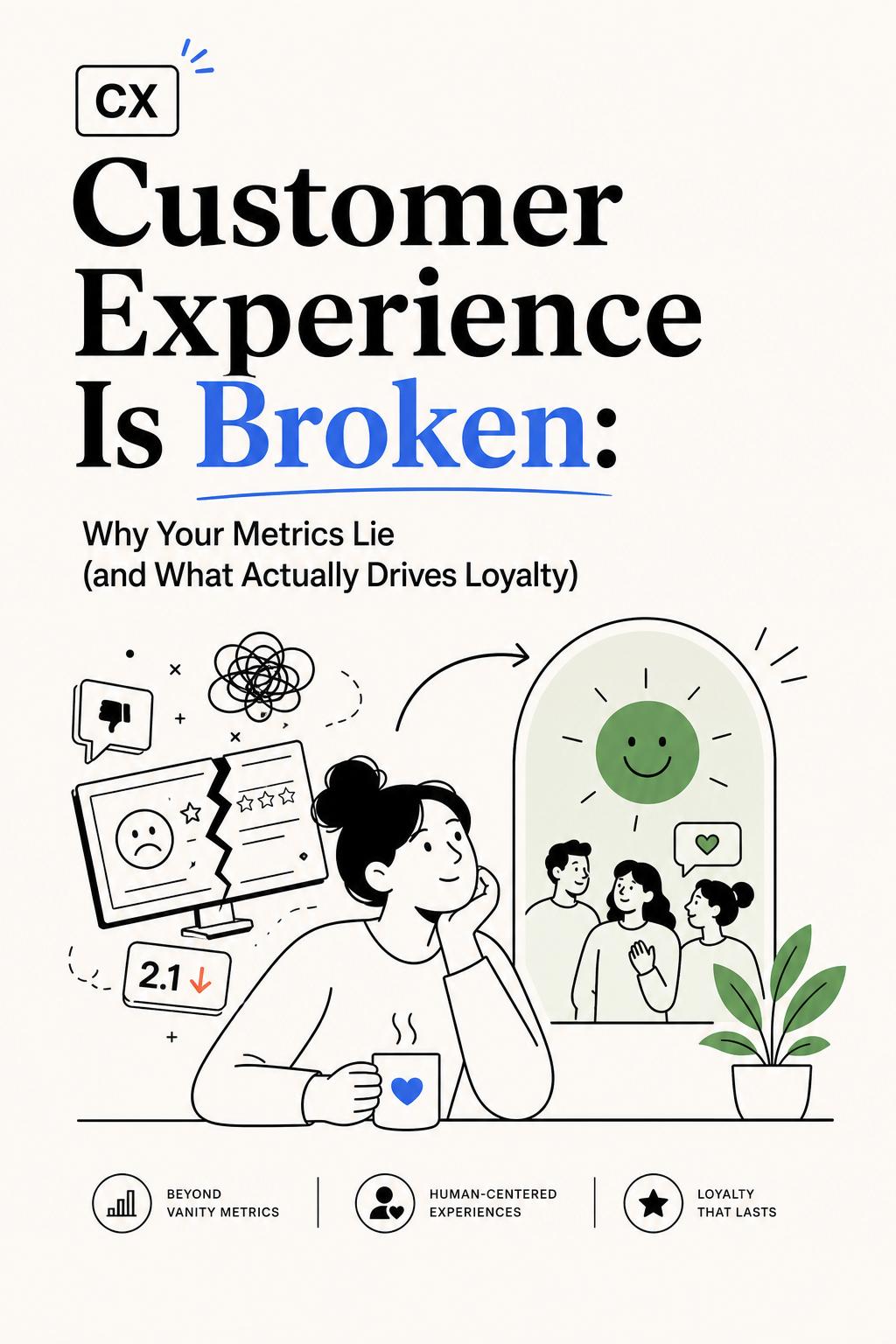
Here’s the uncomfortable truth most CX customer experience teams eventually run into: your metrics are telling you something is wrong—but not what, not why, and definitely not what to fix. I’ve seen companies spend months debating a 0.4 drop in NPS while churn quietly climbs in a specific segment no one bothered to isolate. The dashboard looks sophisticated. The decisions are still guesses.
This is the core tension in modern CX: we’ve gotten very good at collecting feedback, and surprisingly bad at extracting truth from it. If your CX program can’t explain why customers hesitate, abandon, downgrade, or leave—with precision—it’s not a strategy. It’s reporting.
CX customer experience programs fail for one simple reason: they measure symptoms, not causes
Most CX programs are built around surveys because they scale easily. NPS, CSAT, CES—they’re easy to deploy, benchmark, and trend over time. But they create a dangerous illusion: that tracking sentiment equals understanding behavior.
It doesn’t.
Here’s where traditional CX approaches break down in practice:
- Lagging feedback: Surveys arrive after the experience, when memory is distorted and context is gone.
- Surface-level answers: Customers rationalize their responses instead of revealing real constraints.
- Averaged insights: Critical differences between segments get flattened into one score.
- No behavioral link: Feedback isn’t tied to what users actually did in the product or journey.
- Slow action loops: By the time insights surface, the moment to intervene has passed.
The result? Teams end up optimizing the score instead of fixing the experience.
I worked with a subscription product where leadership was obsessed with improving CSAT after support interactions. They hit their target—CSAT went up 12%. But churn didn’t move. When we dug deeper, we found that support quality wasn’t the real issue. Customers were contacting support because onboarding failed to set expectations correctly. The team improved the symptom, not the cause.
The shift that actually improves CX: from feedback collection to behavioral understanding
If you want CX customer experience to drive real business outcomes, you need to stop treating feedback as the primary signal and start treating it as supporting evidence.
The companies that get this right operate on a different model entirely:
- Behavior shows where something broke (drop-offs, churn, repeat contacts).
- Qualitative insight explains why it broke (expectation gaps, confusion, internal constraints).
- Journey context reveals when to intervene (specific moments, not general sentiment).
- Targeted changes validate what actually works (measurable impact, not assumptions).
This sounds obvious, but most teams skip step two entirely. They try to infer customer intent from analytics alone, which is how you end up fixing the wrong problems.
One of the clearest examples I’ve seen: a B2B SaaS company noticed that only 38% of trial users reached activation. The assumption was poor UX in the setup flow. But when we ran in-the-moment interviews triggered after failed setups, we discovered something else entirely: users were pausing because they needed internal approval before connecting sensitive data. The friction wasn’t usability—it was organizational risk. No amount of UI polish would have fixed that.
Why timing matters more than volume in CX research
Most CX programs are built on a calendar: quarterly surveys, monthly reports, weekly dashboards. But customer experience doesn’t happen on a schedule—it happens in moments.
The highest-impact CX insight comes from capturing feedback exactly when something meaningful happens:
- Right after a user abandons onboarding
- Immediately following a failed task or repeated error
- After a successful “aha” moment
- When a customer downgrades or cancels
- During unusually high or low engagement patterns
This is where most teams fall behind—not because they don’t care about customers, but because their tooling and processes aren’t designed for in-the-moment learning.
Tools like Usercall fundamentally change this dynamic. It enables AI-moderated interviews and research-grade qualitative analysis tied directly to product behavior, so you can intercept users at critical moments and understand the “why” behind metrics in real time. That’s a different category of capability compared to traditional survey tools—it’s closer to continuous discovery than periodic feedback.
I’ve used this approach in a growth-stage product where we intercepted users who downgraded within 14 days of upgrading. The assumption was pricing sensitivity. The interviews revealed something more nuanced: customers didn’t perceive enough incremental value between tiers to justify the jump. The issue wasn’t price—it was packaging clarity. That insight led to a restructuring of plan positioning, which improved upgrade retention by double digits.
The 5-layer CX investigation framework (what to do when metrics drop)
When a CX metric moves, most teams jump straight to solutions. That’s a mistake. You need a structured way to diagnose before acting.
Here’s the framework I use across teams:
- Pinpoint the moment: Identify the exact stage in the journey where the issue occurs.
- Segment aggressively: Break down the problem by user type, behavior, plan, and context.
- Capture in-context insight: Talk to users immediately after the relevant behavior.
- Separate friction types: Distinguish between product, process, pricing, and perception issues.
- Test focused interventions: Change one variable and measure real impact.
This framework forces discipline. It prevents teams from overgeneralizing and ensures that every CX initiative ties back to a specific, validated problem.
What surveys will never tell you (and why that matters)
Surveys are useful—but they systematically miss the most important parts of customer experience.
Customers rarely articulate:
- The internal constraints shaping their decisions
- The alternatives they’re actively comparing you against
- The exact moment trust broke
- The workaround they’ve adopted instead of complaining
- The language they use internally to justify staying or leaving
I once worked on a CX project where customers consistently reported “confusion” in surveys. The team responded by simplifying UI labels and rewriting help content. No impact. When we conducted interviews, we uncovered the real issue: customers weren’t confused about the interface—they were unsure whether they were making the right decision. The experience lacked confidence signals, not clarity. That distinction changed the entire solution approach.
How to make CX customer experience drive real business decisions
CX only becomes valuable when it influences decisions across product, UX, and business teams. Otherwise, it stays stuck as a reporting layer.
The key is translation.
For product teams, frame CX insights as blockers to activation, retention, or expansion. For UX, highlight breakdowns between expectation and interaction. For leadership, quantify the business impact of specific experience failures.
If your insight doesn’t clearly answer these three questions, it won’t drive action:
- What is happening?
- Why is it happening?
- What should we change first?
Anything less is noise.
The future of CX: continuous, contextual, and causally grounded
CX customer experience is at an inflection point. The old model—periodic surveys, static dashboards, retrospective analysis—is breaking under the complexity of modern products and customer journeys.
The next generation of CX will be:
- Continuous: Always-on insight instead of periodic snapshots
- Contextual: Tied to real behavior and specific journey moments
- Qualitative-first: Focused on explaining decisions, not just measuring sentiment
- Experiment-driven: Validating changes through measurable outcomes
The teams that adopt this model won’t just report on customer experience—they’ll actively shape it.
Because at the end of the day, CX isn’t about listening to customers more. It’s about understanding them well enough to change what actually matters.
NPS and CSAT are only part of the story — for the complete argument on why dashboards miss what's actually breaking customer experience, read the pillar guide: customer experience is broken and your dashboard is the last one to know. If you're ready to measure what actually drives loyalty, Usercall helps teams run the qualitative research that fills in what surveys can't.
Related: why IT metrics hide failing customer experience · the moment customers quietly quit before you see it · customer experience tools worth evaluating