
Digital Customer Experience Strategy Is Broken—Fix the 5 Moments That Actually Drive Conversion & Retention
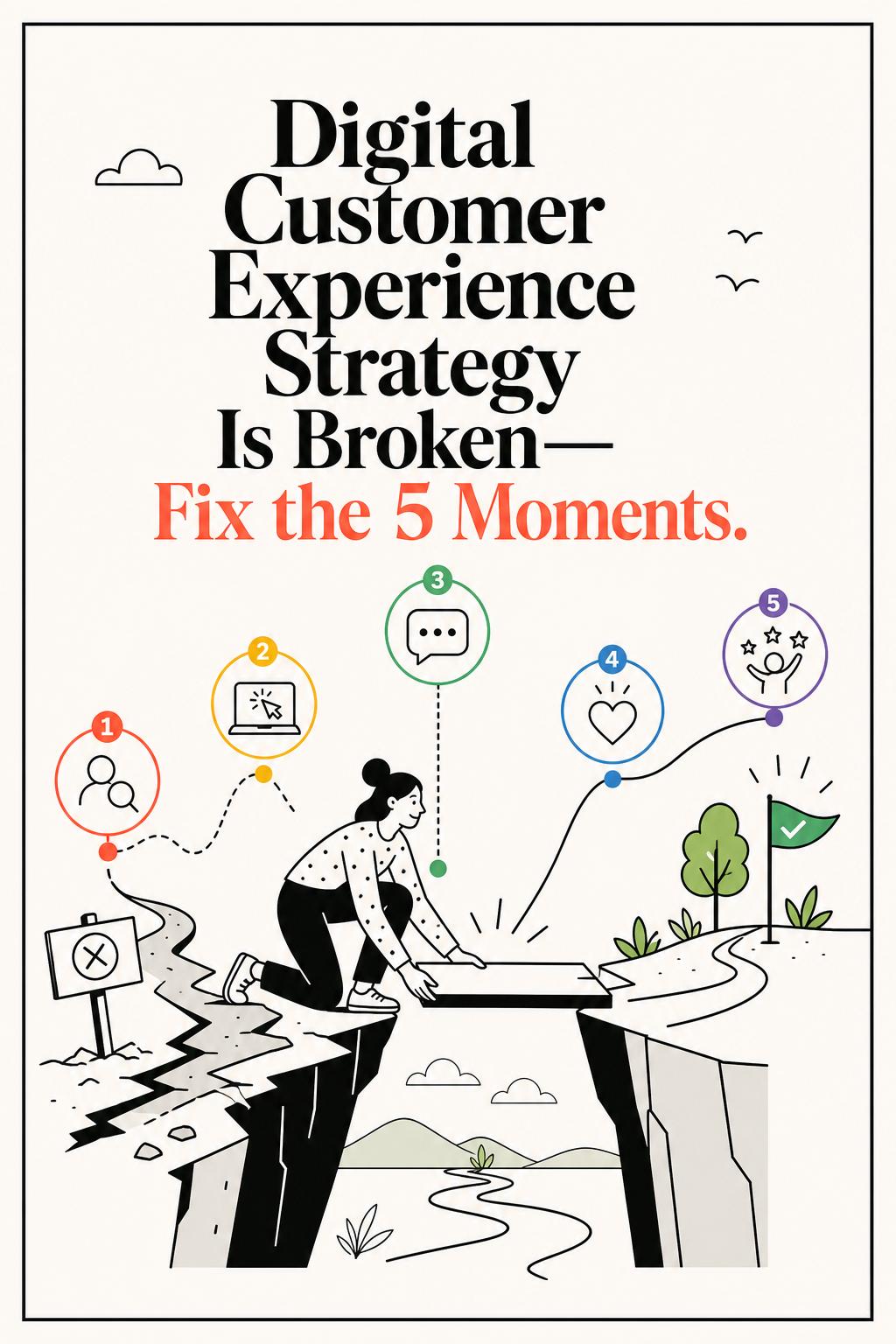
Here’s the uncomfortable truth: most digital customer experience strategies are built on clean dashboards and completely wrong assumptions. Teams obsess over funnel metrics, celebrate minor conversion lifts, and still can’t explain why high-intent users hesitate right before the moment that matters.
I’ve sat in too many rooms where growth, product, and UX teams confidently debate “what users are thinking”—without a single piece of direct evidence from the moment of decision. And that’s the failure. Not lack of data. Lack of proximity to real customer reasoning under pressure.
A digital customer experience strategy that actually drives growth does one thing differently: it stops optimizing journeys and starts diagnosing decisions.
The real job of a digital customer experience strategy
Let’s be precise. Your job is not to make the experience smoother. Your job is to make customers feel confident enough to move forward.
That distinction changes everything.
Because customers are not passively flowing through your funnel. They are actively managing risk. Every click is a micro-decision: Is this worth it? Will this work? What happens if I’m wrong?
If your strategy doesn’t answer those questions at the exact moment they arise, no amount of UX polish or personalization will save you.
- Weak strategy: Optimize flows, reduce clicks, improve usability
- Strong strategy: Identify decision friction, reduce perceived risk, increase user confidence
Most teams are doing the first and wondering why results plateau.
Why most digital customer experience strategies fail
The playbook most companies follow is fundamentally flawed—not because it’s useless, but because it stops too early.
Here’s where things break down in practice:
- Journey maps describe intent, not behavior: They show what should happen, not where users actually struggle when stakes are real.
- Surveys capture opinions after the fact: By the time you ask, the decision is already rationalized.
- Analytics show where, not why: A 40% drop-off tells you nothing about the mental barrier causing it.
- Teams optimize in silos: Marketing, product, and support fix their piece without addressing the full decision context.
I worked with a fintech company that had a 35% drop-off at identity verification. The team assumed it was a UX issue—too many steps, too much friction. But when we intercepted users in that exact moment, the truth was different: users were worried about how their data would be used, not how long the process took.
The fix wasn’t simplification. It was trust signaling—clear explanations, visible safeguards, and reassurance at the exact moment of doubt. Completion rates increased without removing a single step.
That’s what most strategies miss: friction is often psychological, not functional.
The Decision Moment Framework (what actually works)
After years of running qualitative research tied to real product behavior, I’ve found that effective digital customer experience strategy comes down to one repeatable system:
1. Find high-stakes moments (not journeys)
Stop mapping everything. Focus on moments where hesitation directly impacts revenue or retention.
- First key action after signup
- Upgrade or payment decision
- Complex setup or integration step
- Feature adoption drop-offs
- Cancellation or downgrade flows
If it doesn’t materially impact the business, it’s not strategic.
2. Capture insight at the moment of hesitation
This is where most teams fail completely. They rely on post-hoc feedback instead of in-the-moment understanding.
The difference is massive.
In one SaaS onboarding flow, we triggered short AI-moderated interviews when users paused for more than 20 seconds on a configuration step. Instead of guessing, we heard exactly what users were thinking:
“I don’t know if this setting will mess things up later, so I’d rather come back to it.”
This single insight reframed the entire onboarding strategy.
3. Diagnose the real barrier (not surface symptoms)
Most friction falls into a few categories—but teams misclassify it constantly.
If you solve the wrong problem, you often make the experience worse.
4. Redesign for confidence, not simplicity
Here’s where most teams get it backwards: they remove steps when they should be adding clarity.
In another project, a B2B tool reduced onboarding steps from 7 to 4. Conversion improved slightly, but retention dropped. Why? Users moved faster—but with less understanding and more doubt.
We reversed course and added:
- Contextual explanations tied to user goals
- “Safe default” recommendations with rationale
- Signals showing what successful users choose
- Clear reversibility of decisions
Activation slowed slightly—but retention increased significantly. Because confidence compounds.
5. Validate behavior and belief
If you only measure conversion, you’re missing half the picture.
Better digital customer experience strategies measure:
- Behavior change (conversion, retention, usage)
- Confidence change (clarity, trust, perceived risk)
Short-term gains without confidence usually lead to long-term churn.
The tooling gap most teams underestimate
You cannot execute this strategy with analytics alone. And traditional research methods are too slow and detached from real behavior.
You need systems that connect what users do with what they think in that moment.
- UserCall: purpose-built for this exact problem—research-grade AI qualitative analysis with AI-moderated interviews triggered at key product moments. It allows teams to intercept users at points like drop-offs, hesitation, or upgrade decisions and uncover the “why” behind metrics with depth and speed. Strong researcher controls make it viable for serious insight work, not just lightweight feedback.
- Analytics tools: essential for identifying where problems exist, but blind to motivation.
- Survey platforms: useful for trend tracking, but too delayed and shallow for decision-level insight.
The winning combination is not more data. It’s tighter feedback loops between behavior and reasoning.
The shift that separates high-performing teams
The best teams don’t ask, “Where are users dropping off?”
They ask, “What decision is the user trying to make right here—and why are we failing to support it?”
That shift sounds small. It’s not.
It forces you to:
- Focus on moments, not journeys
- Prioritize insight over assumptions
- Design for psychology, not just usability
- Measure confidence, not just clicks
And most importantly, it aligns your entire organization around something real: how customers actually think and decide.
How to implement this in the next 30 days
If your digital customer experience strategy feels abstract, here’s how to make it concrete fast:
- Pick one critical drop-off point tied to revenue
- Instrument it with behavioral tracking
- Trigger in-the-moment qualitative capture
- Synthesize insights by decision barrier
- Redesign specifically for that barrier
- Measure both conversion and confidence shifts
Do this once, properly, and your entire approach to customer experience will change.
Because you’ll stop guessing.
And once you see how often your assumptions are wrong, you won’t want to go back.
Fixing decision moments is just one piece of a complete CX strategy. Read our customer experience CX strategy guide for the full picture, and consider Usercall to hear directly from customers at the moments that matter most.
Related: the 5 moments that decide whether customers stay or leave · a CX framework that actually drives retention · why customers leave after a good experience