
 Table of Contents
I’ve sat in too many product reviews where a team proudly presents “insights” from an online market research platform—only for someone to ask a simple question that no one can answer: “But why did users do that?” And suddenly the entire room goes quiet.
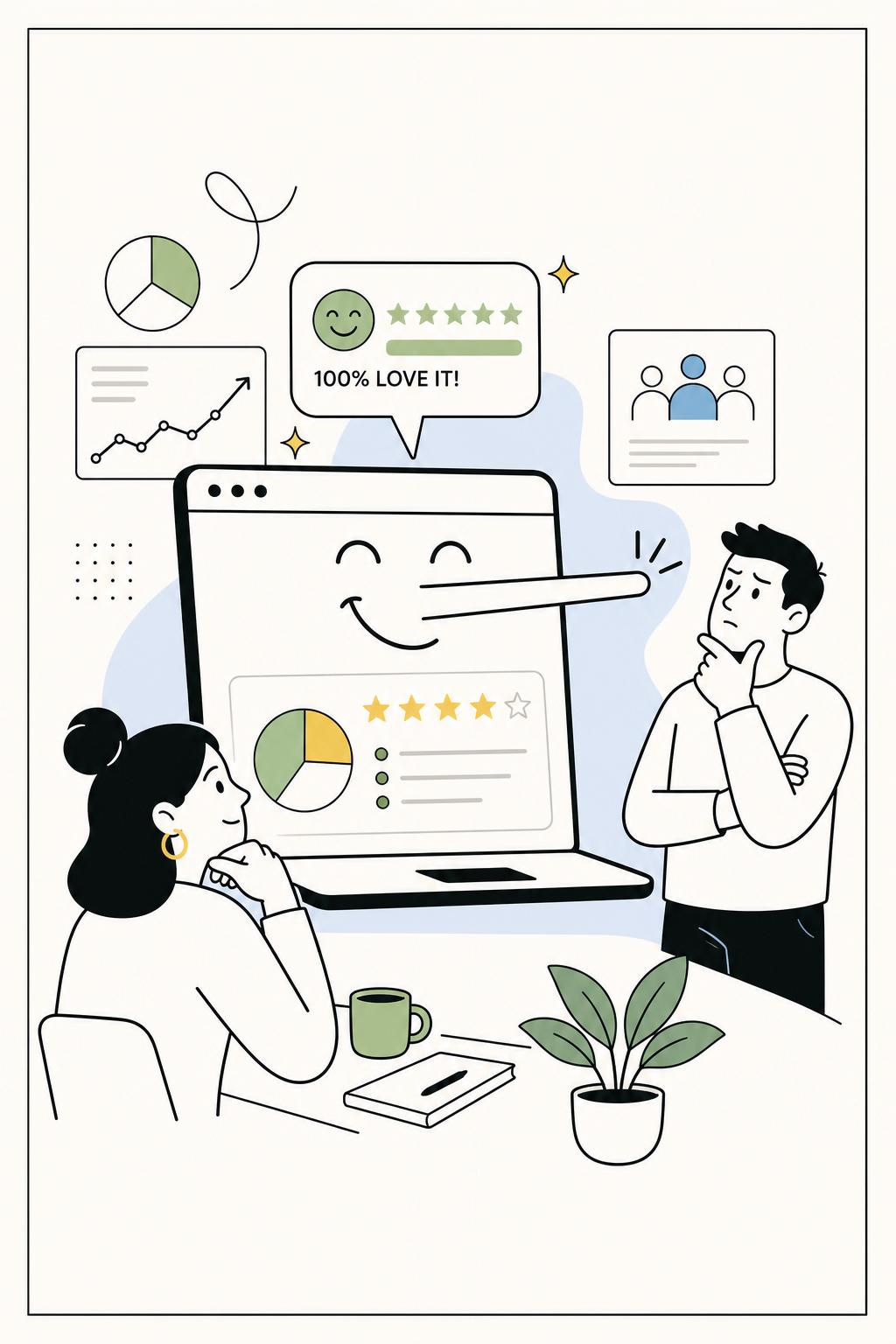
This is the core problem with most online market research platforms. They are incredibly good at collecting answers and dangerously bad at uncovering truth. They give you charts, percentages, and summaries that look decisive—but leave out the messy, contradictory, high-signal human context that actually drives behavior. And when you make decisions without that layer, you’re not reducing risk. You’re just moving faster toward the wrong conclusion.
If you’re searching for an online market research platform, the real question isn’t “Which tool has the best features?” It’s: Which platform will actually help me understand what customers mean—not just what they say?
Speed has become the dominant selling point in this category. Launch surveys in minutes. Get hundreds of responses overnight. Auto-generate reports instantly.
That sounds great—until you realize what got sacrificed to make that possible.
Most platforms are designed around structured inputs: multiple choice, ratings, predefined options. That inherently limits what you can learn. You only get answers to questions you already thought to ask. And in real research, that’s the least valuable kind of knowledge.
The most important insights are almost always unprompted. They show up as:
Traditional online market research platforms flatten all of that into clean datasets. And in doing so, they remove the very signals you need to make high-stakes decisions.
Surveys force users into predefined boxes. That makes analysis easier—but reality less accurate.
I once worked with a SaaS team evaluating pricing changes. Their survey showed 68% of users preferred the “Pro” plan. Clear signal, right? Except in follow-up interviews, users admitted they chose it because it sounded safer, not because they understood the differences. When pricing launched, conversion dropped 22%.
The survey didn’t lie. It just captured surface-level preference instead of actual decision behavior.
There’s a dangerous assumption that more responses = better insight. In practice, more responses often just amplify shallow patterns.
If your method is flawed, scaling it doesn’t fix anything. It just makes weak insight feel statistically convincing.
Most platforms prioritize outputs that look polished: charts, summaries, auto-insights. But these often strip away nuance.
In qualitative research, nuance is the insight. The hesitation in a response. The story behind a complaint. The exact words someone uses. When those are abstracted away, teams lose the ability to interpret meaning correctly.
A strong online market research platform shouldn’t just help you collect data. It should help you make better decisions with less risk.
That requires a fundamental shift in how you evaluate tools. Instead of asking “What can this platform collect?”, ask:
If a platform fails any of these, it will eventually produce insights that sound useful—but don’t change decisions.
After years of running research across product, UX, and growth teams, I’ve narrowed platform evaluation down to four dimensions that actually matter.
Can the platform handle rich qualitative input—interviews, open-ended responses, probing follow-ups?
If it’s primarily survey-based, it will struggle with exploratory research. And that’s where most high-value insights come from.
AI is transforming research—but many tools treat it as a black box. That’s a problem.
You need systems where researchers can guide analysis, validate themes, and trace insights back to raw data. Otherwise, you’re outsourcing judgment without accountability.
The best insights come from capturing feedback at the moment behavior happens.
Think:
Platforms that support in-product intercepts at these moments unlock a level of insight surveys can’t replicate.
Speed matters—but only if you’re not trading away insight quality.
The best platforms compress the time from question → insight → decision, without reducing everything to shallow inputs.
Scenario 1: Feature adoption mystery
A product team sees that only 18% of users adopt a new feature. Analytics show where users drop off—but not why.
Survey approach: “Why didn’t you use this feature?” → vague answers like “not useful” or “too complex.”
Better approach: intercept users right after they ignore the feature, run short AI-moderated interviews, and probe deeper.
Outcome: users didn’t understand when to use the feature—not how. Completely different problem, completely different solution.
Scenario 2: Churn diagnosis
I worked on a churn project where the company assumed pricing was the issue. Surveys supported that assumption.
But when we conducted deeper interviews under tight timelines, a different pattern emerged: users never reached value during onboarding. Pricing wasn’t the problem—perceived value was.
Fixing onboarding reduced churn far more than any pricing change would have.
Scenario 3: Messaging failure
A B2B company tested new positioning with a survey. Results were positive. Launch flopped.
Follow-up qualitative work revealed the issue: the message sounded good but didn’t match how buyers described their problem internally. It lacked credibility.
This is the kind of gap only shows up when you analyze real language, not structured responses.
Not all platforms are built for the same job. Here’s how to think about the landscape:
The key is not choosing the most popular tool—it’s choosing the one aligned with the type of decisions you need to make.
The category is shifting fast. The old model—separate tools for surveys, interviews, and analysis—is breaking down.
The new model is integrated and AI-powered, but with an important caveat: the best platforms don’t replace researchers—they amplify them.
This means:
Teams that adopt this model are not just faster. They are directionally correct more often—which is what actually matters.
If an online market research platform promises effortless insights, be skeptical. Good research isn’t frictionless. It requires depth, interpretation, and sometimes uncomfortable findings.
The goal isn’t to make research easier. It’s to make decisions smarter.
That means choosing a platform that:
Because in the end, the teams that win aren’t the ones with the most data.
They’re the ones who actually understand their customers.
If you're rethinking your research stack, our guide to the 15 best market research tools in 2026 breaks down exactly which platforms deliver real decisions versus just dashboards. It's a practical starting point for building a stack that actually tells you why customers buy, not just what they clicked.
Related: why most market research platforms don't explain customer decisions · how top teams fix broken online surveys · the online market research tools worth using in 2026
