
 Table of Contents
Here is the uncomfortable truth about most STEEP analyses: they are completed after the strategy has already been chosen. Teams fill five boxes with “AI,” “inflation,” “sustainability,” and “regulation,” congratulate themselves for being strategic, then continue building the same product for the same customer in the same way.
That is why so many market scans produce nothing but polished slides. They describe the world without changing a single decision. A strong STEEP analysis should do the opposite: it should identify the external force most likely to make your current roadmap, positioning, or research assumptions wrong.
The best STEEP analysis examples are not broad lists of trends. They show a credible chain from a macro change to a customer behavior, a business exposure, and a specific response. That is the standard product leaders, UX researchers, and business teams should use.
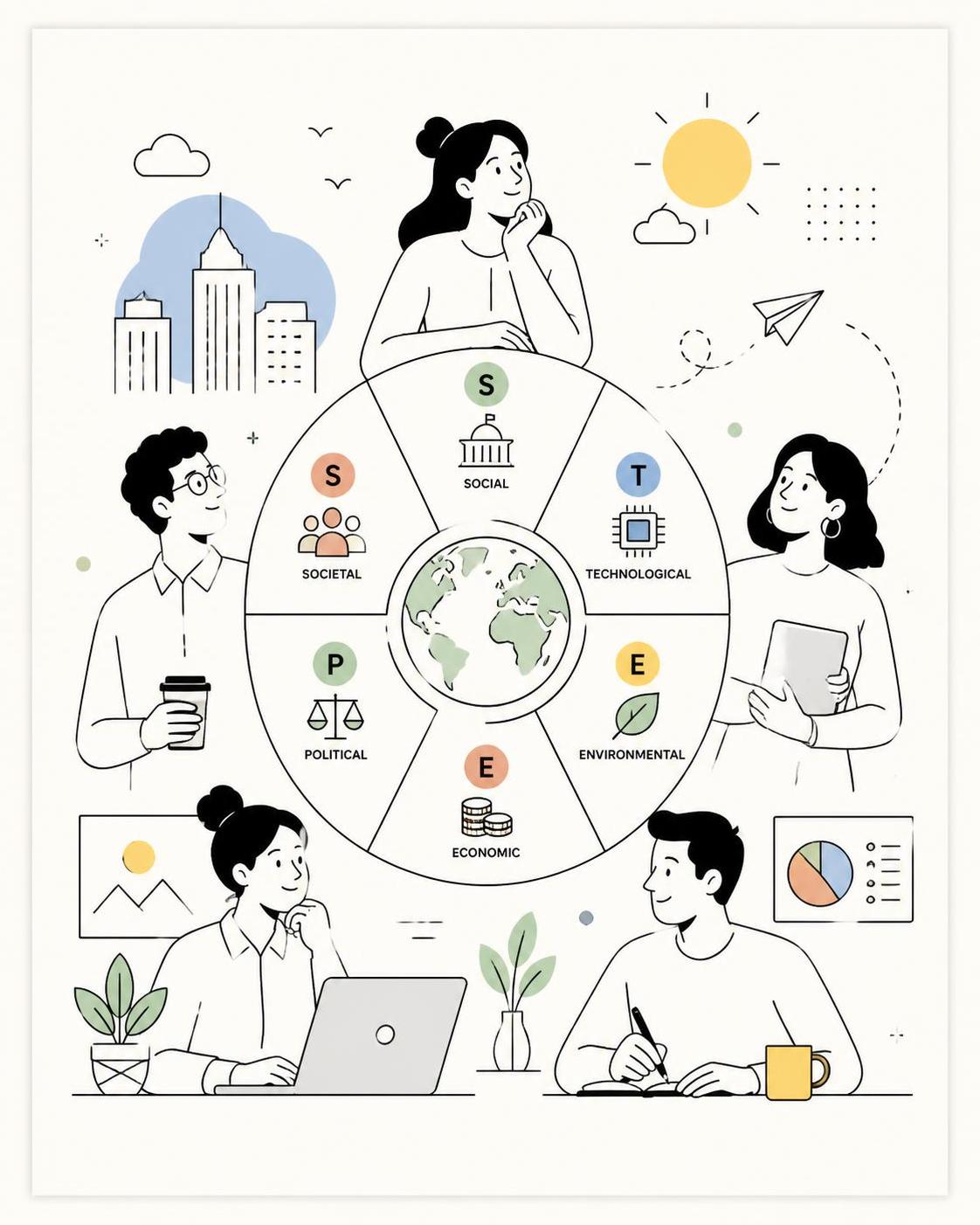
STEEP analysis examines five external forces: Social, Technological, Economic, Environmental, and Political. It is useful when a team needs to understand the market context around a new product, customer segment, expansion market, pricing decision, or strategic bet.
But the framework is routinely misused as a categorization exercise. “Economic: inflation is rising” is not analysis. It is an observation. Analysis begins when you ask how inflation changes purchasing behavior, which customers are most exposed, and what your company should do differently because of it.
I use one rule when reviewing a STEEP analysis: if the factor does not challenge an assumption or force a choice, remove it. Strategy teams do not need more information. They need sharper reasons to prioritize, delay, reposition, or stop an investment.
The standard template encourages weak thinking because it separates forces that customers experience all at once. A buyer does not wake up and think, “Today I am affected by a technological factor.” They experience a tighter budget, a new AI expectation, a colleague’s recommendation, a procurement requirement, and a delivery delay as one messy reality.
Three common mistakes make STEEP analysis less useful than it should be.
The fix is not a bigger STEEP spreadsheet. It is a more demanding chain of logic.
For every factor, use four steps. This turns a vague environmental scan into a decision-making tool.
This model is deliberately strict. If you cannot explain the mechanism, you have a hypothesis, not an insight. If you cannot identify exposure, the trend may not matter to your business yet. If you cannot name a response, put it on a watchlist rather than pretending it belongs on the roadmap.
Signal: B2B buyers increasingly form opinions through peer communities, practitioner content, private Slack groups, and shared implementation stories before they speak with sales.
Mechanism: Trust now forms earlier than the sales conversation. Prospects arrive with narrower requirements and less tolerance for generic product demos. They are not looking for a tour of every feature; they want proof that people like them can succeed quickly.
Exposure: A research software company sees steady demo volume but a 20% fall in demo-to-close conversion. The sales team assumes the issue is price. Interviews show that prospects see the product as capable but intimidating compared with tools they have watched peers use.
Response: Replace feature-led demonstrations with role-specific workflows. Show a researcher moving from messy interview evidence to a defensible recommendation in 30 minutes. Publish onboarding paths that a prospective champion can share internally before purchase.
The social insight is not “community matters.” It is that credibility has moved upstream, changing the evidence buyers need before they will tolerate implementation effort.
Signal: Generative AI has reset expectations for drafting, summarization, search, and analysis inside professional software.
Mechanism: Customers now expect routine work to happen faster. But they also distrust AI output when it affects a product launch, customer decision, compliance process, or executive recommendation. The faster the output appears, the more rigorously experienced users ask, “Where did this claim come from?”
Exposure: A UX research platform introduces automatic interview summaries. Initial use is high, but senior researchers export transcripts and redo the synthesis manually because the summaries flatten nuance and do not connect conclusions to source evidence.
Response: Design AI for verification, not merely generation. Research-grade qualitative AI should preserve participant context, distinguish evidence from interpretation, reveal contradictory feedback, and let researchers control codes, segments, and analytic prompts.
I saw this failure during a study involving 36 interviews across three customer segments. An early AI summary confidently called onboarding the primary churn driver. When we examined the interviews, onboarding was frustrating, but the actual churn trigger was a later handoff between operations and finance. The summary over-weighted what participants mentioned first. Without traceability, the team would have spent a quarter fixing the wrong journey.
Usercall is designed for this higher bar: AI-moderated interviews can accelerate evidence collection, while research-grade AI-native qualitative analysis and deep researcher controls help teams inspect, challenge, and refine the findings. It can also trigger user intercepts at meaningful product analytics moments, such as repeated errors or checkout abandonment, so teams learn why a metric moved instead of inventing explanations after the fact.
Signal: Budget holders are scrutinizing new software, subscriptions, and discretionary projects more closely.
Mechanism: Buyers do not simply seek the lowest price. They seek the lowest commitment risk. A product can be affordable but still lose if implementation takes too long, adoption is uncertain, or value cannot be demonstrated inside one budget cycle.
Exposure: A customer-insights platform loses mid-market deals despite being priced below competitors. Prospect interviews reveal the real alternative: continuing with spreadsheets, surveys, and ad hoc interviews. The existing workflow is inefficient, but it feels familiar and politically safe.
Response: Position against the cost of delayed or poor decisions, not just competing vendors. Offer a narrow first use case with measurable value: identify churn drivers in two weeks, test a pricing hypothesis before development, or cut synthesis time from five days to one.
In one subscription research project during a spending freeze, leadership pushed for discounting because cancellations had risen. We interviewed 18 recent cancelers under the constraint that every recommendation had to be testable within six weeks. Price was mentioned, but it was not the decisive issue. Customers could not see ongoing value after the initial novelty wore off. Discounting would have protected neither retention nor margin; recurring proof of value did.
Signal: Extreme weather, supply disruptions, energy volatility, and resource constraints affect how reliably products and services can be delivered.
Mechanism: Customers do not separate operational disruption from the brand experience. A stockout, delayed delivery, failed appointment, or degraded service becomes a trust problem regardless of its environmental cause.
Exposure: A grocery delivery service sees satisfaction decline in regions experiencing extreme heat. Operations blames courier availability. Customer interviews show that the larger frustration is unpredictable substitutions for refrigerated items and a lack of warning before checkout.
Response: Redesign expectation-setting. Let customers set substitution preferences early, surface availability risk before payment, and explain constraints without using vague apology language. Environmental resilience is partly an operations challenge, but it is also a service-design challenge.
Signal: Rules and scrutiny around data use, AI governance, consent, localization, and sector-specific compliance are increasing.
Mechanism: Political and regulatory conditions change procurement. A buyer may love a product but be unable to approve it without clear answers about data retention, model behavior, audit trails, and access controls.
Exposure: An AI-enabled platform has strong interest from financial services and healthcare teams, yet enterprise deals stall in security review. The sales team treats this as a legal bottleneck. Buyers treat it as evidence that the platform is not ready for high-stakes work.
Response: Make governance visible in the product experience. Build clear controls for consent, permissions, data retention, source evidence, and review workflows. In regulated markets, trust is not sales collateral. It is a product feature.
Signal: Consumers want convenience but increasingly feel financial and social pressure to avoid wasteful spending.
Mechanism: This creates behavior that looks contradictory in funnel data. Customers browse premium products, save items, abandon checkout, and return later when the purchase feels more practical or justifiable.
Exposure: An apparel retailer sees high cart abandonment and responds with broader discounts. Conversion barely improves, while margins fall. Follow-up interviews reveal customers are worried about fit, return effort, and whether the product will last—not only price.
Response: Reduce regret risk before reducing price. Improve sizing confidence, show durability evidence, clarify returns, and help customers compare options by likely use rather than aspirational styling. Behavioral friction is often mistaken for price sensitivity because teams only measure the final abandonment event.
Do not try to identify every trend. That produces false confidence and no action. Choose the two or three forces most likely to alter your customer’s constraints, expectations, or alternatives in the next 6 to 18 months.
The real value of STEEP analysis is not that it makes your strategy deck look complete. It is that it exposes where your internal plans depend on an external world that may no longer exist. That is the kind of insight worth acting on.
