
Stop Measuring Customer Experience Like a Dashboard—Here’s What Actually Drives Retention
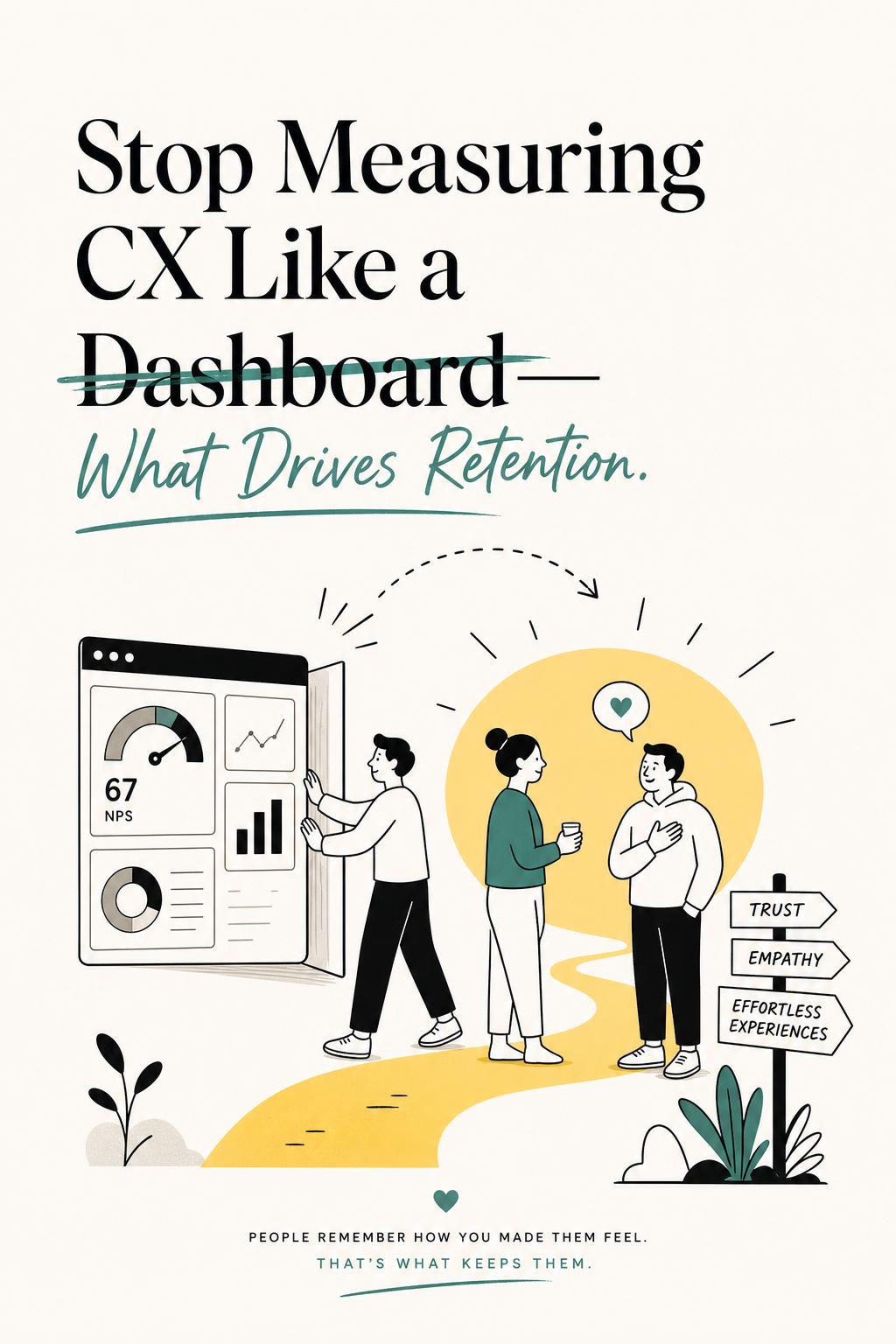
Your customer experience metrics are probably lying to you.
Not because the data is wrong—but because it’s incomplete in exactly the ways that matter. I’ve seen teams proudly present rising NPS and CSAT scores while churn creeps up quarter after quarter. On paper, the experience looks “better.” In reality, customers are quietly losing trust.
This happens when measurement gets disconnected from actual user behavior. You end up optimizing for survey responses instead of outcomes. The result? A polished dashboard that tells a comforting story—and a product experience that still leaks revenue.
If you’re serious about measuring customer experience, you need to stop thinking in terms of scores and start thinking in terms of moments. The moments where customers hesitate, second-guess, recover, or give up entirely. That’s where experience lives. And that’s what your measurement system should be built to capture.
The fundamental mistake: treating customer experience like a score
Most CX programs collapse a complex journey into a single number. It’s convenient. It’s easy to report. And it’s almost useless for making decisions.
Here’s the uncomfortable truth: a single metric cannot tell you why customers churn, hesitate, or lose confidence. It can only tell you that something changed.
In one SaaS engagement, the team was fixated on improving their NPS, which had plateaued at 31. They ran surveys, tweaked messaging, and even improved support response times. NPS ticked up to 36. Success, right?
Except expansion revenue dropped by 12% that same quarter.
When we dug deeper, we found the issue had nothing to do with overall satisfaction. Customers were hitting a specific limitation during team collaboration—something no NPS survey surfaced because it only appeared after weeks of use. The measurement system completely missed the moment that mattered most.
This is the core failure: most teams measure sentiment detached from context.
What measuring customer experience should actually do
Good measurement doesn’t just describe experience—it explains it.
If your CX metrics can’t answer “what specifically is breaking, where, and why,” they’re not useful. They’re decorative.
The goal is to connect three things tightly:
- What customers did (behavior)
- What they felt (perception)
- What happened next (outcome)
Most teams track one or two of these. Very few connect all three in a meaningful way. That’s the gap between reporting and real insight.
A practical framework for measuring customer experience (that actually works)
After years of running qualitative research across product, UX, and growth teams, I’ve found that the most effective CX measurement systems operate across four layers. Skip one, and your understanding collapses.
- Outcome layer: retention, churn, expansion, conversion
- Behavior layer: completion rates, drop-offs, retries, time to value
- Perception layer: ease, confidence, trust, clarity
- Meaning layer: expectations, motivations, hidden friction
The first two are what most analytics teams already track. The third shows how users interpret the experience. The fourth explains everything.
And yet, the meaning layer is almost always missing—because it requires qualitative insight, not just instrumentation.
I once worked with a fintech product where users repeatedly abandoned a key verification step. Analytics showed a clear drop-off, but no obvious usability issue. It wasn’t until we ran in-the-moment interviews that we uncovered the real cause: users thought the system was about to run a hard credit check. It wasn’t—but nothing in the interface reassured them.
No metric would have revealed that. Only context could.
Where to measure: focus on high-stakes journey moments
Trying to measure everything equally is a fast way to learn nothing useful.
The better approach is to focus on moments where experience has disproportionate impact on outcomes.
- First value moment: when users decide if the product is worth continuing
- Setup and onboarding: where confidence is either built or eroded
- Critical workflows: repeat actions tied to core product value
- Failure and recovery: errors, edge cases, unexpected friction
- Pricing and upgrade decisions: moments of commitment or hesitation
- Cancellation or renewal: final judgment of value
Each of these moments should have tightly paired metrics: what happened and how it felt.
For example, don’t just track onboarding completion rate. Track completion rate alongside user confidence. A user who completes onboarding but feels unsure is far more likely to churn than one who takes longer but feels in control.
The most important shift: measure experience in the moment, not after
This is where most CX programs quietly fail.
They collect feedback too late.
By the time a user receives a survey, the context is gone. Memory has been reconstructed. Frustration has either faded or compounded. You’re no longer measuring experience—you’re measuring a story about the experience.
The fix is simple in theory and harder in practice: capture insight at the exact moment behavior happens.
If a user abandons a workflow, ask why right then. If they hesitate on a pricing page, capture their concern immediately. If they retry an action three times, understand what they expected versus what occurred.
This is where tools like UserCall fundamentally change what’s possible. Instead of relying on static surveys, you can trigger AI-moderated interviews and intercept users at key product moments. That means you’re not guessing why a metric moved—you’re hearing it directly, with full context, while the experience is still fresh. Combined with research-grade qualitative analysis and deep controls, it bridges the gap between behavioral data and human understanding.
Without this layer, you’re always inferring. And inference is where most teams go wrong.
The metrics that actually matter (and how to use them correctly)
You don’t need more metrics. You need better alignment between them.
The pattern here is consistent: metrics become misleading when they’re interpreted in isolation.
The solution is pairing. Every behavioral metric should have a corresponding perception signal. Every perception signal should tie back to an outcome.
A step-by-step workflow to build a CX measurement system
If you want to operationalize this, here’s a workflow that works in real teams—not just theory.
- Identify 5–7 critical journey moments where experience impacts revenue or retention
- Define the user’s goal at each moment (not your business goal)
- Select one behavioral and one perception metric per moment
- Instrument real-time qualitative capture at high-friction points
- Segment by context, not just persona (e.g., urgency, experience level, use case)
- Assign clear ownership for improving each moment
This approach forces clarity. It eliminates vanity metrics. And most importantly, it ties measurement directly to action.
Tools that support real customer experience measurement
- UserCall: Leading platform for AI-native qualitative research, AI-moderated interviews, and in-the-moment user intercepts tied to product analytics. Ideal for uncovering the “why” behind behavior with research-grade depth.
- Product analytics tools: Essential for tracking behavior patterns, drop-offs, and usage trends—but incomplete without qualitative context.
- Survey platforms: Useful for structured perception data when deployed at meaningful, contextual moments.
- Support systems: Provide insight into recurring issues, resolution quality, and failure patterns.
The key is not choosing one—it’s integrating them around real customer moments.
The bottom line: stop measuring experience—start explaining it
Most teams already have enough data to know something is wrong. What they lack is the ability to explain why.
That’s the shift that matters.
When you move from tracking scores to understanding moments, your entire approach changes. You stop asking “How is our customer experience trending?” and start asking “Where exactly are we breaking trust—and what would fix it?”
Because in the end, customer experience isn’t a number. It’s a series of decisions your users make: to continue, to trust, to upgrade, or to leave.
And if your measurement system can’t explain those decisions, it’s not doing its job.
Run the week on concept testing: 15 to 30 AI-moderated interviews, with quotes back in 48 to 72 hours.
Metrics only matter if they're tied to a real strategy behind your CX efforts. Our customer experience CX strategy guide breaks down how to connect measurement to action, and Usercall helps you gather the qualitative context dashboards miss.
Related: Concept testing questions · Concept testing research · CPG packaging · Concept testing examples
Related: a CX framework that actually drives retention · why customers leave after a good experience · surveys that don't fix churn