
 Table of Contents
If you’ve ever searched for NVivo pricing, you’ve probably realized the hardest part isn’t the number on the website. It’s figuring out which NVivo license actually applies to you and what you’ll end up paying once your research grows beyond a single person.
NVivo’s license structure was built for an earlier era of qualitative research: individual analysts, long timelines, and relatively stable teams. In 2026, most research teams no longer look like that. Work is more continuous, more collaborative, and often sits in a gray zone between academic and commercial use.
Most teams start with a single NVivo license (~$1,200–$2,500), but costs increase quickly once multiple users or collaboration needs are involved.
This guide explains NVivo license types in plain language, surfaces where costs quietly increase, and helps you decide when NVivo still makes sense and when it becomes cost-inefficient.
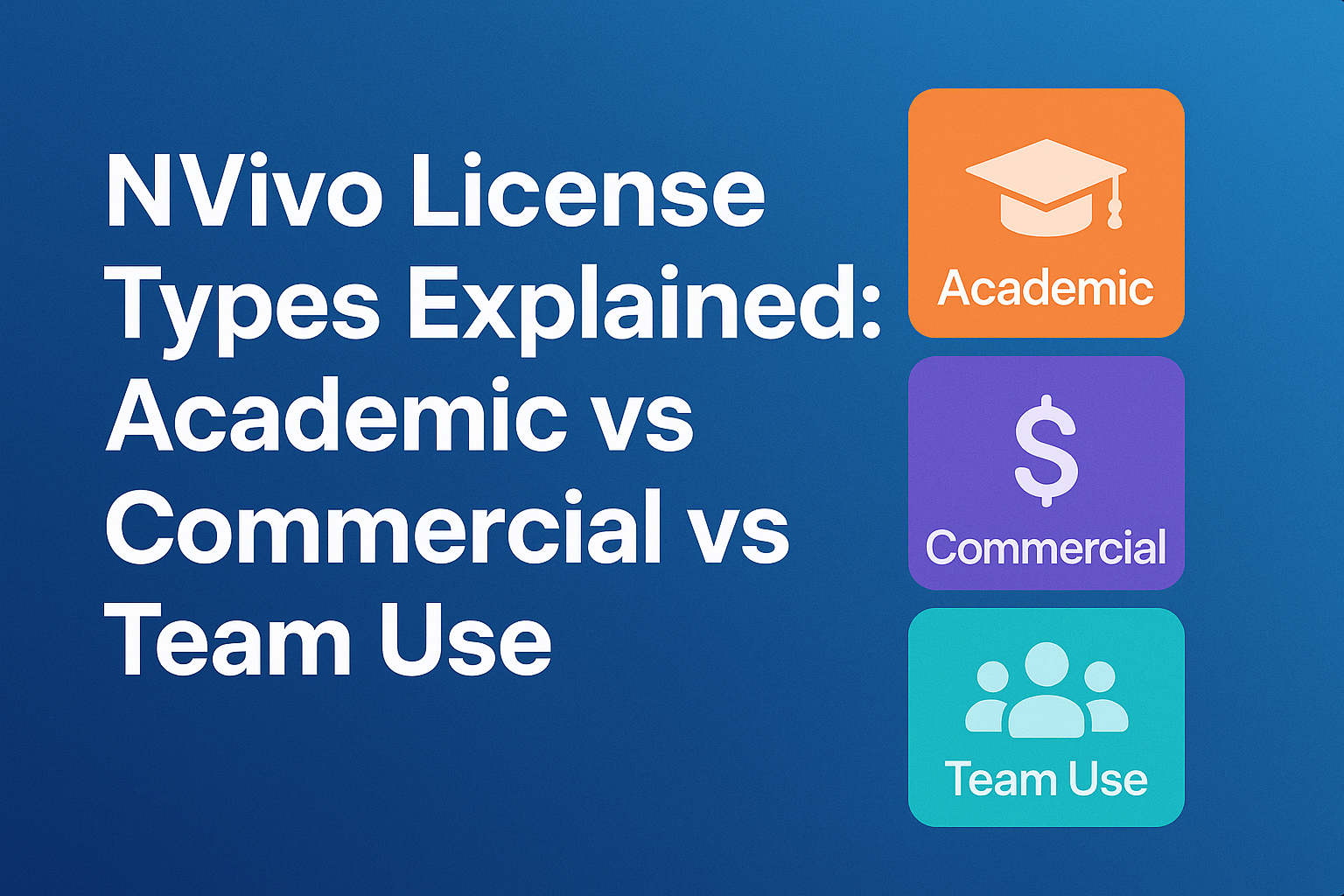
At a high level, NVivo licenses fall into three buckets:
On paper, this looks straightforward. In practice, confusion starts when these license types collide with modern research workflows.
Academic licenses are where NVivo looks most attractive initially, especially for students and university researchers.
For solo students or faculty working on theses, dissertations, or independent research, academic pricing can be reasonable. For mixed academic–industry projects or university teams collaborating with external partners, license boundaries can become blurry and risky.
If there’s any chance your work crosses into paid research, consulting, or client delivery, clarifying eligibility before purchase matters more than the sticker price.
If you’re unsure where that line sits, see the full NVivo pricing breakdown to understand total costs before committing.
Commercial licenses are what most industry teams ultimately need, even if they first explore academic options.
This model works reasonably well for:
It becomes far less efficient for product teams, insights teams, or agencies running ongoing research programs. This is often the moment teams start actively searching for NVivo alternatives that better support AI and collaboration.
NVivo was not designed as a collaborative, cloud-native research platform. Teams can make it work, but usually at a cost that doesn’t appear in the pricing table.
The biggest mistake teams make is choosing based on the lowest upfront price instead of total cost once multiple users and workflows are involved.
In practice, teams often discover that time spent managing NVivo projects rivals the software cost itself. Once three or four researchers are involved, inefficiencies compound quickly.
This is why many teams evaluating tools compare NVivo with platforms like ATLAS.ti or newer, AI-native tools such as UserCall, which are built around shared workflows rather than single-user ownership. Side-by-side comparisons such as NVivo vs ATLAS.ti vs Usercall make these trade-offs more visible.
NVivo remains a strong tool for specific use cases. The key is recognizing when its license model aligns with your reality.
At this stage, teams typically shift from comparing license prices to comparing total cost of ownership, including researcher hours and opportunity cost. That’s where modern alternatives start to look compelling.
Before purchasing, ask three practical questions:
Answering these honestly often makes the decision clear. Either NVivo fits your workflow, or you’ll quickly see why teams start exploring alternatives built for speed and collaboration.
NVivo licensing isn’t confusing because it’s poorly documented. It’s confusing because research workflows have evolved faster than the licensing model.
Academic licenses work well for individuals. Commercial licenses work for solo professionals. But as soon as teams scale, costs grow through a mix of additional licenses, time overhead, and operational friction.
If you’re evaluating NVivo in 2026, look beyond the license price. Pair NVivo pricing with an honest assessment of how your team works today and how that workflow is likely to evolve over the next year. That’s where the real cost difference usually reveals itself.
If NVivo’s licensing structure is starting to feel expensive or restrictive as your team grows, you’re not alone. See how it stacks up against leaner alternatives in the ATLAS.ti vs NVivo vs UserCall in 2026 guide, or try UserCall to experience a qualitative research workflow with no license headaches.
NVivo offers three main license types: academic licenses (discounted, restricted to students and faculty), commercial licenses (full price, no usage restrictions), and team or multi-user arrangements. Academic licenses are the most affordable but cannot be used for commercial or client work. Commercial licenses are priced per user and scale linearly as teams grow.
A single NVivo license typically costs between $1,200 and $2,500 depending on license type. Academic licenses are significantly cheaper but come with usage restrictions. Commercial licenses sit at the higher end of that range. Costs increase quickly once multiple users are involved, since each active researcher requires a separate license.
Academic licenses are discounted and intended for students, faculty, and university researchers, but they cannot be used for commercial, consulting, or client-facing work. Commercial licenses include full access to NVivo functionality with no usage restrictions. Choosing the wrong type creates compliance risk, especially on mixed academic-industry research projects.
NVivo licenses are tied to individual users, not teams. Multiple researchers cannot share a single license. Collaboration typically requires separate licenses per person, plus manual file transfers and project merging to sync work. This makes NVivo operationally painful for teams of three or more working in parallel on the same project.
NVivo does not offer a permanently free version. A free trial is available but is time-limited. Given that licenses start around $1,200 to $2,500 per user and team scaling costs are not reflected upfront in the pricing table, evaluating total workflow costs during any trial period is strongly recommended before purchasing.
Beyond per-user license fees, teams commonly face costs from manual project file merging, version control problems when multiple people code simultaneously, and significant training time due to NVivo's steep learning curve. In practice, time spent managing NVivo projects can rival the software cost itself, particularly for teams running ongoing research programs.
NVivo works reasonably well for solo consultants, independent researchers, and very small teams running occasional studies. It becomes cost-inefficient for product teams, insights teams, or agencies with continuous research programs. Once three or more active users are needed, or AI and real-time collaboration matter, teams typically begin evaluating alternative qualitative research platforms.
Once you know which license tier fits your situation, the next question is whether NVivo is the right tool at all. Our comparison of ATLAS.ti vs NVivo vs Usercall helps you see how the licensing models stack up against what each platform actually delivers. If your team is doing regular interview research, Usercall's pricing structure is worth comparing directly.
License-based pricing like NVivo's makes it hard to know what you'll actually pay until you're deep into a purchase decision. Our competitor pricing pages guide breaks down these tactics across the research tool market, and Usercall offers a simpler alternative with clear, upfront pricing.
Related: what NVivo actually costs overall · student and academic discounts for NVivo · MAXQDA's plan costs and add-ons
