
Fairing Alternative: When You Need More Than a Post-Purchase Survey
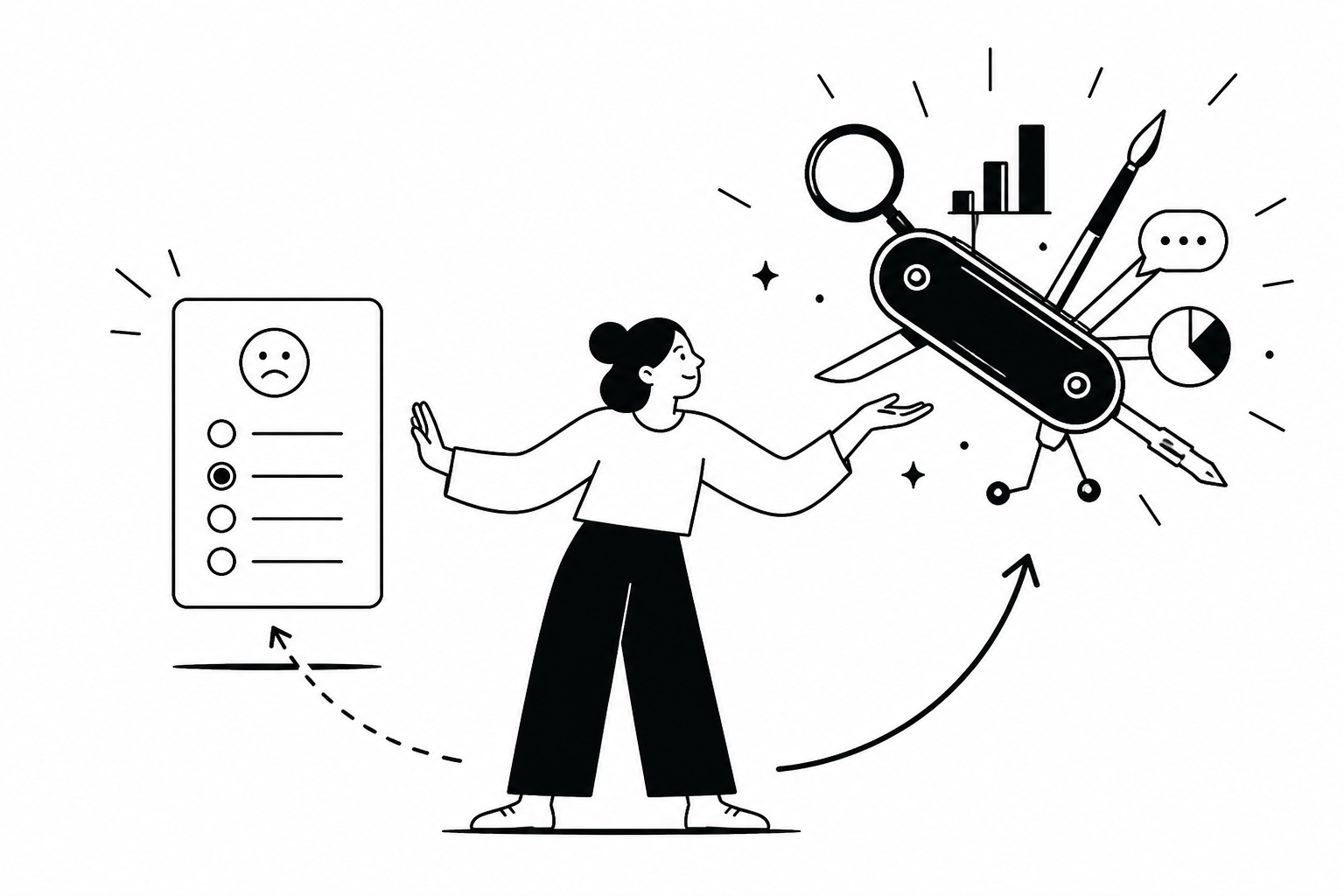
Most brands don’t outgrow a fairing post purchase survey because response rates drop. They outgrow it because the survey keeps telling them what happened, not why it happened. “Instagram ad,” “Google search,” and “friend recommendation” look useful in a dashboard, but they rarely explain why one customer converted in 4 minutes while another lurked for 19 days, bought three sizes, and returned two.
I’ve seen this pattern for years with DTC teams: they add another answer choice, tweak the attribution wording, maybe ask one more open text question, and expect depth to appear. It doesn’t. Post-purchase surveys are excellent for categorizing demand, but weak at surfacing the real decision logic behind a purchase.
Why a fairing post purchase survey fails once your growth questions get expensive
A fairing post purchase survey works well when your question is narrow: where did this customer hear about us? Which channel deserves more credit? That’s a valid use case. The trouble starts when teams ask it to solve pricing friction, trust gaps, repeat purchase behavior, or return risk.
The format is the limitation. Customers answer in seconds, usually right after checkout, when they’re optimizing for speed rather than reflection. You get compressed explanations, post-rationalized answers, and shallow signal that looks precise because it fits neatly in a chart.
One team I worked with sold premium skincare online, about 35 people total with a lean growth team and one solo researcher. Their fairing post purchase survey kept showing “TikTok” and “friend” as top acquisition drivers, so they doubled down on creator spend. In interviews, we learned customers were discovering the brand on TikTok, then spending days validating ingredients on Reddit, comparing prices in Sephora, and waiting for payday before converting. The outcome was blunt: TikTok created awareness, but trust was built elsewhere, and their media mix decision was wrong until qualitative research exposed the sequence.
This is the blind spot with most post-purchase survey programs: they flatten a messy buying journey into one answer. That’s fine for directional reporting. It’s bad for strategy.
The right alternative is not “more survey” — it’s targeted qualitative research at the moments that matter
If you want an actual Fairing alternative, don’t start by replacing one survey widget with another. Start by deciding which customer decisions are too valuable to leave at the multiple-choice level. The best alternative is targeted qualitative research tied to key behavioral moments.
For ecommerce brands, those moments usually sit in four places: right after first purchase, after a delayed conversion, after a return, or after repeat purchase. Each moment gives you access to a different layer of truth. Immediate buyers explain triggers. Delayed buyers explain hesitation. Returners explain expectation gaps. Repeat purchasers explain what actually creates loyalty.
This is where I’d use Usercall instead of stretching a survey past its limits. Usercall lets brands run AI-moderated interviews with deep researcher controls, so you can intercept customers at specific product or journey moments and ask follow-up questions that adapt in real time. That matters because the useful insight is almost always in the second or third probe, not the first answer.
I’d rather hear a customer say, “I picked you because your before-and-after photos looked less fake than the others, but I still waited because I thought your subscription would be hard to cancel,” than read 500 responses tagged “social” and “price.” One quote like that can reshape both landing page proof and retention messaging.
The best brands combine categorization from surveys with explanation from interviews
You do not need to kill your post-purchase survey. You need to stop expecting it to carry the whole insight program. Surveys classify patterns; interviews explain patterns. When teams separate those jobs, decision quality improves fast.
My default setup is simple. Keep the fairing post purchase survey for broad attribution and high-volume trend tracking. Then sample specific customer groups for short qualitative interviews: first-time purchasers above a certain AOV, customers who used a discount code after a long browse window, customers who returned within 14 days, and customers who reordered within 30 to 45 days.
I used this approach with a 12-person DTC home goods brand that had a painful margin problem. Their survey suggested customers were buying because of a seasonal promotion, so the team assumed discounting was essential. Interviews revealed something more useful: shoppers were using the promotion as a “permission slip” to try a product they already wanted, but the real conversion blocker was uncertainty about size and setup difficulty. Once the team rewrote PDP content and added clearer installation proof, conversion rose and discount dependence eased. The promotion wasn’t the driver; it was the risk reducer.
If you want a sharper survey foundation, start with better question design. Usercall’s guide to post-purchase survey questions for ecommerce brands covers the kinds of prompts that generate cleaner signal. But cleaner signal is still not the same as deep understanding.
The questions worth asking after purchase are rarely the ones brands put in a survey
Most ecommerce surveys ask source questions because they’re easy to quantify. The hard questions are about motivation, comparison, fear, expectation, and tradeoff. Those are the questions that change positioning, merchandising, and retention.
Questions that actually uncover buying logic
- What nearly stopped you from buying today?
- What were you comparing us against, even if you didn’t buy from them?
- What convinced you our product would work for your specific situation?
- What felt risky about the purchase?
- What expectation do you already have for the unboxing or first use experience?
- If the product disappoints, what do you think will be the reason?
These questions work because they surface tension, not just attribution. They expose the hidden standards customers are using to judge your brand. That’s where product-market fit gets won or lost.
Another overlooked move is interviewing non-average customers. Don’t just talk to your median buyer. Talk to the unusually fast converter, the high-AOV first-time customer, the person who bought after three abandoned carts, and the customer who returned an item but bought again later. Extreme behaviors reveal system weaknesses much faster than average ones.
If your team is still debating whether qualitative research is worth the effort, read qualitative market research: methods, tools, and when it actually beats a survey. My bias is obvious: when the business question involves trust, hesitation, or meaning, interviews beat surveys almost every time.
Returns, repeat purchase, and trust gaps are where post-purchase surveys break down fastest
The costliest ecommerce problems usually happen after the sale. That’s exactly where a fairing post purchase survey has the least leverage. It can tell you a customer came from Meta. It won’t tell you why they felt misled by fabric quality, why they hesitated to subscribe, or why they bought a gift item but would never use it themselves.
I learned this the hard way on a subscription ecommerce study for a team of roughly 50, split across growth, CX, and product. They were seeing healthy first-purchase conversion but weak second-order rates, and the survey data looked fine. In interviews, customers kept describing the same issue in different language: they understood the product benefit, but they did not understand the cadence fit. They weren’t rejecting the product. They were rejecting the commitment model. The fix was onboarding and replenishment logic, not acquisition.
This is also why return research deserves its own workflow. Returners often tell a more honest story than purchasers because the social pressure to justify the decision is gone. If that’s a live issue for your brand, read why customers return products. You’ll get better answers from a 10-minute interview with 20 returners than from a blunt “reason for return” dropdown used 2,000 times.
The practical takeaway: keep Fairing for attribution, but use interviews for decisions that move revenue
My view is simple. A fairing post purchase survey is a good instrument for classification. It is a poor instrument for explanation. Once your questions involve positioning, trust, pricing, returns, or loyalty, you need a method that can follow the customer’s thinking instead of forcing it into preset bins.
The strongest setup is a layered one. Use the survey to detect patterns at scale. Then use AI-moderated, research-grade interviews to investigate the segments and behaviors that matter most. That’s the difference between reporting on customers and actually learning from them.
If you’re building a broader insight program, voice of customer research is the right next step. The brands that win don’t ask customers more questions. They ask better questions at the moment the answer is most revealing.
If you're evaluating tools beyond Fairing, it helps to see how the broader landscape stacks up before you commit. Our competitor comparisons guide breaks down how to weigh feature-by-feature checklists against the deeper question of what a tool actually reveals about your customers. Usercall is built for teams who need real conversations, not just survey data — worth a look if attribution surveys are hitting a ceiling.
Related: Usercall vs Fairing breakdown · best post-purchase survey apps for Shopify