
Stop Picking the Wrong Study: Research Design Categories That Actually Drive Product Decisions
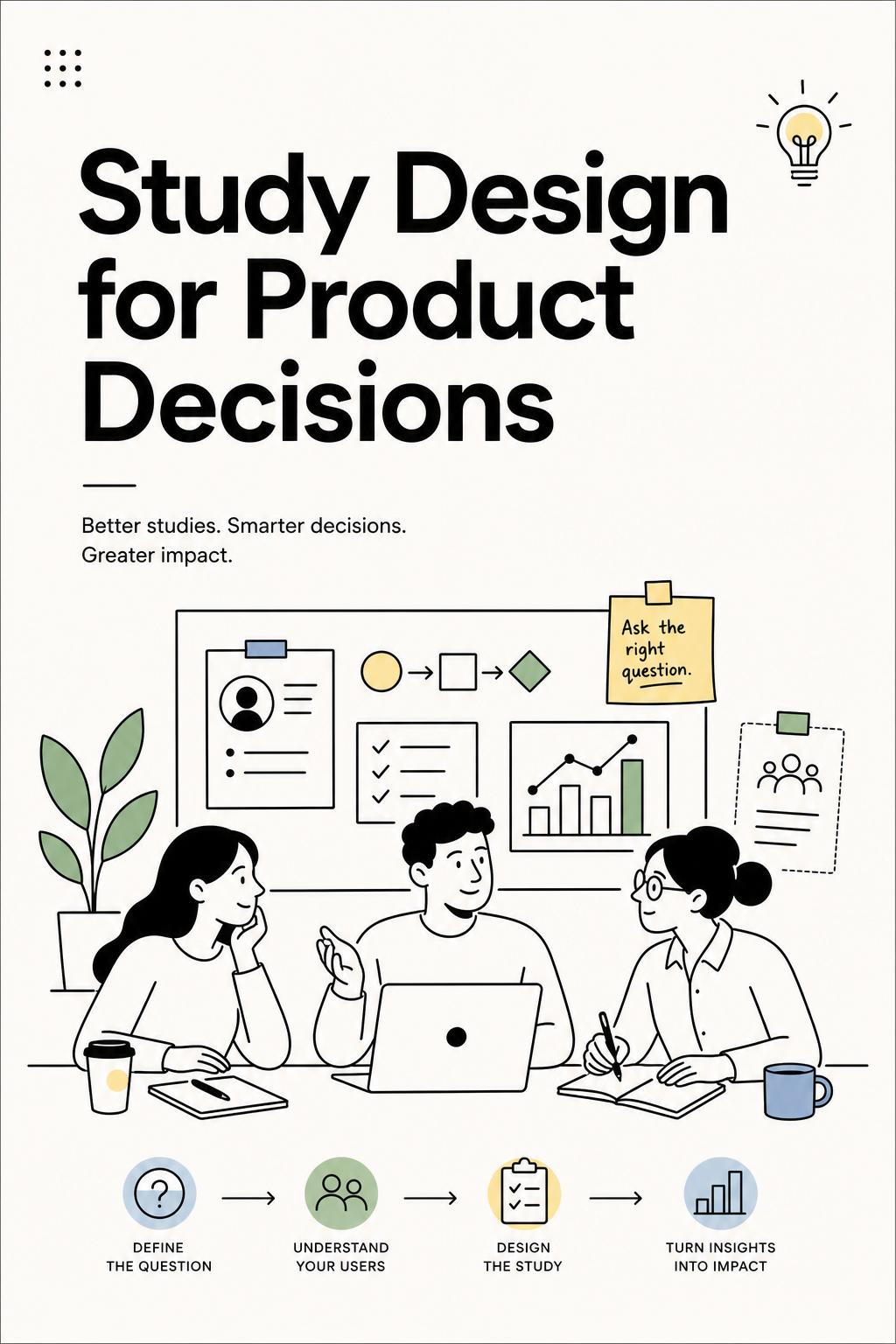
I’ve sat in too many meetings where a team confidently presents research results that sound polished—but can’t actually answer the decision on the table. The worst part? The research itself wasn’t poorly executed. It was just the wrong design. They ran a descriptive survey when they needed causal evidence. They ran interviews when they needed scale. They picked a method before defining the uncertainty.
This is the real problem with how people think about research design categories. They treat them like academic labels instead of decision tools. And that’s exactly why so much research ends up interesting—but strategically useless.
If you care about making better product, UX, or market decisions, you don’t need more methods. You need sharper judgment about when each research design actually works—and when it quietly fails.
Why most teams misuse research design categories
Search for “research design categories,” and you’ll get clean lists: exploratory, descriptive, correlational, experimental. Helpful, but dangerously incomplete.
In practice, these categories are not interchangeable options. They represent fundamentally different types of evidence. And when teams blur them, they start making claims their research can’t support.
Here’s the pattern I see constantly:
- Exploratory interviews used to justify product decisions (they shouldn’t)
- Descriptive surveys interpreted as causal proof (they can’t provide it)
- Correlational data turned into strategy without validation (risky at best)
- A/B tests expected to explain behavior (they rarely do)
The issue isn’t execution—it’s misalignment. Teams are asking one type of research to do another type’s job.
The fix is simple but non-obvious: stop choosing methods first. Start by defining what kind of uncertainty you need to reduce.
The only framework you need to understand research design categories
Forget memorizing definitions. Use this instead. Every research study is trying to do one of four things:
- Discover what you don’t yet understand
- Describe what is happening and at what scale
- Relate variables to see if they move together
- Prove that one thing causes another
These map directly to the core research design categories:
- Exploratory = Discover
- Descriptive = Describe
- Correlational = Relate
- Experimental = Prove
Most research failures happen when teams blur these boundaries. They try to “prove” something using exploratory insights, or “explain why” using an experiment designed only to measure impact.
Strong researchers don’t just know these categories—they enforce the limits of each.
Exploratory research: high insight, low certainty—and that’s the point
Exploratory design is what you use when the problem itself is unclear. You’re not testing hypotheses—you’re generating them.
Typical methods include interviews, diary studies, open-ended surveys, and increasingly, AI-moderated conversations triggered at key user moments.
Here’s where teams go wrong: they treat exploratory findings as directional truth instead of early signals.
I worked with a growth team trying to diagnose a 22% drop in activation. We ran 12 user interviews and quickly heard “confusing onboarding” come up repeatedly. The team was ready to redesign immediately.
But we pushed further. By interview 10, a different pattern emerged: users understood onboarding—they just didn’t trust the product enough to commit data. The real issue wasn’t usability. It was perceived risk.
If we had stopped early—as most teams do—we would have confidently solved the wrong problem.
The takeaway: exploratory research is for expanding possibility space, not narrowing decisions.
Descriptive research: the most underestimated category
Descriptive research answers a deceptively simple question: what’s actually happening?
This includes surveys, segmentation, behavioral analytics summaries, and benchmarking studies. It’s often dismissed as “basic,” but in reality, it’s where most strategic clarity comes from.
The failure mode here isn’t sample size—it’s category design.
Teams define segments, behaviors, or response options based on internal assumptions instead of real user variation. The result? Clean charts that reflect internal thinking, not customer reality.
I once audited a segmentation study where users were grouped by company size. It looked rigorous—but it completely missed that adoption behavior was driven by team workflow maturity, not company size. The segmentation was precise—and useless.
Here’s a better workflow:
- Start with exploratory research to uncover real behavioral or attitudinal differences
- Translate those into structured categories grounded in user language
- Quantify only after validating that categories reflect real-world variation
- Test whether categories predict meaningful outcomes (conversion, retention, expansion)
Descriptive research isn’t about measuring everything. It’s about measuring the right distinctions.
Correlational research: where smart teams accidentally mislead themselves
Correlational design looks for relationships between variables. It’s useful, fast, and dangerously easy to misuse.
The classic mistake: treating correlation as causation.
In one SaaS study, users who engaged with a collaboration feature had 2.4x higher retention. Leadership immediately prioritized driving feature adoption.
But deeper research showed the feature wasn’t causing retention—it was being adopted by already high-performing teams. It was a signal, not a driver.
This distinction matters. Acting on correlation without validation leads to wasted roadmap bets.
Use correlational research to identify where to investigate—not what to change.
Experimental research: powerful, but incomplete on its own
Experimental design—A/B tests, randomized trials—is the gold standard for causal evidence.
If you need to know whether a change works, this is your category.
But here’s what teams consistently get wrong: experiments tell you what happened, not why.
An A/B test might show a 12% lift in conversion. But it won’t tell you whether users felt more trust, less friction, or simply noticed the change more.
That gap matters because without understanding mechanism, results don’t generalize well.
The strongest approach is sequencing:
- Use exploratory research to identify potential drivers
- Use descriptive research to validate patterns at scale
- Use experiments to confirm causal impact
This layered approach turns isolated findings into durable insight.
Qual vs quantitative isn’t the real decision
One of the most persistent misconceptions is treating qualitative and quantitative research as competing categories.
They’re not. They’re evidence types that can be used across all research designs.
The real power comes from combining them.
This is where modern tooling changes what’s possible. Platforms like UserCall enable continuous, research-grade qualitative insight by running AI-moderated interviews with deep researcher controls and analyzing responses at scale. More importantly, they allow teams to trigger in-product intercepts at key behavioral moments—so you’re not guessing why a metric moved, you’re asking users in context.
This collapses the traditional gap between analytics and understanding. Instead of choosing between qual and quant, you connect them.
How to actually choose the right research design
If you want a practical decision model, use this:
- If the problem is unclear → use exploratory
- If you need to measure patterns → use descriptive
- If you’re identifying relationships → use correlational
- If you need causal proof → use experimental
- If the decision is high-stakes → combine methods sequentially
But here’s the nuance most guides miss: the higher the cost of being wrong, the stricter you need to be about matching design to claim.
Exploratory insights should not justify roadmap decisions. Correlation should not drive strategy. And a single experiment should not define your entire understanding of users.
The real tradeoff: speed vs certainty vs depth
Every research design category forces a tradeoff:
- Exploratory → deep insight, low certainty
- Descriptive → broad clarity, limited explanation
- Correlational → directional signal, no causality
- Experimental → causal confidence, shallow understanding
There is no perfect design—only appropriate ones.
I once had 8 days to inform a pricing strategy decision tied to a quarterly revenue target. A full experimental setup wasn’t feasible. Instead, we combined rapid interviews with a structured pricing sensitivity survey. It wasn’t perfect—but it was aligned to the time constraint and decision risk.
The worst move would have been pretending we could get causal certainty in that timeframe.
What expert researchers do differently
Expert researchers don’t just choose methods. They control the claims those methods are allowed to support.
They know that:
- Exploratory research reveals possibilities—not answers
- Descriptive research clarifies reality—but only within its categories
- Correlational research suggests direction—but not action
- Experimental research proves impact—but not meaning
That discipline is what turns research from a reporting function into a decision engine.
So if you’re searching for “research design categories,” don’t stop at definitions. The real skill is knowing when each category breaks—and designing around those limits.
Because the difference between good research and wasted effort isn’t rigor. It’s alignment.
Once you've picked the right research design category, the next step is asking the right questions inside it. Our guide on how to write qualitative research questions breaks down 45+ examples you can adapt for exploratory, descriptive, or causal studies. If you're ready to run the study itself, Usercall lets you conduct AI-moderated interviews that map directly to whichever design you choose.
Related: how to choose the right research design for qualitative research · a step-by-step research design example · evaluation vs research