
Client Experience Interview Questions That Uncover Hidden Churn (Not Just Polite Feedback)
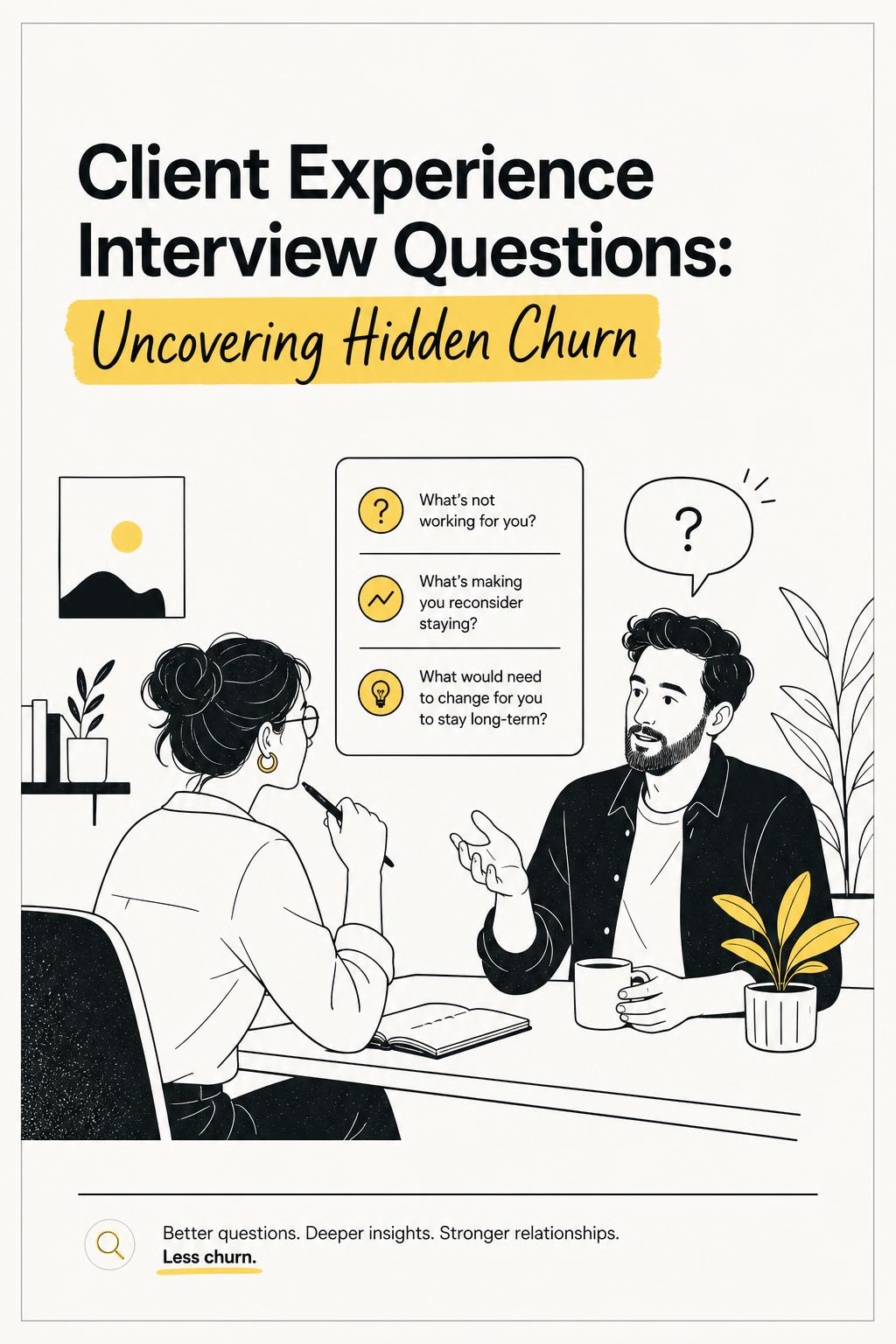
Here’s the uncomfortable truth: most client experience interviews are designed to fail. Not because teams don’t care—but because they ask questions clients can safely answer without telling you anything useful. “How’s your experience been?” gets you politeness. “What could we improve?” gets you low-stakes suggestions. Meanwhile, the real issues—the ones that quietly kill renewals—never get said out loud.
I’ve sat through dozens of these interviews where everything sounds fine. Then six months later, the same client churns or downsizes. When we go back and re-interview with better questions, a completely different story emerges: unclear ownership during onboarding, internal stakeholders losing confidence, hidden workarounds, or value that never became visible enough to defend.
If you’re searching for client experience interview questions, you don’t need more questions. You need better ones—designed to surface reality, not opinions.
Why most client experience interview questions fail
The default approach to client interviews is built around evaluation. That’s the root problem.
- They invite politeness instead of honesty. Clients protect relationships, especially in B2B contexts where switching costs are high.
- They collapse time into a single answer. Experience isn’t static—it shifts across onboarding, delivery, support, and renewal moments.
- They prioritize opinions over evidence. Clients generalize when asked broadly, but recall specifics when asked about real events.
In one SaaS study, a team had solid NPS and CSAT scores but declining expansion revenue. Their interviews used standard satisfaction questions—and surfaced nothing alarming. When we re-ran interviews using moment-based questioning, a pattern appeared: clients consistently lost momentum after initial onboarding due to unclear next steps. No one had flagged it because it didn’t feel like a “big issue.” It was just enough friction to stall growth.
This is why most client experience research underdelivers. It captures sentiment, not mechanisms.
The shift: interview moments, not impressions
If you want interviews that drive decisions, you need to stop asking clients what they think and start asking what actually happened.
The most reliable way to do this is to structure interviews around four layers:
- Expectation: what they thought would happen
- Interaction: what actually happened
- Interpretation: what they concluded about your value
- Memory: what they remember strongly enough to act on
This forces specificity. And specificity is what reveals churn risk, trust gaps, and expansion opportunities.
Client experience interview questions that actually reveal truth
These are not generic prompts—they’re designed to expose the mechanics behind client behavior.
1. Expectation-setting questions (where most problems begin)
- When you decided to work with us, what were you expecting us to do especially well?
- What were you worried might go wrong?
- Who internally had the highest expectations—and what were they expecting to see?
- What would early success have looked like in the first 30–60 days?
Expectation gaps are the earliest indicator of churn—but they’re almost never measured directly.
2. Experience reconstruction questions (where reality shows up)
- Walk me through your onboarding or kickoff experience—what stood out?
- Tell me about a recent interaction that worked really well.
- Tell me about a moment that felt unclear, slow, or frustrating.
- Where does working with us feel easiest? Where does it create extra effort?
These questions anchor the conversation in events—not vague summaries.
3. Trust and value questions (what actually drives retention)
- What has made you trust us most so far?
- What has made you question that trust, even slightly?
- When you justify our value internally, what do you point to?
- What feels most worth paying for—and what feels less clear?
In one project, clients consistently renewed not because of “strategy” (the marketed value), but because the team reduced internal risk and saved time. That insight changed positioning, pricing, and onboarding priorities.
4. Hidden friction questions (the things clients don’t volunteer)
- What have you had to adapt to or work around?
- Have you ever had to follow up more than expected or repeat context?
- What’s something you haven’t mentioned before because it felt minor?
- If you warned another client about working with us, what would you say?
These questions unlock what clients normalize—but shouldn’t have to.
5. Churn and expansion signals (before they show up in metrics)
- Has there been any point where continuing felt uncertain?
- What would need to improve to make renewal an easy decision?
- Who internally is least convinced of our value?
- If this relationship ended, what would be the likely reason?
By the time churn shows up in dashboards, it’s already too late. These questions surface it early.
How to run interviews that produce real insight
Even great questions fail if the interview structure is wrong. Here’s the workflow I use across client research programs.
1. Start with their world, not your performance
Ask about their goals, pressures, and internal dynamics first. This builds context and reduces guarded responses.
2. Focus on recent, specific moments
Memory is unreliable in general but sharp for recent events. Always anchor in “last time” scenarios.
3. Probe for consequences
Don’t stop at the issue—ask what it caused. Delays? Extra meetings? Loss of confidence? This is where business impact becomes clear.
4. Identify compensating behavior
Clients rarely complain directly—but they adapt. Workarounds, manual tracking, reduced usage—these are signals of broken experiences.
I once interviewed a mid-market client who said everything was “working fine.” But when I asked her to walk through her weekly workflow, she showed a shadow system her team built to track deliverables. It existed because they didn’t trust visibility in the product. That one insight reframed the entire retention strategy.
Where most teams still get it wrong
Even with better questions, many teams fall into these traps:
- Only interviewing decision-makers. Daily users often experience more friction—and earlier.
- Treating interviews as a one-off exercise. Client experience changes constantly.
- Not connecting insights to product or operational data. Interviews should explain metrics, not exist separately.
This is where tooling matters. If you're serious about scaling client interviews, platforms like UserCall stand out because they enable AI-moderated interviews with strong researcher control—so you can go deep without losing rigor. More importantly, they let you trigger interviews at key moments (like feature drop-off or onboarding friction), so you’re not guessing why metrics change—you’re asking clients directly in context.
A simple framework to turn interviews into decisions
Raw insights don’t drive change—structured insights do. After interviews, organize findings like this:
Where in the journey did this happen?
What caused the outcome?
What did it affect (trust, retention, effort)?
This turns vague feedback into actionable problems. Instead of “clients want better communication,” you get: “During onboarding handoffs, ownership becomes unclear, increasing client effort and reducing confidence before first value.” That’s fixable.
The real goal of client experience interviews
The goal isn’t to collect feedback. It’s to understand how your client experience actually works under pressure—when expectations are tested, when things go wrong, and when value needs to be proven internally.
If you rely on surface-level questions, you’ll get surface-level answers. If you focus on real moments, tradeoffs, and consequences, clients will show you exactly where trust is built—or lost.
And that’s the difference between a client who says they’re happy—and one who actually stays.
Asking the right questions is only step one — you also need a repeatable process for turning those answers into retention wins. Our guide on customer exit interviews breaks down that exact playbook, and Usercall can help you run these interviews consistently without adding to your team's workload.
Related: churn interview questions to understand why customers leave · 10 churn interview questions that reveal why users leave · how to find out why users leave through churn analysis