
Customer Experience Services: Stop Paying for Surveys That Don’t Fix Churn
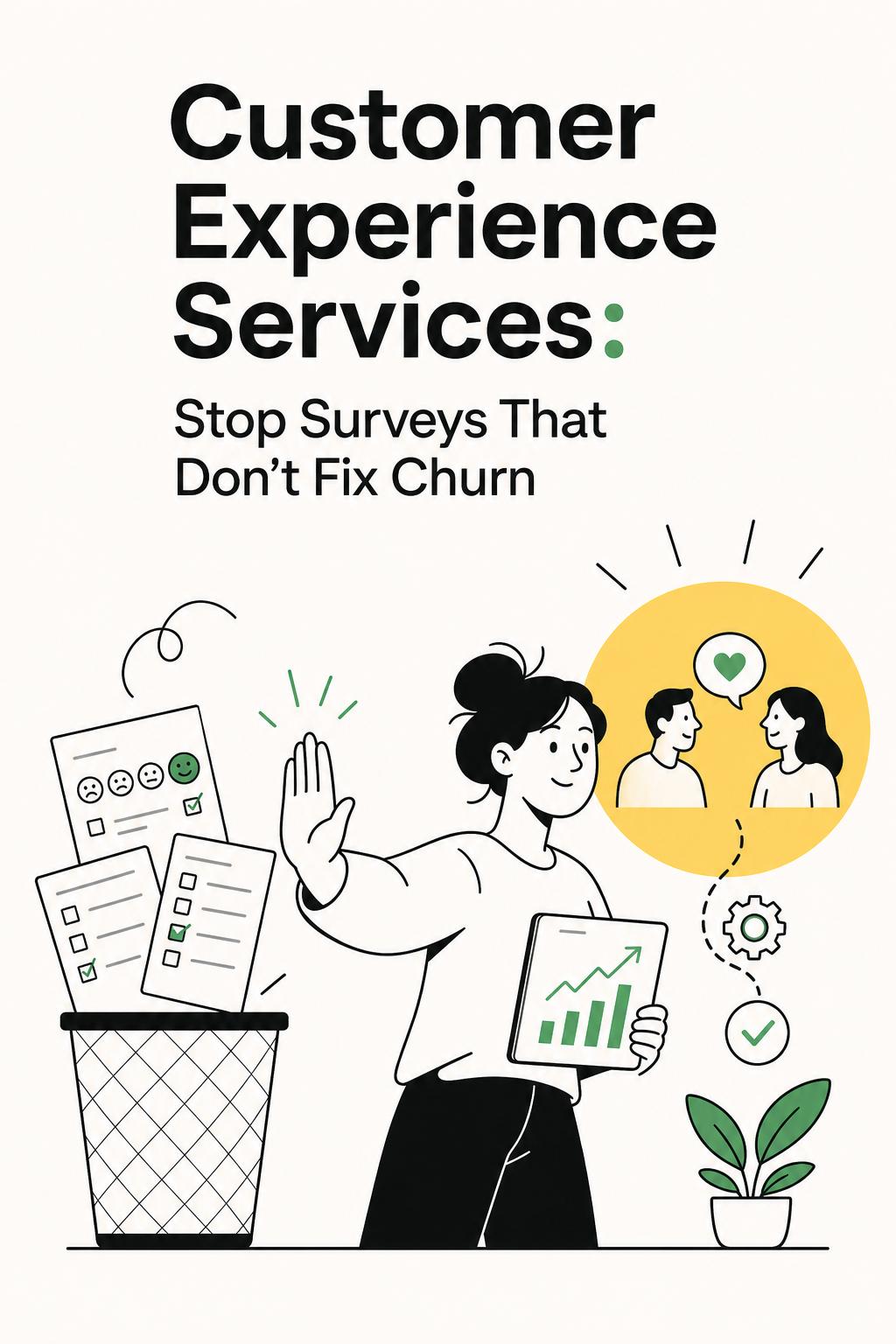
Companies rarely buy customer experience services because they are curious. They buy them after something has already gone wrong: churn has climbed, onboarding has stalled, support tickets are multiplying, or a once-reliable conversion rate has slipped. Then comes the familiar response: launch an NPS survey, commission a journey map, schedule a workshop, and wait for a slide deck that says customers want “simplicity,” “better communication,” and “more value.”
That is not customer insight. It is expensive confirmation of what everyone already suspected.
The hard truth is that most customer experience programs fail because they document dissatisfaction without identifying the operational mechanism behind it. A declining score tells you that customers are less happy. It does not tell you whether they failed to reach value, lost trust after a billing surprise, could not get internal buy-in, or found a workaround that made your product irrelevant. The customer experience services worth paying for do not just measure the experience. They expose the specific failure your organization keeps rationalizing away.
Why Traditional Customer Experience Services Often Fail
The traditional CX playbook is built around artifacts: surveys, personas, journey maps, dashboards, and executive readouts. Those artifacts can be useful, but they are frequently mistaken for outcomes. A beautifully designed journey map does not improve retention. A dashboard does not resolve a confusing implementation process. An NPS trend does not explain why customers who initially loved your product quietly stop using it.
The problem is structural. Most conventional customer experience services begin with broad attitudes instead of concrete behavior. Teams ask, “How satisfied are you?” or “What could we improve?” Customers answer based on the most memorable part of their recent experience. That may be a slow support response, a disliked interface detail, or a feature they heard about but never used. Meanwhile, the actual reason they failed to activate, expand, or renew may go unmentioned.
Customers are excellent witnesses to their goals, constraints, frustrations, and workarounds. They are not reliable root-cause analysts. They cannot always tell you which part of your product, service design, pricing, or communication created the problem. Asking them to do so is one of the most common mistakes in CX research.
I saw this firsthand while researching churn for a B2B workflow platform. The leadership team believed its 14-day trial was too complicated. Survey comments appeared to support that conclusion: trial users repeatedly complained about setup. But when I interviewed 18 recently churned accounts, the issue was more specific and more commercially serious. Administrators could complete setup, but they could not show their executive sponsor a meaningful result quickly enough to justify rolling the tool out to the wider team. “Setup is hard” was shorthand for “I cannot prove this purchase was worth the political effort.” A simpler setup wizard alone would not have fixed the retention problem.
Weak customer experience services report the shorthand. Strong ones uncover the consequence beneath it.
The Core Principle: Study the Moment Where Confidence Breaks
Companies often try to map every interaction across the entire customer journey. This sounds comprehensive, but it usually produces a generic diagram with too many touchpoints and too little accountability. Not every moment matters equally. Customer experience is shaped disproportionately by a small number of high-stakes interactions where customers decide whether your company is competent, trustworthy, and worth the effort.
I call these confidence-breaking moments.
For a consumer business, a confidence-breaking moment may be the first failed delivery, a cancellation attempt, an unexpected renewal charge, or a return that feels harder than the purchase. For SaaS and B2B businesses, it is often the first data import, a permissions decision, a security review, a support issue during a deadline, or the moment a champion needs to prove value to a senior stakeholder.
These moments matter because they change behavior. A customer who is mildly annoyed may continue. A customer who loses confidence starts creating a backup plan: contacting support repeatedly, reducing usage, avoiding rollout, postponing payment, or exploring competitors.
Prioritize these moments using a simple model: priority = customer consequence × business exposure × likelihood of recurrence.
A problem affecting 5% of users may deserve more attention than one affecting 40% if those 5% are enterprise administrators, high-value subscribers, or customers approaching renewal. Volume is not the same as importance. Customer experience services that prioritize only by ticket count or survey frequency will repeatedly miss the issues that quietly damage revenue.
What Effective Customer Experience Services Should Actually Deliver
Before hiring a CX agency, consultant, or research partner, define the standard. Then compare a short list of customer experience consulting firms. You are not buying a survey program. You are buying greater confidence in a business or product decision.
At minimum, customer experience services should produce evidence that answers four questions.
- Who is affected? Identify the exact customer segment, role, account type, maturity level, and use case. “Customers” is not a segment. A first-time administrator, an experienced daily user, and an executive buyer can have entirely different experiences of the same product.
- What happened? Reconstruct the actual sequence: what the customer expected, what they encountered, what they tried next, where they hesitated, and what workaround or abandonment behavior followed.
- Why did it matter? Connect the friction to an outcome customers and leaders care about: delayed activation, increased support demand, lower repeat use, poor conversion, weakened trust, or renewal risk.
- What should change first? Recommend a specific intervention, explain why it addresses the mechanism, assign an owner, and state the behavioral signal that would show improvement.
If a provider cannot move from “customers want more guidance” to “mid-market administrators abandon role configuration after the third permission decision because they cannot predict downstream access consequences,” the work is not yet actionable. Insight must be specific enough to change what a team builds, says, or does.
Why Surveys and Journey Maps Need Behavioral Evidence
Surveys are valuable for sizing a known issue. They are weak at discovering why the issue exists. Journey maps are useful for aligning teams. They are weak when built entirely from internal assumptions. Neither should be discarded, but neither should be allowed to lead the diagnosis.
The better sequence is behavior first, explanation second.
- Locate a meaningful behavioral break. Start with a measurable signal: a sudden onboarding drop-off, repeated visits to help content, a spike in contacts after a policy change, declining use of a core feature, or lower renewal rates in a specific segment.
- Define the context before recruiting. Separate customers by role, tenure, account value, product configuration, and outcome. Interviewing a mixed group without segmentation is how teams end up with contradictory findings and vague recommendations.
- Speak to customers close to the event. Ask about the experience while the decisions, uncertainty, and workarounds are still fresh. Retrospective interviews conducted months later are often polished narratives, not reliable reconstructions.
- Trace the path from expectation to behavior. Explore what the customer was trying to accomplish, what they believed would happen, what created doubt, and what they did when the expected path failed.
- Triangulate across evidence sources. Compare interviews with product analytics, support transcripts, sales calls, renewal notes, and account outcomes. A finding becomes much stronger when multiple sources point to the same mechanism.
- Test an intervention, not a slogan. Replace “improve onboarding” with a clear hypothesis, such as showing an executive-ready first-value report within the first session for new team administrators.
This approach avoids an expensive trap: treating customer feedback as a voting system. Customers may request more features, more tutorials, or more options. But if the underlying problem is uncertainty, adding options can make the experience worse. The goal is not to give customers every requested solution. It is to remove the obstacle preventing them from reaching the outcome they hired you for.
A Real-World Example: The Small Friction That Was Not Small
In another qualitative study, I worked with a collaboration software company that wanted to improve feature adoption. Product analytics showed that only 8% of users visited its notification settings. The initial assumption was that the settings page was low priority because the usage volume was low.
That conclusion was wrong.
We interviewed team leads who had attempted configuration after rollout. They were not ordinary users. They were the people accountable for adoption across teams of 25 to 200 employees. When they failed to configure notifications correctly, colleagues missed activity, habits never formed, and the product became easier to ignore. The settings page was used by few people because only a small group needed it, but that group controlled whether the product became embedded in daily work.
The solution was not a full settings redesign. It was a guided default configuration that explained consequences in plain language and reduced decisions from 11 to four. Within the next quarter, implementation-related escalation volume fell and the customer success team reported fewer adoption risks among new accounts.
This is why effective customer experience services must distinguish between high-frequency friction and high-leverage friction. The most important problem is often not where the most clicks occur. It is where a small number of influential customers lose confidence.
How AI Improves Customer Experience Research Without Replacing Research Judgment
AI has changed the economics of qualitative CX research. Teams can now analyze larger volumes of customer conversations, identify recurring patterns across support interactions, and collect feedback nearer to the moment an experience occurs. But faster analysis does not automatically produce better insight.
An AI summary that concludes “customers find onboarding confusing” is only useful if researchers can inspect the underlying evidence, identify which customers mean it, understand what “confusing” refers to, and connect that confusion to behavior. Without that discipline, AI simply helps teams generate vague conclusions more quickly.
For researchers, UX teams, and product leaders, the value is not merely more data. It is the ability to investigate a behavioral signal at scale while preserving the ability to probe, segment, challenge assumptions, and trace themes back to real customer evidence.
How to Choose Customer Experience Services That Lead to Action
Ask a prospective CX partner one question early: What decision will this research help us make differently within 90 days? If the answer is “understand our customers better,” the scope is too vague. Better understanding is not a business outcome.
- Which customer behavior or commercial outcome is the engagement designed to improve?
- How will the work distinguish between customer roles, segments, and situations instead of averaging them together?
- How will feedback be connected to product, service, support, and revenue evidence?
- Will teams receive the raw customer evidence behind each recommendation?
- Who will own each action after the research concludes?
- What metric or observed behavior will confirm that the intervention worked?
Be skeptical of providers promising a universal journey map, a single loyalty score, or a set of generic quick wins before they understand your product and customers. The most valuable CX findings are often inconvenient because they expose a handoff between teams, a policy nobody owns, or a promise made in marketing that the product cannot yet keep.
Customer Experience Is a Retention System, Not a Reporting Function
The best customer experience services do not make your reporting more sophisticated. They make preventable customer failures visible early enough to fix them. They reveal where customers lose confidence, why a metric changed, which segment is actually at risk, and what intervention has the highest chance of changing behavior.
That is the standard to demand. Do not pay for another deck confirming that customers want a better experience. Pay for the evidence that tells your team exactly where the experience breaks, who pays the price, and what must change before that friction becomes churn.
For the strategic thinking behind picking the right CX approach, read our customer experience CX strategy guide. If you're evaluating vendors or tools right now, Usercall is built specifically to replace static surveys with root-cause insight you can act on.
Related: why dashboard-style measurement fails to explain churn · a CX framework built around retention, not reporting · personalizing experiences beyond marketing tactics