
Focus Groups and Qualitative Research: Why Nods Don’t Equal Demand
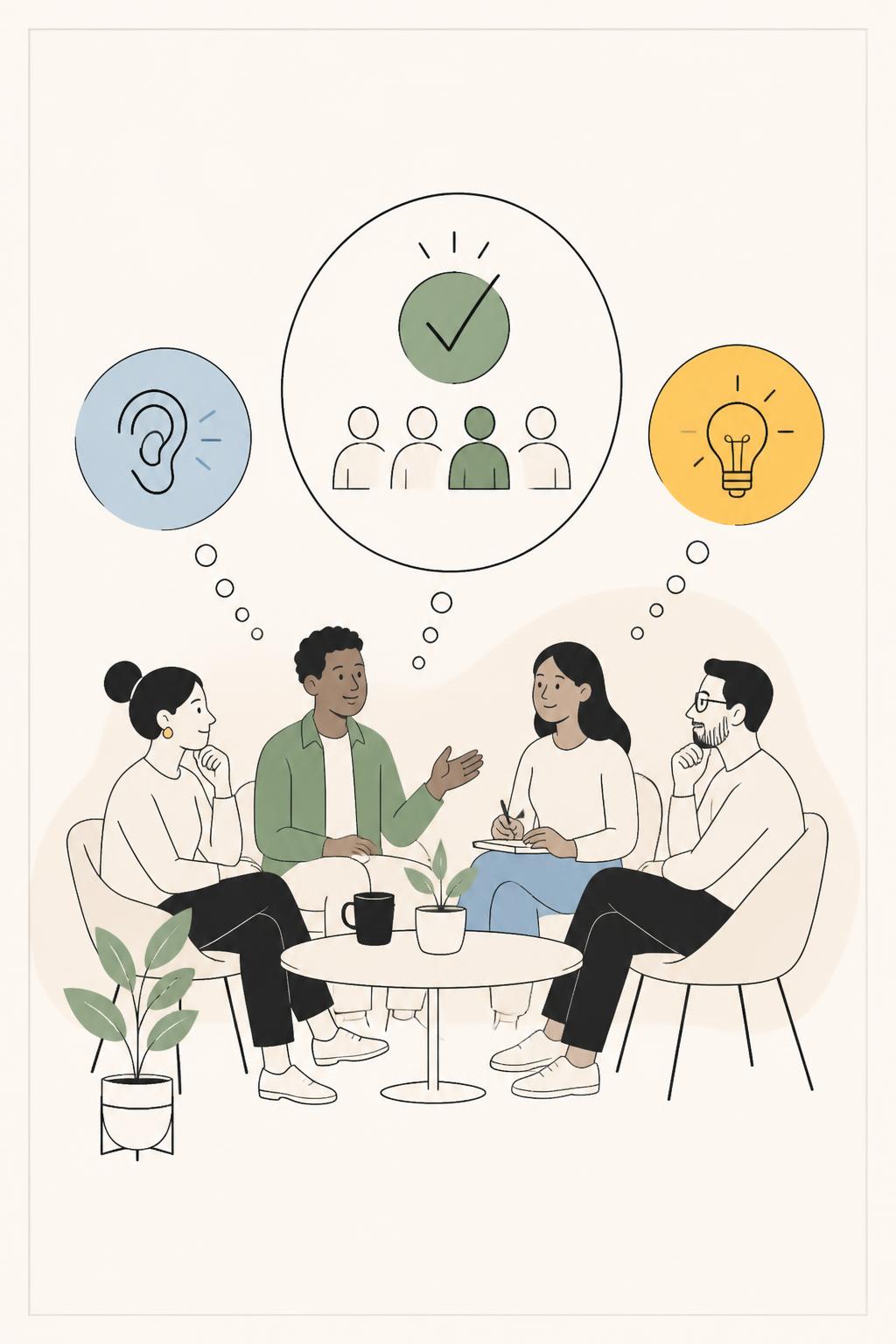
A product team once told me their focus group had delivered an unusually clear verdict: eight target customers wanted the new feature. The recording was full of nods. The concept test scored well. Stakeholders left convinced they had found product-market fit.
Six months later, the feature had a 7% activation rate.
The research had not been “wrong” because participants lied. It failed because the team asked people to predict future behavior in a room built for social agreement. Nobody had to migrate data, persuade a manager, learn a new workflow, or give up the spreadsheet they trusted. Saying “I would use that” cost them nothing.
This is the central problem with focus groups and qualitative research: teams routinely collect opinions when they need evidence of behavior. Focus groups can be extremely valuable, but only when researchers stop treating them as a fast, cheaper survey. Their real value is exposing shared language, social influence, category assumptions, and the tradeoffs customers make when no one from your company is watching.
Why conventional focus groups produce polite fiction
The common focus group formula is almost engineered to create misleading certainty. Recruit six to eight people, introduce a product concept, ask what they like, ask whether they would use it, and tally positive reactions. The results are easy to summarize and dangerously easy to believe.
Three forces distort the evidence.
- Social proof distorts individual judgment. The first articulate participant often defines the acceptable answer. Others adjust, soften disagreement, or borrow the language of the group.
- Concepts conceal implementation costs. Participants react to a promise, not to the work required to change a habit, connect systems, obtain approval, or train colleagues.
- Memory smooths out real behavior. People remember their intentions and outcomes better than the messy sequence of interruptions, workarounds, and compromises in between.
These weaknesses are not reasons to abandon focus groups. They are reasons to stop asking them to answer the wrong questions. A group can tell you whether a message triggers skepticism, whether users share a vocabulary for a problem, or whether an idea conflicts with a social norm. It cannot reliably tell you how many people will adopt a feature.
In a B2B study I moderated for an operations platform, nearly every manager called automated reporting “essential.” Instead of accepting that answer, I asked them to reconstruct the last report they had delivered. Five had never created one themselves; analysts assembled the reports. Two only reviewed reports at quarter-end. The apparent feature opportunity was actually a trust problem: managers did not believe different teams were using the same metric definitions. Building faster reports would have treated the symptom, not the decision barrier.
When a group agrees immediately, I assume we have found a norm—not an insight—until behavioral evidence proves otherwise.
Start with the decision, not the method
Focus groups are often chosen because stakeholders want to observe customers live, multiple participants fit into a 90-minute session, and the format feels familiar. Those are logistical benefits. They are not research justification.
Before recruiting, write one sentence: “At the end of this research, we need to decide whether to _____.” Then ask what evidence would make that decision safer. If the answer involves a private workflow, an emotionally loaded experience, a complex purchase journey, or a sequence of actions, a group is rarely the primary method you need.
- Use focus groups to explore shared attitudes, category language, messaging, social norms, or ideas that require consensus among users.
- Use one-to-one qualitative interviews to reconstruct a decision journey, explore sensitive topics, and understand role-specific workflows.
- Use contextual observation when tools, interruptions, physical surroundings, or colleagues shape behavior in ways participants will not remember to report.
- Use diary research when the experience unfolds over time, such as financial decisions, health management, enterprise adoption, or repeat purchasing.
- Use in-product intercepts after a meaningful event—abandoned onboarding, a failed checkout, a downgrade, or an unused feature—to learn why a metric moved while the customer still remembers the context.
The strongest research programs combine these methods. Focus groups generate hypotheses about collective meaning. Interviews and behavioral data test whether those hypotheses survive contact with actual decisions.
The behavioral reconstruction framework: replace opinions with evidence
“What do you think of this?” is the question that has damaged more qualitative research than any other. It invites participants to become amateur product strategists. They will give you reasonable-sounding answers, but their answers usually describe an idealized version of themselves.
Instead, make people replay a specific past event. I use a five-step behavioral reconstruction framework in both focus groups and individual sessions.
- Trigger: What happened that made this task or decision necessary at that moment?
- Context: Where were they, what was competing for attention, what tools were open, and who else was involved?
- Action: What did they do first, what did they try next, and where did they change course?
- Tradeoff: What did they sacrifice to move forward: time, certainty, money, control, privacy, or political capital?
- Outcome: What happened afterward, and what would have changed their next action?
This framework converts vague feedback into usable product evidence. “Setup is confusing” is a complaint. “I reached the integration screen, realized I needed an admin token, postponed it until Friday, forgot, and invited my teammate without connecting data” identifies a sequence, an ownership problem, and an intervention point.
During a consumer finance project, I had 90 minutes with a group of first-time investors. The early discussion produced the expected answers: transparency, security, lower fees. Then I asked each person to describe the last transfer they delayed. One participant had left money in a low-interest account for four months because she could not distinguish among three similarly named funds. Another waited until his partner was home because he was afraid of making a visibly “stupid” choice alone. The real barrier was not generic trust. It was decision anxiety at a specific moment of choice.
That distinction matters. “Build trust” is not a product requirement. “Reduce irreversible-feeling choices with plain-language comparisons and a reversible first step” is.
Make disagreement a research output, not a moderation failure
Weak moderators pursue harmony. Strong moderators create conditions where disagreement is safe, specific, and useful. A room that reaches consensus too easily may simply be responding to the most confident participant.
Start important topics with silent individual work. Ask participants to write down the last time they encountered the problem, rank options privately, or note the first thing they distrust about a concept. Give them two minutes before opening discussion. This simple move prevents the loudest participant from becoming the group’s unofficial spokesperson.
Then use contrast questions. Do not ask, “What do you like about this dashboard?” Ask, “Who would use this every week, who would ignore it, and what would be different about their jobs?” Do not ask, “Would this save time?” Ask, “What would this replace, and what would still make you keep your current process?”
Most importantly, test the problem before the proposed solution. If participants do not recognize the problem in a concrete past experience, positive prototype feedback is low-value flattery. If they recognize the problem but reject your solution, investigate the constraint you missed: approval, data confidence, timing, ownership, perceived risk, or a deeply entrenched workaround.
Analyze qualitative research for mechanisms, not quotes
After focus groups, teams often build reports around memorable quotes and broad themes such as “users value simplicity.” That is presentation material, not analysis. Customers do not value simplicity in the abstract; they value it when complexity threatens a particular outcome they care about.
The useful unit of analysis is a decision pattern: a recurring connection between a trigger, a context, a behavior, a tradeoff, and an outcome. A finding should explain not merely what people said, but what repeatedly caused them to act.
For every finding, document five elements:
- Pattern: What behavior or tension appeared repeatedly?
- Segment: Which role, lifecycle stage, company type, or usage context experienced it?
- Mechanism: What caused that behavior?
- Consequence: Which business metric, customer risk, or strategic opportunity does it affect?
- Decision: What should the team build, test, change, or deliberately avoid?
AI can reduce the painful work of comparing transcripts, but it should not turn research into untraceable sentiment summaries. Usercall is designed for research-grade AI-native qualitative analysis and AI-moderated interviews with deep researcher controls. It helps researchers identify patterns across conversations, compare evidence by segment, return to the underlying responses, and interrogate conclusions rather than accepting a generic theme list. It also supports user intercepts at key product analytics moments, connecting behavioral signals with the customer’s explanation of why that behavior happened.
The standard should be simple: if a finding cannot be traced to evidence and connected to a decision, it is not ready for a roadmap.
Turn focus group findings into action before the insight expires
Focus groups lose value when the final deliverable is a long report that stakeholders read once. The better approach is a two-week research-to-decision cycle.
Within 24 hours, write a provisional readout with three categories: what appears consistent, what genuinely surprised you, and what needs validation. Within three days, organize patterns by audience segment and journey stage. In the first week, convene product, design, marketing, and analytics around a single question: What will we do differently next week because of this evidence?
Classify every outcome as a near-term experience change, a quantitative validation question, or a strategic assumption to monitor. This prevents qualitative research from becoming a museum of interesting observations.
Good focus groups and qualitative research do not validate whatever a team hoped to build. They expose the inconvenient gap between what customers say in public and what they do under real constraints. That gap is where the most valuable product decisions live.
Nods and polite agreement aren't the same as evidence of demand — our pillar post, Focus Group Research: Why It Keeps Failing Teams, breaks down why this gap keeps tripping up product and research teams. If you want a faster way to test behavior instead of opinion, Usercall runs structured qualitative interviews that push past agreeable feedback.
Related: the mistakes that turn insight into groupthink · what top researchers do instead · how interviews compare to focus groups