
Focus Group Qualitative Research: 7 Mistakes That Turn Customer Insight Into Groupthink
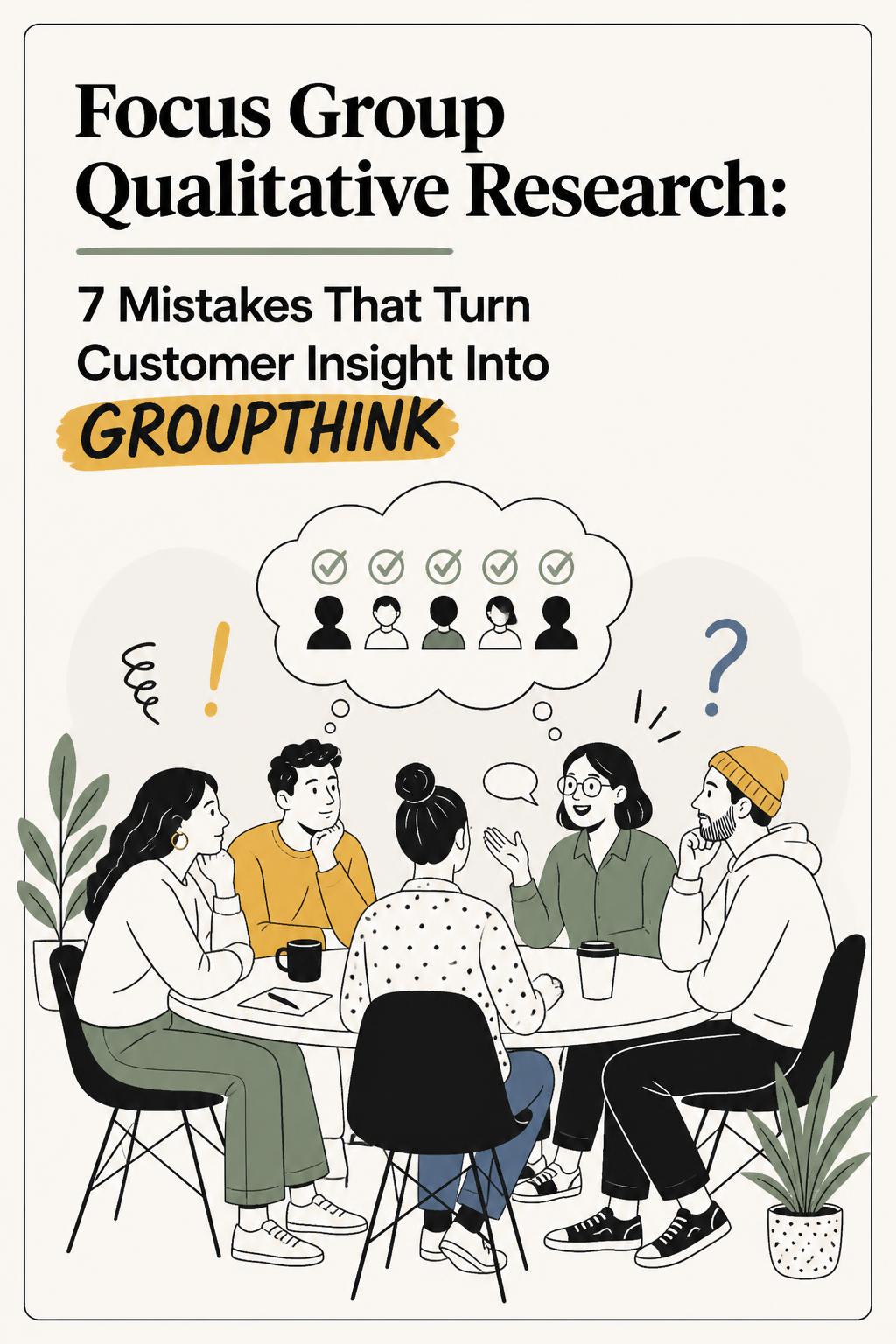
A product team once told me their focus groups had “validated” a new subscription offer. Eight participants liked the concept. Everyone agreed the pricing looked fair. Yet the offer underperformed immediately after launch. When we revisited the recordings, the failure was obvious: one outspoken participant had framed the offer as a good deal in minute 12, and the rest of the group spent the next hour reacting to his frame—not their own buying reality. Nobody had been asked what they would stop paying for, what budget it would come from, or what would make them cancel after month one.
That is the uncomfortable truth about focus group qualitative research: it can create false confidence faster than almost any other research method. But when designed properly, focus groups do something individual interviews cannot. They show how people form opinions in public, negotiate social risk, borrow language from peers, and decide what is acceptable to admit. The goal is not to collect agreement. The goal is to expose the pressures behind a decision.
What focus group qualitative research is actually good for
Focus group qualitative research is not a cheaper substitute for a survey and it is not a room full of people voting on your roadmap. It is a method for studying how attitudes are formed, challenged, and reinforced in a social setting.
Use a focus group when the decision is influenced by other people’s expectations. That includes brand perception, category language, workplace software adoption, household purchases, health and financial decisions, social identity, and products where one user must persuade another person to participate.
For example, a collaboration tool may be easy for an individual contributor to use but difficult to introduce to a manager who worries about governance. A meal kit may appeal to one parent but feel wasteful to another. A financial app may be seen as empowering by one participant and irresponsible by someone who has experienced irregular income. These conflicts are not research noise. They are the market.
Focus groups are a poor choice when you need statistical prevalence, individual task performance, confidential disclosures, or a clean read on unprompted behavior. If your core question is, “Can users complete this workflow?” run usability testing. If it is, “How many customers prefer option A?” run quantitative research. If it is, “What does this person privately fear or regret?” conduct a one-to-one interview.
The discipline is simple: use groups to understand how people make meaning together. Use other methods to measure what people do alone.
Why most focus groups fail before the session begins
The standard focus group process is optimized for convenience: recruit people matching a broad target profile, show a polished concept, ask for reactions, and summarize the repeated themes. This produces clean-looking slides and weak decisions.
It fails because opinions are cheap. Participants can tell you that a product is useful, attractive, or innovative without explaining whether it can displace an existing habit. Worse, a group environment rewards sounding reasonable. People often state the preference they believe is socially acceptable, especially when discussing money, health, work, parenting, privacy, or technology competence.
- Generic recruiting creates generic findings. “Adults aged 25–45 who use the category” can include loyalists, reluctant users, bargain hunters, first-time triers, and people who only use the product because somebody else chose it.
- Early concept exposure anchors the conversation. Once participants see your naming, claims, and interface, they begin responding to your framing rather than describing their natural needs and language.
- Broad questions produce polished rationalizations. “What do you think?” asks people to become critics. It does not reveal the real trigger, competing option, or sacrifice behind a purchase.
- Consensus gets mistaken for validation. A room can agree because a confident participant defined the safe answer, not because the idea reflects strong underlying demand.
- Theme-based analysis removes the mechanism. “Trust matters” is not a finding until you know what breaks trust, for whom, at which moment, and what behavior follows.
The cure is to design around real decisions under pressure, not abstract reactions to ideas.
Use the decision-pressure framework, not the opinion question
People do not buy, adopt, switch, or churn because a feature receives a high score in isolation. They make tradeoffs under constraints. A strong focus group guide reconstructs those constraints before asking participants to react to anything new.
I use a five-part decision-pressure framework in every strategic qualitative study.
- Context: Identify the specific situation in which the need appeared. Ask what was happening that day, who was involved, and what made the issue relevant.
- Trigger: Find the event that made the old approach insufficient: a deadline, a mistake, a recommendation, an unexpected cost, or a repeated frustration.
- Alternatives: Map the options people actually considered, including spreadsheets, manual workarounds, competitors, asking another person, and doing nothing.
- Tradeoff: Surface what they were protecting or giving up: time, control, money, privacy, reliability, status, or freedom from effort.
- Consequence: Ask what happened after the decision. Did the value persist? Did they revert? Did they need to justify the choice to someone else?
Consider a team exploring automated savings. “Would you use automatic transfers?” nearly guarantees enthusiastic answers. Instead, ask participants to reconstruct the last time they intended to save but did not. What happened to the money? What did they do instead? What would make an automatic transfer feel irresponsible? That line of inquiry separates a feature opportunity from a cash-flow problem, a trust issue, or a household decision dynamic.
Recruit for contrast, not just qualification
The quality of a focus group is determined less by whether it has six or eight participants than by whether the people in it create useful contrast. The best recruitment plans deliberately include differing decision paths.
For a B2B product, recruit voluntary adopters separately from employees required to use the product. For a subscription business, compare recent joiners with recent cancelers. For a marketplace, distinguish people who compare options aggressively from people who default to a familiar provider. These are not minor subgroups. They often reveal the actual adoption boundary.
In one study for a workflow software company, we had a two-week recruiting window and could only run four groups. The original plan called for “operations administrators” in every session. I pushed to split the sample by adoption path instead: self-initiated users, manager-mandated users, and former users who had gone back to spreadsheets. The former users changed the story. They did not leave because the software was too complicated. They left because its reporting made exceptions visible to senior managers, which felt like surveillance. The team changed permissions, onboarding, and positioning. A broad usability complaint would have sent them toward the wrong fix.
Moderate the group to reveal influence, not suppress it
Group influence is both the benefit and the danger of focus group qualitative research. Participants can unlock memories for one another, challenge assumptions, and reveal shared norms. They can also conform within minutes. A skilled moderator does not pretend influence is absent; they make it observable.
Get private answers before public discussion
Before discussing a concept, give participants two or three minutes to write independently. Ask them to describe a recent experience, rank options, or complete a sentence such as, “I would only trust this if...” Then invite conversation. This prevents the first articulate participant from providing the room’s answer.
Interrogate agreement
When the group agrees, do not congratulate yourself and move on. Ask, “Who sees this differently?” “When would this fail?” and “What would somebody outside this room object to?” Real insight often arrives when participants explain the exceptions to an apparent consensus.
Bring evidence from real behavior into the room
Memory turns people into coherent characters. Real artifacts restore the mess. Ask participants to bring a receipt, screenshot, calendar entry, product comparison, email thread, or abandoned cart. These materials expose the gap between stated values and actual choices.
In a meal-planning study, one participant said she “always prioritized healthy choices.” We asked her to pull up her three most recent delivery orders. Healthy meals appeared early in the week; convenience took over after late workdays. The team stopped treating health as the primary conversion message and focused on reducing weekday decision fatigue. That was not a subtle wording change. It changed the product’s positioning and campaign timing.
A 90-minute focus group structure that produces usable evidence
A discussion guide should be an evidence sequence, not a long checklist of stakeholder questions. If you cover ten features in 90 minutes, you will get ten shallow reactions. Prioritize depth on the decision that matters most.
- 0–15 minutes: establish context. Explore routines, vocabulary, and recent experiences without showing product stimulus.
- 15–35 minutes: reconstruct actual decisions. Use the decision-pressure framework for one recent example from each participant.
- 35–50 minutes: compare norms and differences. Let participants react to one another, while probing where motives, risks, and workarounds diverge.
- 50–70 minutes: introduce stimulus progressively. Show rough messages, concepts, or prototypes in pieces. Ask what participants expect before explaining intent.
- 70–85 minutes: force tradeoffs. Ask what participants would choose instead, what they would give up, and what would stop adoption.
- 85–90 minutes: identify the unresolved risk. End with, “What have we not discussed that could change this decision?”
Never end with “Any final thoughts?” That question produces compliments. End with a behavioral constraint: “If this launched tomorrow, what would stop you from trying it in the next 30 days?”
Analyze movement in the room, not just repeated words
The most valuable data may be the moment a participant changes their position after hearing a peer. Watch for laughter around discomfort, pauses before sensitive admissions, attempts to seek permission from the group, and stories that cause others to say, “That happened to me too.” Those moments reveal social meaning that a transcript theme alone will miss.
For every finding, document five elements: who experienced it, in what situation, what mechanism caused it, how consistent the pattern was, and what decision should change. “Customers want control” is weak. “New managers need an approval checkpoint during their first month because they fear accountability for unseen AI actions more than they value time saved” is a finding a product team can build against.
Keep stable patterns, meaningful contradictions, and provocative outliers separate. A divided room does not mean the research failed. It may mean you have discovered a segment boundary that your analytics and personas have obscured.
Where AI strengthens focus group qualitative research
AI can reduce the slowest part of qualitative research: sorting through hours of discussion to locate recurring language, sharp contradictions, and decision moments. But AI cannot rescue a poorly designed group. If participants were recruited broadly, prompted with leading questions, and allowed to converge without challenge, an automated summary will simply produce a faster version of weak evidence.
The right workflow is straightforward: design around a decision, protect independent thinking, use AI to surface patterns and contradictions, then apply experienced research judgment to validate the mechanism and implications.
The real standard for a successful focus group
A successful focus group does not produce unanimous praise, a colorful word cloud, or a deck full of quotes. It improves a business decision. It identifies the assumption most likely to be wrong, the segment that should not be averaged away, the message that creates credibility, and the tradeoff customers will not accept.
If your final report could apply to every company in the category, the research was not specific enough. Good focus group qualitative research reveals the uncomfortable detail: the hidden fear, the social permission people need, the workaround they prefer, and the exact condition under which your product becomes worth changing behavior for.
Run the week on concept testing: 15 to 30 AI-moderated interviews, with quotes back in 48 to 72 hours.
If groupthink keeps showing up in your sessions, the problem usually isn't your questions—it's the format itself. Read the full breakdown in our focus group research guide for a wider look at why these methods fail and what to run instead, or try Usercall to run one-on-one conversations that surface real reasoning without social pressure.
Related: Concept testing questions · Concept testing research · CPG packaging · Concept testing examples
Related: Focus Group Qualitative Research Is Lying to You · why nods don't equal demand · the facilitator's role in preventing groupthink