
Empirical Data in Research: Why Most ‘Data-Driven’ Teams Still Get It Wrong
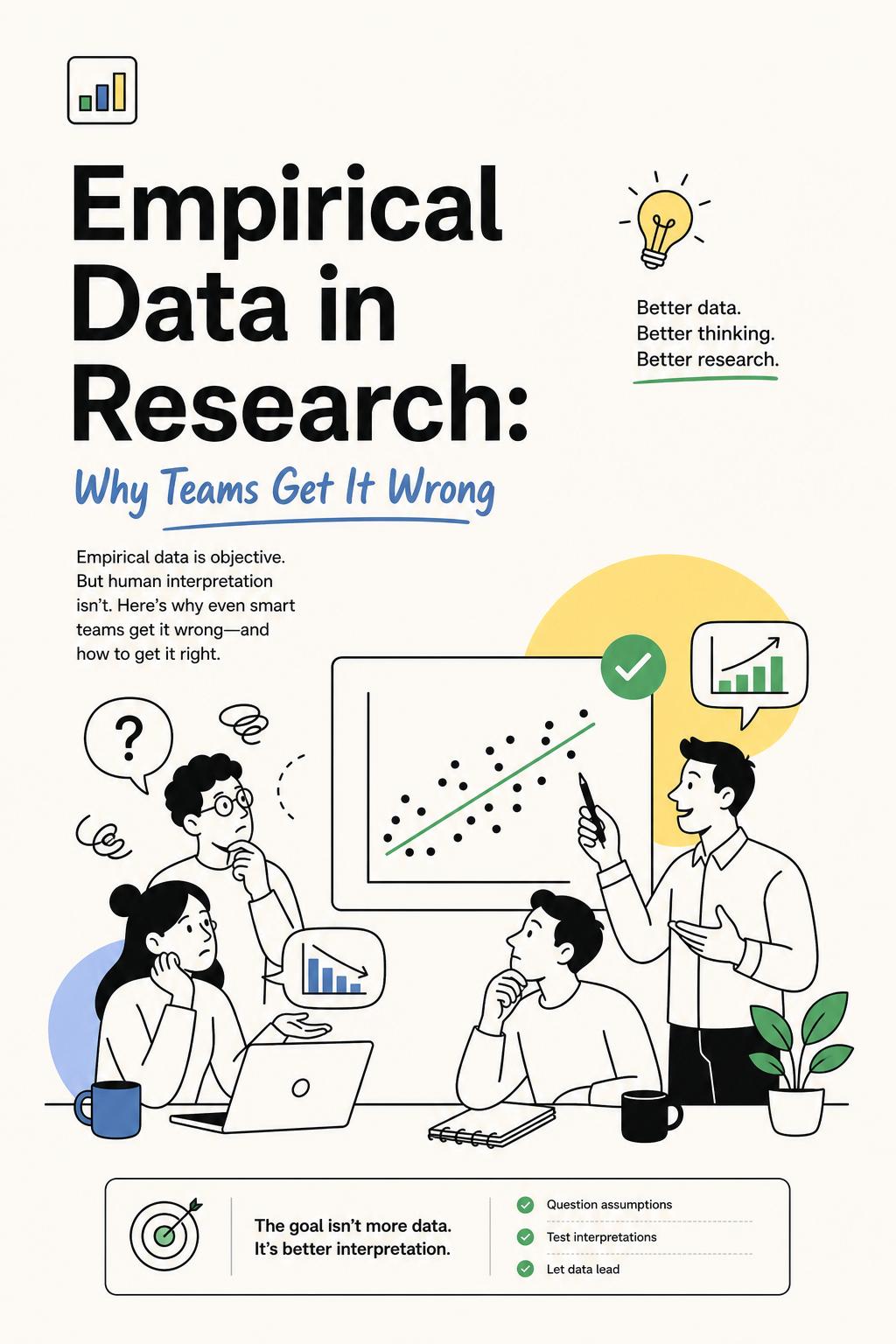
I’ve sat in too many meetings where someone says, “Well, the data shows…”—and everyone just nods. No one asks what data, how it was collected, or whether it actually answers the question. That’s how bad decisions survive inside “data-driven” companies. Not because they lack empirical data, but because they misunderstand what counts as evidence.
Here’s the uncomfortable truth: most teams are drowning in empirical data and still starving for insight. They track everything, survey everyone, and interview a handful of users—yet still ship features that flop, redesign flows that don’t convert, and misdiagnose why users churn. The issue isn’t access to data. It’s using the wrong kind of empirical data for the decision at hand.
Empirical data is only valuable if it reduces real uncertainty
The textbook definition of empirical data—information derived from observation or experience—isn’t wrong, but it’s not useful enough for product teams. In practice, empirical data only matters if it helps you make a better decision.
That means two things:
- It must be tied to a specific question. Data without a decision context is just noise.
- It must reflect actual behavior or grounded experience. Not opinions in a vacuum, not abstract preferences.
Most teams fail here. They collect what’s easy—NPS scores, feature usage, post-hoc opinions—then try to stretch that data to answer deeper questions like “Why are users dropping off?” or “Why didn’t this feature land?”
Empirical data doesn’t fail you. Misapplied data does.
Why most empirical research falls apart in practice
Before fixing your research approach, you need to understand why common methods fall short. The problem isn’t the tools—it’s how they’re used.
- Analytics without context leads to false certainty. You see a 40% drop-off and assume friction—but you don’t know if it’s confusion, lack of intent, or external constraints.
- Surveys capture what sounds reasonable, not what’s true. People rationalize. They rarely reconstruct real decision-making accurately.
- Interviews often drift into storytelling instead of evidence. Ask broad questions, and you’ll get polished narratives—not grounded behavior.
- Teams over-index on scale. 1,000 responses feel more credible than 10 interviews—even if those interviews are directly tied to the behavior in question.
The result? Teams feel confident while being fundamentally misinformed. That’s a dangerous combination.
The real standard: empirical data must match the decision
Strong researchers don’t ask, “Do we have data?” They ask, “Do we have the right evidence for this decision?”
Here’s a simple mental model I use:
If your evidence doesn’t match your decision type, you’re guessing—just with charts.
A better approach: the 4-layer evidence model
To consistently use empirical data well, you need to combine different types of evidence. I use a four-layer model that forces teams to build a complete picture:
- Behavior: What actually happened?
- Context: Where and when did it happen?
- Meaning: What did the user think was happening?
- Impact: Why does it matter for the business?
Most teams operate with only one or two layers. That’s why insights feel shallow or contradictory.
For example, analytics might show that users abandon onboarding at step three (behavior), but without context and meaning, you don’t know whether it’s confusion, lack of motivation, or missing information. Fixing the UI alone might not solve anything.
Where modern tools actually change the game
The biggest shift in empirical research isn’t more dashboards—it’s capturing insight at the moment behavior happens.
If you’re evaluating tools to do this well:
- UserCall – Built specifically for research-grade qualitative analysis with AI-moderated interviews and deep researcher control. Its real advantage is intercepting users at key product moments, so you capture feedback exactly when behavior occurs—closing the gap between analytics and understanding.
- Traditional survey tools – Fast and scalable, but limited by recall bias and lack of behavioral grounding.
- Product analytics platforms – Essential for identifying patterns, but incomplete without qualitative depth.
The winning setup isn’t one tool—it’s connecting behavioral signals with real-time qualitative insight.
Anecdote: when “pricing issues” were completely misleading
I worked with a SaaS team that saw a 12% drop in conversion from trial to paid. A survey showed “pricing” as the top issue, so leadership pushed for discounts.
But something didn’t add up. Users who never even viewed pricing were citing cost as a reason.
We ran targeted interviews with users who dropped off after inviting teammates. The real issue surfaced quickly: people weren’t confident enough to justify the tool internally. Pricing wasn’t the barrier—perceived risk was.
We shifted onboarding to emphasize quick team validation instead of feature exploration. Conversion rebounded without touching pricing.
This is the danger of weak empirical data: it gives you a clean answer to the wrong question.
Anecdote: five interviews that killed a month of debate
On another project, two analytics teams spent weeks debating mobile checkout drop-off. One blamed shipping costs, the other blamed payment friction.
We ran five interviews with users who had abandoned checkout within 24 hours. Four out of five struggled to find delivery timing details on mobile.
Not price. Not payment. Just hidden information.
A single layout change resolved the issue. Weeks of analysis were replaced by one day of targeted empirical research.
Small samples aren’t the problem. Irrelevant samples are.
The biggest mistake: confusing precision with truth
One of the most dangerous assumptions in research is that precise data is accurate data.
You can measure the wrong thing perfectly.
I’ve seen teams track feature adoption down to decimal points—only to discover users were engaging out of obligation, not value. The metric looked strong. Retention told a different story.
Empirical data always reflects a slice of reality. The question is whether it’s the right slice.
A practical workflow for better empirical research
If you want empirical data that actually improves decisions, use this workflow:
- Define the decision first. What are you trying to choose or change?
- Identify the key uncertainty. What don’t you know that blocks action?
- Match method to question. Behavior → analytics. Meaning → interviews. Scale → surveys.
- Capture data close to the moment of behavior. Avoid relying on memory.
- Recruit the right users. Not all users—relevant users.
- Triangulate findings. Combine at least two evidence types.
- Validate outcomes. Did your change actually shift behavior?
This isn’t more work—it’s better-targeted work. Most teams waste time collecting data that never had a chance of being useful.
The bottom line: empirical data should change your mind
If your research confirms what you already believed, it’s probably not doing its job.
Good empirical data introduces tension. It challenges assumptions. It forces tradeoffs into the open.
That’s what separates real research from data theater.
So the next time someone says, “We have the data,” ask a better question: Is this the kind of evidence that should change what we do next?
If the answer is no, you don’t need more data. You need better empirical research.
Run the week on concept testing: 15 to 30 AI-moderated interviews, with quotes back in 48 to 72 hours.
Collecting empirical data is only half the battle—the questions you ask determine whether that data actually explains behavior. Check out our guide on how to write qualitative research questions for 45+ examples that turn raw observations into usable evidence. Usercall can help you run those interviews at scale without losing the depth that makes empirical data meaningful.
Related: Concept testing questions · Concept testing research · CPG packaging · Concept testing examples
Related: qualitative vs quantitative research · what qualitative data actually is · customer research techniques that expose the truth