
Ethnography and Observation: The Brutal Truth About Why You’re Watching Users Wrong
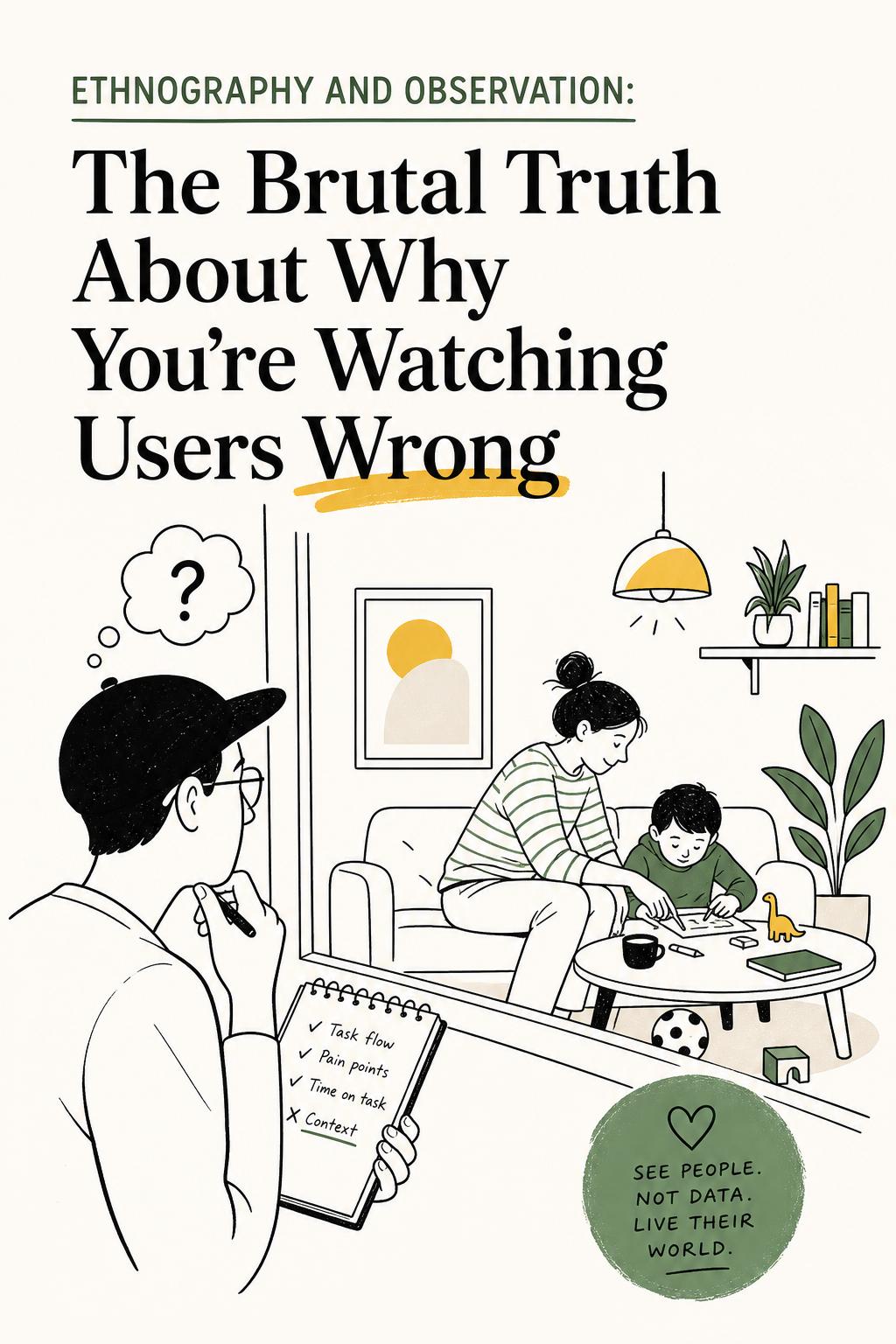
I once watched a product team confidently ship a redesign based on “clear” user feedback—only to see adoption drop 18% within two weeks. Their research wasn’t sloppy. They ran interviews, collected quotes, and even reviewed session recordings. The problem was deeper: they never actually understood what they were observing. They mistook surface behavior for real behavior.
This is the uncomfortable truth about ethnography and observation: most teams think they’re doing it, but they’re not. They’re watching users interact with a product, not studying how people operate within a system. That gap is exactly where bad decisions come from.
If you’re here searching for ethnography and observation, you don’t need another definition. You need to know why your current approach isn’t working—and what to do differently so your insights actually change product decisions.
The Core Mistake: Observing Actions Without Context
Here’s the blunt reality: observing clicks, screens, and task completion is not ethnography. It’s not even good observation. It’s interface-level watching.
Most research today happens in controlled environments—Zoom calls, guided tasks, staged scenarios. That strips away the very thing ethnography depends on: context. Real behavior is shaped by interruptions, constraints, incentives, and invisible workarounds. Remove those, and what you’re left with is performance.
This is why teams keep hearing things like “this is confusing” or “I’d probably use this”—and then get blindsided by what users actually do in production.
In one B2B SaaS study I led, users consistently said they “relied heavily” on a reporting dashboard. But during live observation embedded in their workday, I noticed something else: before every major decision, they exported the data into Excel and rebuilt the analysis manually. The dashboard wasn’t trusted. Interviews alone would never have revealed that.
Observation without context creates false confidence. Ethnography exists to correct that.
Why Most Ethnography Efforts Still Fail
Even when teams attempt ethnographic research, they often fall into three predictable traps.
- They over-index on what users say. Post-task explanations are treated as truth, even though they’re often reconstructed narratives.
- They collect data without interpretation. Hours of recordings and notes, but no clear model to translate behavior into decisions.
- They isolate the product from the system. Ignoring the broader environment where the behavior actually makes sense.
The result is what I call “performative insight”—it sounds intelligent, it looks thorough, but it doesn’t change outcomes.
Ethnography only works when you stop treating behavior as a series of actions and start treating it as a response to pressures.
What Ethnography and Observation Actually Reveal (That Other Methods Don’t)
The real value of ethnography is not empathy. It’s explanation.
Specifically, it helps you answer a question most teams struggle with: Why does this behavior make sense to the user, even if it looks irrational to us?
That shift matters because most product problems are not usability problems. They are tradeoff problems.
- Users choose speed over accuracy because they’re under time pressure
- They bypass features because of organizational risk, not confusion
- They duplicate work because trust is low, not because tools are missing
These are not issues you can fix with better UI alone.
I saw this clearly in a fintech product where users repeatedly skipped a “secure verification” step. The initial assumption was friction. But observation revealed the real issue: completing that step created a visible audit trail that triggered additional scrutiny from compliance teams. Skipping it wasn’t laziness—it was strategic avoidance.
Without ethnography, the team would have optimized the wrong thing.
A Practical Framework: The 5 Layers of Real Observation
If you want to get better at ethnography and observation, you need a structure. Otherwise, you’ll drown in details and miss the signal.
I use a simple five-layer model to analyze behavior:
- Task: What is the user trying to accomplish right now?
- Tools: What products, documents, or workarounds are involved?
- People: Who influences, approves, or interrupts this process?
- Environment: What external conditions shape attention and execution?
- Incentives: What risks, rewards, or pressures drive decisions?
Most research stops at the first two layers. That’s why insights feel shallow.
The real breakthroughs happen in layers four and five—where behavior stops being about usability and starts being about reality.
How to Actually Run Ethnographic Observation in Modern Product Teams
You don’t need months of fieldwork to apply ethnographic thinking. But you do need to change how and when you observe users.
1. Observe at the moment of friction, not after
Retrospective interviews are clean, but they miss the mess. The best insights come from observing behavior as it happens.
This is where modern tooling changes the game. Platforms like UserCall allow you to intercept users directly at key behavioral moments—drop-offs, repeated actions, or unusual flows—and run AI-moderated interviews in context. Combined with research-grade qualitative analysis and strong researcher controls, this gives you something traditional ethnography struggled with: scale without losing depth.
Instead of guessing why a metric moved, you can ask at the exact moment it happens.
2. Sample for tension, not averages
Average users give you average insights. That’s rarely where the opportunity is.
Recruit for contrast:
- Power users vs. reluctant users
- Teams with strict processes vs. teams full of workarounds
- High-stakes environments vs. low-stakes ones
In one study, comparing a highly regulated enterprise team with a startup team revealed completely different product usage patterns—not because of preference, but because of risk tolerance. That insight directly influenced feature prioritization.
3. Focus on breakdowns, not flows
Happy paths are misleading. Real insight lives in breakdowns—pauses, errors, workarounds, and deviations.
Watch for:
- Moments where users stop and think
- Switching to other tools or people
- Repeated actions that signal low trust
- Shortcuts that bypass intended workflows
These are not edge cases. They are signals of system misalignment.
4. Capture artifacts, not just conversations
Some of the most valuable insights don’t come from what users say—they come from what surrounds them.
Open tabs, saved templates, handwritten notes, Slack messages, copied data—these artifacts reveal the invisible infrastructure of work.
I once discovered an entire shadow workflow built in Google Docs that replaced a core product feature. No user mentioned it in interviews. But it showed up immediately during observation.
Turning Observation Into Decisions (Not Just Stories)
The biggest failure point in ethnography is synthesis. Teams collect rich data but struggle to translate it into action.
Here’s a structure that forces clarity:
This forces you to move beyond “what happened” into “what should we do about it.”
When to Use Ethnography and Observation (And When Not To)
Not every problem requires ethnography. But when you’re dealing with behavior that doesn’t make sense on the surface, it’s often the only method that will get you to the truth.
Use it when:
- Your metrics show what is happening but not why
- User feedback contradicts actual behavior
- Adoption problems persist despite UX improvements
- Your product operates within complex workflows or organizations
Skip it when you just need to validate UI clarity or test small design changes.
The Real Value: Better Judgment, Not More Data
Ethnography and observation are not about collecting richer anecdotes. They are about improving how you interpret behavior.
Because the hard truth is this: most product decisions fail not بسبب lack of data, but because teams misread what they already have.
When you observe users properly—within their environment, under real constraints, inside real systems—you stop solving surface problems.
You start solving the conditions that create those problems in the first place.
And that is where real product advantage comes from.
Watching users is only half the job—knowing what to ask before, during, and after an observation session is what turns raw footage into insight. If you're still refining your discussion guide, check out How to Write Qualitative Research Questions: 45+ Examples for prompts that hold up in the field, or use Usercall to run structured follow-up interviews that fill the gaps observation alone can't answer.
Related: rapid ethnographic assessment · contextual inquiry · ethnographic research methods