
Evaluation vs Research: The Costly Confusion That’s Killing Product Decisions
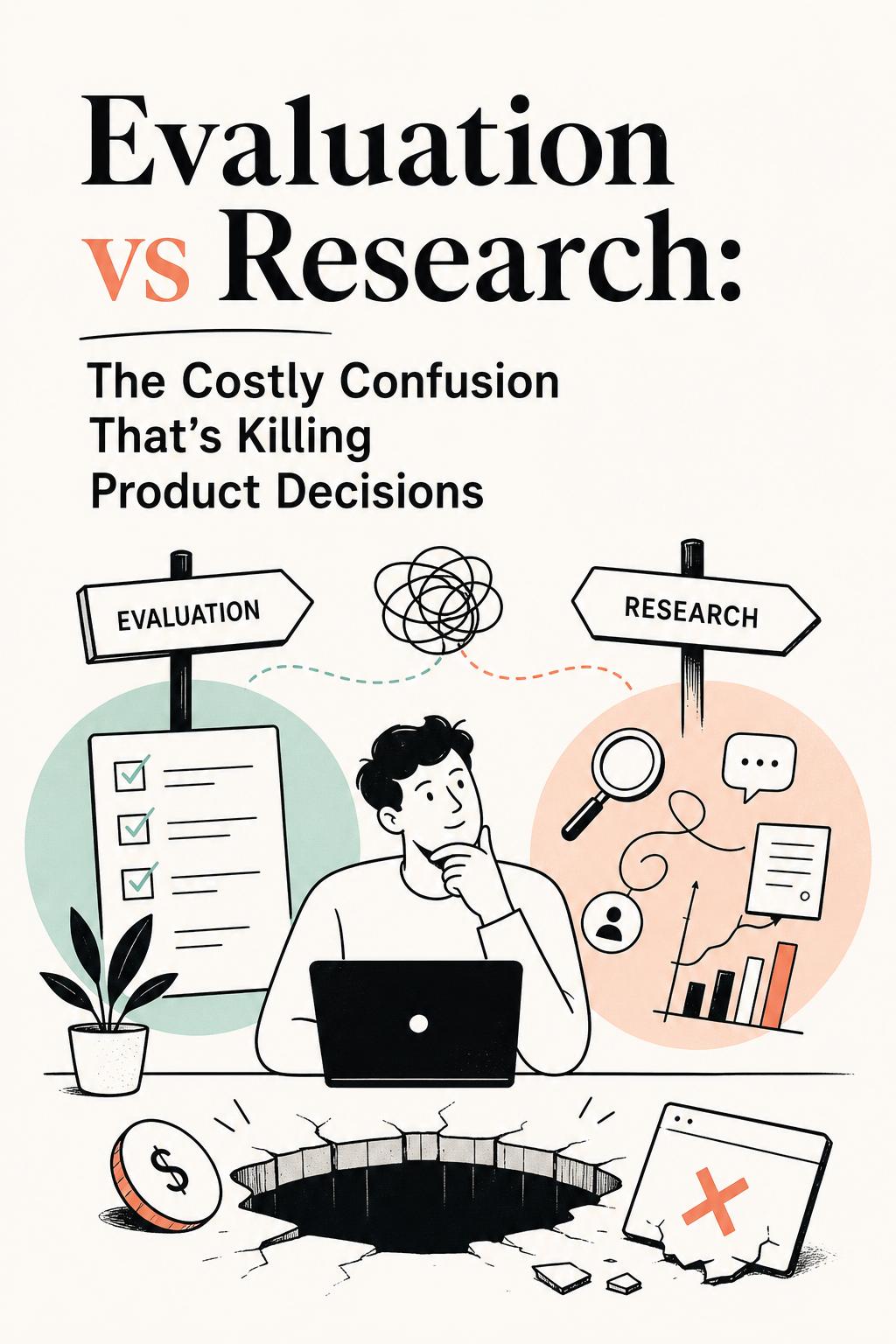
I once watched a team confidently ship a redesign after what they called “strong research validation.” Two weeks later, conversion dropped 18%.
The problem wasn’t lack of effort—they had run interviews, usability tests, and surveys. The problem was more fundamental: they confused evaluation with research. They validated a solution before truly understanding the problem. Everything looked rigorous. Everything sounded credible. And it still led them straight into a bad decision.
This is the quiet failure behind a huge percentage of product missteps. Teams don’t fail because they ignore users—they fail because they misunderstand what kind of insight they actually need.
If you’re searching for evaluation and research, here’s the blunt truth: these are not interchangeable terms. Treating them as such is why so many “insight-driven” teams still ship the wrong things.
Evaluation and research are fundamentally different tools
Most teams collapse these into a single bucket called “user research.” That’s convenient—and completely wrong.
Here’s the distinction that actually matters in practice:
- Research reduces uncertainty about people: their needs, behaviors, motivations, and context.
- Evaluation reduces uncertainty about solutions: how well something performs against a defined goal.
Research is about understanding reality. Evaluation is about judging your response to it.
That difference might seem semantic, but it changes everything about how you design studies, interpret findings, and make decisions.
When teams blur this line, they end up using evaluative methods (like usability tests) to answer generative questions (“what do users actually need?”). That’s like judging a book by reading a single paragraph you wrote yourself.
The hidden reason most “research” doesn’t change decisions
Let’s be honest: a lot of research outputs don’t meaningfully influence product direction. They create alignment theater—interesting slides, memorable quotes, and very little shift in strategy.
This usually happens because the study was never tied to a real decision in the first place.
Instead, it was framed like this:
- “Let’s better understand our users”
- “Let’s validate this concept”
- “Let’s get feedback on the new design”
These sound reasonable, but they’re dangerously vague. They mix research and evaluation into one fuzzy objective.
In practice, that leads to three predictable failures:
- Shallow insights: You get reactions instead of understanding.
- Weak evidence: You rely on opinions instead of behavior.
- Indecision: Stakeholders interpret findings in whatever way supports their prior beliefs.
I’ve seen this play out repeatedly. In one SaaS project, we were asked to “evaluate onboarding.” The team had already decided on a redesign direction. What they actually needed was to understand why activation was low in the first place.
We ran initial usability tests, and users completed tasks with moderate friction. The team declared the redesign “good enough.”
But when I pushed for follow-up exploratory interviews, a different story emerged: users didn’t trust the setup process. They were afraid of making irreversible mistakes. The friction wasn’t usability—it was perceived risk.
No amount of UI polish would have fixed that.
That’s the cost of skipping research and jumping straight to evaluation.
A sharper mental model: match the method to the decision
If you want better outcomes, stop thinking in terms of methods and start thinking in terms of decisions.
Here’s a simple but powerful framework I use:
1. Define the decision you need to make
If the study doesn’t clearly influence a decision, it’s already off track.
Examples:
- Should we change onboarding flow A to B?
- Why are users dropping off after step 2?
- Which problem is most worth solving next?
2. Identify the type of uncertainty
- Problem uncertainty: We don’t understand user needs → Research
- Solution uncertainty: We don’t know which approach works best → Evaluation
- Performance uncertainty: We don’t know if this meets the bar → Evaluation
- Behavioral uncertainty: We don’t know why users act this way → Research
3. Choose evidence that actually answers the question
This is where most teams go wrong.
If you’re deciding between two designs, user preference is weak evidence. Observed behavior under realistic conditions is stronger.
If you’re trying to understand churn, analytics alone are insufficient. You need in-context explanations.
Different questions require different evidence. There is no universal method.
The real workflow high-performing teams use
The best teams don’t debate evaluation vs research. They sequence them.
Here’s the workflow I’ve seen consistently produce better product decisions:
- Discover: Identify unmet needs, behaviors, and constraints.
- Frame: Define the problem and success criteria.
- Evaluate: Test whether solutions actually work.
- Measure: Track real-world behavior post-launch.
- Explain: Intercept users at key moments to understand why metrics move.
That last step is where most teams fall short.
They rely heavily on analytics dashboards but rarely capture insight at the moment behavior happens. By the time they run interviews, users are reconstructing explanations from memory—which is notoriously unreliable.
This is exactly where tools like Usercall stand out. It enables teams to run AI-moderated interviews with deep researcher control and trigger intercepts at key product moments—like abandonment, hesitation, or unexpected behavior. That means you’re not guessing why a metric changed—you’re hearing it directly, in context, from the user.
That shift—from retrospective guessing to real-time explanation—is one of the biggest upgrades a research function can make.
Why evaluation often gives false confidence
Evaluation feels decisive. It produces clear outputs: pass/fail, better/worse, usable/not usable.
But it has a major blind spot: it only evaluates what you chose to test.
If your concept is fundamentally misaligned with user needs, evaluation won’t save you. It will simply help you optimize the wrong thing.
I learned this the hard way during a pricing redesign project. We tested three pricing page variants, and one clearly outperformed the others in comprehension and preference.
Stakeholders were thrilled. The decision seemed obvious.
But post-launch, revenue barely moved.
Why? Because the real issue wasn’t pricing clarity—it was value ambiguity. Users didn’t understand why the product was worth paying for in the first place.
We had run a perfect evaluation study on the wrong problem.
This is why research must come first when problem understanding is weak. Evaluation cannot compensate for a flawed premise.
What strong evaluation actually looks like
Good evaluation is not just “getting feedback.” It’s structured judgment against defined criteria.
That means:
- Clear success metrics (completion, time, confidence, error rate)
- Realistic scenarios (not guided walkthroughs)
- Representative users (not whoever is easiest to recruit)
- Behavioral evidence over stated opinions
One mistake I made early on was over-moderating usability tests—subtly guiding users when they got stuck. Sessions looked smooth, stakeholders felt reassured, and we shipped.
In reality, I had removed the very friction we needed to observe.
Now, I bias heavily toward minimal intervention. If users struggle, that’s the insight—not something to smooth over.
What strong research actually uncovers
Great research goes beyond surface-level “pain points.” It reveals the structure behind behavior.
Specifically:
- Triggers: What causes a need to become urgent
- Barriers: What prevents action even when motivation exists
- Workarounds: What users do instead of your product
- Perceived risks: What feels dangerous or costly about adopting a solution
- Mental models: How users conceptualize the problem space
In one project focused on collaboration tools, we discovered that users weren’t avoiding a feature because it was hard to use—but because using it signaled ownership. And ownership meant accountability.
The barrier wasn’t usability. It was organizational psychology.
No usability test would have surfaced that cleanly.
A quick diagnostic: do you need evaluation or research?
If you’re unsure, use this:
If your team is arguing about “why,” you need research. If you’re arguing about “which,” you need evaluation.
The bottom line
Evaluation and research are both essential—but they are not interchangeable.
Research helps you understand the problem space. Evaluation helps you judge your solution within it.
When you confuse them, you get polished insights that don’t hold up in reality. When you separate and sequence them properly, you get something much more valuable: decisions that actually work.
And in product development, that difference shows up quickly—in your metrics, your roadmap, and your credibility.
Whether you're running evaluation or full research, the questions you ask determine whether you get signal or noise. Our guide on how to write qualitative research questions offers 45+ examples to sharpen either approach for surveys, interviews, or user studies. Usercall can help you run structured, insight-rich interviews that support real product decisions—not just checkbox research.
Related: research design categories that drive product decisions · types of customer research · customer research report that drives decisions