
NPS Survey Guide: Why Your Net Promoter Score Is Misleading (and How to Fix It for Real Insight)
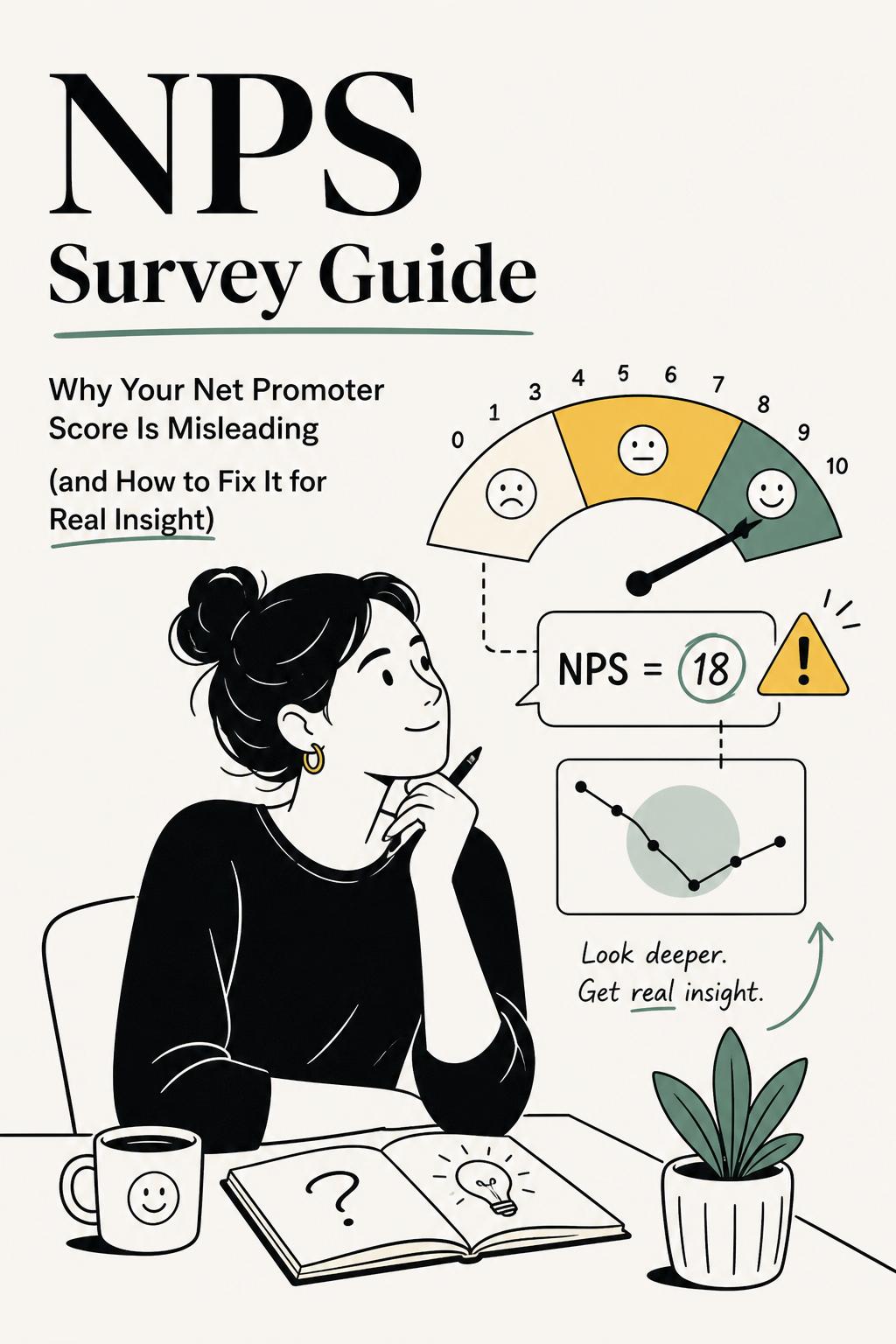
Your NPS score went up. Leadership is happy. The dashboard is green. And yet—churn didn’t budge.
I’ve sat in that exact room. A SaaS company I worked with celebrated a 9-point jump in their net promoter score nps survey results over two quarters. At the same time, expansion revenue stalled and support tickets about the same core issues kept climbing. The conclusion? “Customers are happier.” The reality? The survey had drifted so far from real product experience that it was measuring sentiment theater, not customer truth.
This is the uncomfortable truth: most NPS programs don’t fail because the metric is flawed. They fail because teams treat NPS like a performance KPI instead of a research instrument.
If you want your NPS survey to actually tell you something useful—about retention, loyalty, or product-market fit—you need to fundamentally change how you design, trigger, and interpret it. Otherwise, you’re just collecting polite fiction at scale.
The core problem: NPS feels like insight, but it’s just a signal
The appeal of a net promoter score nps survey is obvious. One question. One number. Easy to track, easy to report, easy to benchmark internally.
But here’s the mistake: teams treat that number as if it explains customer behavior.
It doesn’t.
NPS captures stated likelihood to recommend. That’s it. It does not directly measure satisfaction, loyalty, retention risk, or product success. And those gaps matter more than most teams admit.
In one B2B product study I led, we saw enterprise users give high NPS scores despite actively complaining in interviews about daily friction. Why? Because the product was deeply embedded in their workflows and switching costs were high. They would “recommend” it—but only with caveats. The score looked strong. The experience was not.
If you don’t account for context like switching costs, category norms, or user role, NPS becomes dangerously easy to misread.
Think of NPS as a directional signal—not a diagnosis.
Why most NPS surveys fail (and keep failing)
There’s a pattern I see across companies of all sizes. The same mistakes show up again and again—and they quietly undermine the entire program.
- Surveys are sent on a fixed schedule instead of tied to meaningful user experiences
- All users are grouped together, masking critical differences between segments
- Open-text responses are skimmed or loosely categorized, not deeply analyzed
- Teams chase score improvements instead of fixing root causes
- NPS is disconnected from product analytics and behavioral data
One of the worst offenders is timing. I once audited an NPS program that triggered surveys 24 hours after signup to “maximize response rates.” It worked—response volume tripled. But the data became meaningless. Users were rating onboarding friction, not long-term value. Leadership thought they had a messaging issue. In reality, activation was broken.
This is what happens when you optimize for response rate instead of insight quality.
The shift: Treat NPS as a research trigger, not a metric
The highest-performing teams don’t treat NPS as an endpoint. They treat it as the entry point into deeper customer understanding.
Here’s the model I recommend:
- Score: Capture the 0–10 rating as a signal of sentiment intensity
- Reason: Collect structured qualitative input to explain the score
- Context: Layer in behavioral and segment data to interpret meaning
Without all three, you’re guessing.
This is where modern tooling actually matters. Platforms like UserCall enable teams to go beyond static surveys by running AI-moderated follow-up interviews and intercepting users directly at key product moments—right when friction or value is experienced. That allows you to connect NPS scores to real workflows, not abstract opinions, and apply research-grade qualitative analysis to uncover patterns that traditional tagging misses.
The difference is huge: instead of “users complain about onboarding,” you get “users who fail step 3 of integration drop 18 points in NPS because they can’t map data fields without engineering help.” That’s actionable.
Designing an NPS survey that actually produces insight
The question itself is standardized. The leverage comes from everything around it.
1. Ask at the right moment—not the convenient one
Timing determines what you’re measuring. Ask too early, and you capture expectation. Ask too late, and you capture memory.
The best NPS programs trigger surveys at moments that shape perception:
- After a user reaches a meaningful “first value” milestone
- After onboarding has either succeeded or failed
- After a support interaction is resolved
- After a key workflow is completed repeatedly
- Immediately after a friction event if diagnosing problems
In a product analytics tool I worked on, we moved NPS from a quarterly email blast to an in-product trigger after users built their third dashboard. Response rates dropped slightly—but insight quality improved dramatically. We uncovered that users loved building dashboards but struggled to maintain them over time, which explained long-term churn.
2. Segment before you summarize
A single NPS score is often a lie of averaging.
Break results down by:
- User role (end user vs admin vs buyer)
- Lifecycle stage (new, activated, mature, at-risk)
- Usage patterns (power users vs light users)
- Account size or plan tier
I once analyzed an NPS dataset where the overall score was a decent 28. But segmentation revealed a critical issue:
Segment breakdown
New users (0–30 days): 44
Mid-stage users (31–90 days): 6
Long-term users (90+ days): 31
This exposed a “messy middle” where users struggled to integrate the product into real workflows. Without segmentation, that insight would have been invisible.
3. Ask better follow-up questions
“Why did you give this score?” is necessary—but not sufficient.
Add one targeted question that forces specificity:
- What happened recently that most influenced your score?
- What almost stopped you from getting value?
- What would need to change for you to rate us 2 points higher?
- What do we do better—or worse—than alternatives?
These questions surface mechanisms, not just opinions. That’s the difference between insight and noise.
How to analyze NPS feedback like a researcher (not a dashboard)
Most teams flatten NPS feedback into shallow themes like “pricing,” “UX,” or “support.” That’s not analysis—it’s compression.
Instead, break responses into four layers:
- Experience drivers: What specifically influenced the score
- Outcome drivers: Whether users achieved meaningful results
- Expectation gaps: Where reality diverged from promise
- Emotional signals: Trust, frustration, confidence, effort
This approach reveals something most dashboards hide: the same “theme” can mean very different things.
For example, “support” complaints may actually indicate poor product usability. “Pricing” complaints may signal unclear value, not cost sensitivity. If you don’t separate these layers, you’ll fix symptoms instead of causes.
A useful mental model I rely on:
Score tells you intensity. Verbatims tell you story. Behavior tells you truth.
You need all three to make confident decisions.
What to actually do with promoters, passives, and detractors
Most teams over-focus on detractors and ignore the rest. That’s a mistake.
Promoters reveal your real value
Promoters are not just happy customers—they are signals of differentiated value.
In one study, we found promoters consistently mentioned reduced “internal chaos” when using a collaboration tool. The company had been positioning around productivity features. The real value was organizational clarity. That insight reshaped both messaging and roadmap priorities.
Passives are your growth lever
Passives are often one or two friction points away from becoming promoters—or churn risks. They are the most actionable segment for improvement.
Detractors need diagnosis, not just response
Separate temporary frustration from structural mismatch. Fixing a bug won’t solve a bad product fit—and treating both the same wastes time.
A practical workflow to make NPS actually drive decisions
If your NPS program isn’t influencing roadmap, CX strategy, or retention metrics, it’s not working.
Here’s the workflow I’ve seen work repeatedly:
- Trigger NPS at key product or journey moments
- Capture both open-ended and targeted follow-up responses
- Attach behavioral and segment data to every response
- Analyze by segment and mechanism—not just sentiment
- Identify top drivers of loyalty and friction
- Recruit users into follow-up interviews for deeper insight
- Prioritize changes based on impact, not volume
- Track behavioral outcomes—not just score changes
The last step is where most teams fall short. If your NPS improves but retention, expansion, or activation doesn’t, you haven’t improved the experience—you’ve improved the survey.
The bottom line: NPS is only as good as the system around it
A net promoter score nps survey can be incredibly useful—but only if you stop treating it like a vanity metric.
Used correctly, it tells you where to look, who to talk to, and which experiences matter most. Used poorly, it gives you false confidence while real problems compound underneath.
The difference isn’t the question. It’s the rigor.
If you want NPS to actually drive growth, stop asking “what’s our score?” and start asking “what’s driving it—and what are we going to do about it?”
NPS is just one metric in a broader satisfaction toolkit — check our pillar post on customer satisfaction survey questions for 50+ examples across every stage of the customer journey. If you want to move past a single misleading score, Usercall pairs your NPS with voice follow-ups that explain exactly why customers rated you the way they did.
Related: the net promoter question is misleading you · 5 critical mistakes killing your NPS · best NPS software tools compared