
CPG Concept Testing: How Consumer Packaged Goods Teams Validate Ideas Before Launch
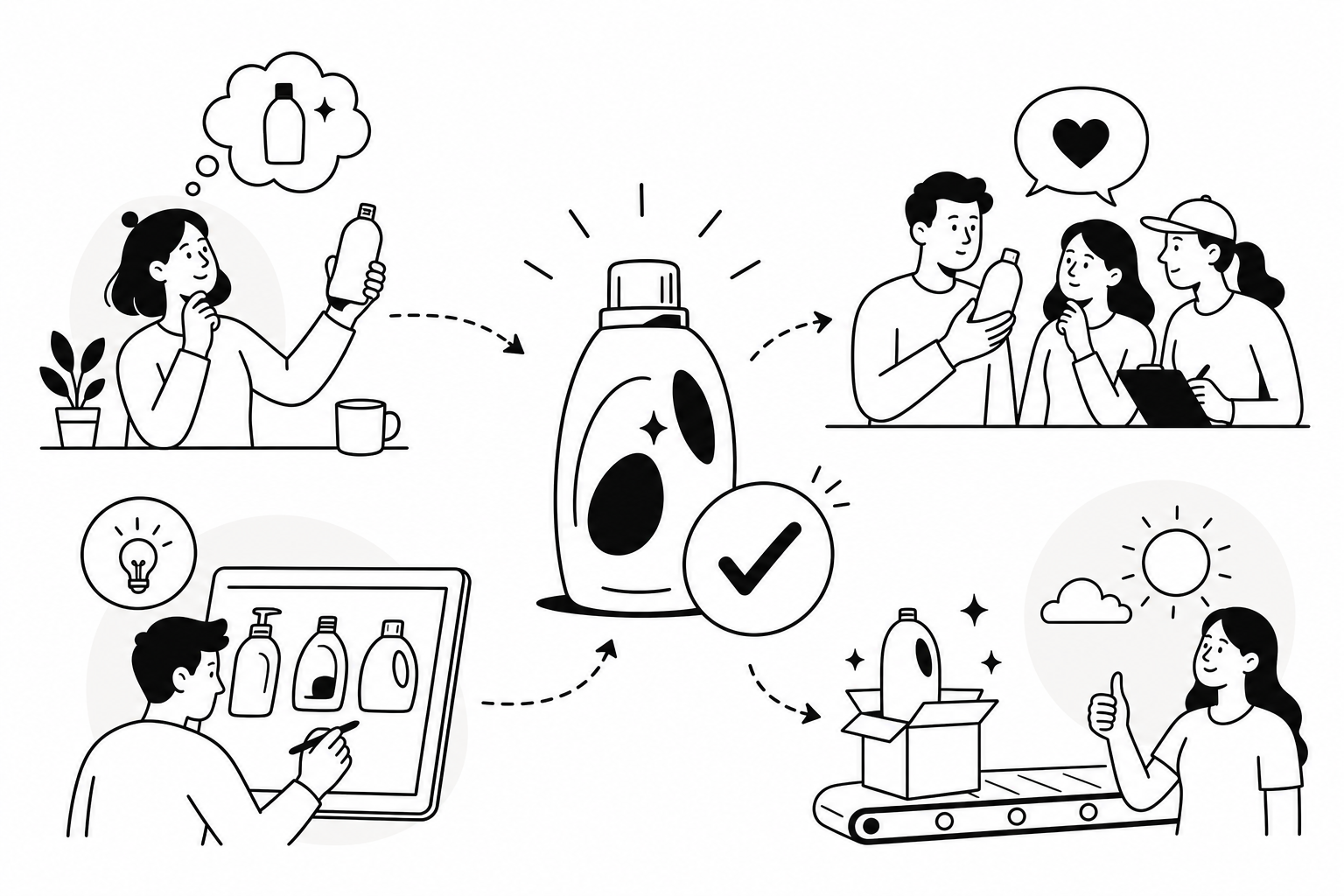
Most CPG concept tests fail before a shopper ever sees the shelf. The team asks whether people “like” an idea, gets a decent top-box score, tweaks the headline, and mistakes stated interest for future purchase. That’s how weak concepts survive and strong ones get watered down.
I’ve watched this happen with snacks, personal care, and household products: the research says “promising,” retail says “maybe,” and six months later velocity misses plan by 20%. The problem usually isn’t the concept alone. It’s that the test never captured the real buying moment, the real comparison set, or the real reasons people hesitate.
Why Traditional CPG Concept Testing Fails
Most teams over-rely on stripped-down survey concepts that remove the exact friction shoppers use to make decisions. A two-paragraph statement with a clean benefit ladder is not a shelf decision. It’s a homework assignment.
The biggest failure mode is testing concepts in isolation. Shoppers never evaluate a new protein bar, dish soap, or sparkling water alone; they evaluate it against familiar brands, price expectations, category rules, and a dozen split-second cues from pack design.
The second failure mode is asking the wrong question. “Would you buy this?” produces polite fiction. “What would make you choose this instead of what you buy now?” produces tradeoffs, and tradeoffs are where truth lives.
I saw this on a 14-person innovation team working on a premium pantry sauce line. We had a polished concept with strong survey scores, but in interviews shoppers kept pausing on one issue: they couldn’t tell if the product was a weeknight shortcut or an aspirational cooking ingredient. That ambiguity looked minor in quant. It killed trial intent once we put the idea next to real alternatives.
Good CPG concept testing recreates the buying decision, not just the message
The best concept tests force choice under realistic constraints. That means people need to react to the full offer: product idea, pack, size, price signal, category placement, and competitor frame. If one of those is missing, you’re not measuring launch readiness. You’re measuring abstract appeal.
For CPG, I like to separate concept testing into three layers. First, test whether the job-to-be-done is meaningful. Second, test whether the brand and pack make that promise believable. Third, test whether shoppers can find a reason to switch from what they already buy.
This is exactly where qualitative work earns its keep. A concept score can tell you what won. It rarely tells you why the idea feels risky, confusing, overpriced, or too niche. AI-moderated interviews through Usercall are useful here because you can probe those moments at scale while still controlling who gets recruited, what stimuli they see, and which follow-up questions the system asks when a shopper hesitates or changes their mind.
The four signals that actually predict whether a CPG concept has a shot
- Instant comprehension: Can a shopper explain what the product is and why it matters in under 10 seconds?
- Distinct value: Can they name what makes it different from current options without reading your copy back to you?
- Believable superiority: Do they believe the claim enough to justify switching, paying more, or trying once?
- Purchase path fit: Does the concept fit a real shopping occasion, budget, and usage habit?
If a concept misses on comprehension, the launch will burn media dollars educating people on basics. If it misses on distinct value, shoppers will default to incumbents. If it misses on believable superiority, you get curiosity but not conversion. If it misses on purchase path fit, you get “nice idea” feedback and weak velocity.
On a household cleaning study, we tested refillable packaging with eco-forward messaging across 42 interviews and a follow-on survey. The sustainability story landed, but shoppers in mass retail channels didn’t believe the refill process would be easier than buying a standard bottle. The learning was blunt: behavioral hassle outweighed environmental intent. We repositioned around storage savings and spill control, and intent improved because the benefit now matched a real home constraint.
The strongest research designs combine forced-choice quant with diagnostic qual
One method is never enough for cpg concept testing. Surveys are good at ranking options and sizing demand. Interviews are good at exposing confusion, credibility gaps, and category assumptions you didn’t know were there.
The mistake is sequencing these badly. Teams often field a broad survey first, lock onto the top concept, and only then run a few conversations to “add color.” That usually means the most important flaws show up after the decision is emotionally made.
A better sequence starts small and sharp. Run 15–30 interviews with category buyers, show rough stimuli, and push hard on switching logic: what they buy now, what triggers trial, what stops it, and what this concept would have to beat. Then quantify the refined options with comparative exposure and price context.
This is where AI tools can genuinely improve the process instead of just making it faster. With Usercall, I can set up AI-moderated interviews that probe for the “why” behind hesitation, compare reactions across concept variants, and analyze patterns across dozens or hundreds of conversations without a research agency timeline. For product and growth teams, user intercepts also matter: if shoppers abandon a PDP, bounce on a launch waitlist, or stall after seeing a hero claim, you can trigger in-the-moment interviews to connect the metric drop to the reasoning behind it.
The method should change based on what kind of CPG concept risk you’re trying to reduce
- New product idea risk: Test whether the problem matters enough to create trial, not just interest.
- Packaging risk: Test findability, clarity, premium cues, and whether the pack signals the right category and usage occasion.
- Positioning risk: Test whether the promise is distinctive and credible against known competitors.
- Price-value risk: Test what shoppers think they’re getting for the money before you ask direct willingness-to-pay questions.
- Retail fit risk: Test where shoppers expect to find it and what adjacent products shape comparison.
I’ve found teams get better outcomes when they name the risk explicitly before they design the study. “We need to validate the concept” is vague and leads to bloated questionnaires. “We need to know whether shoppers understand this as premium enough to justify a $1.50 price gap” leads to usable research.
On a beverage project for a 6-person brand team, the constraint was brutal: one retailer pitch in five weeks, no final packaging, and only a small sample budget. We skipped a giant concept screener and focused on shopper interviews around expected taste, usage occasion, and price anchor versus two known brands. The outcome wasn’t a perfect scorecard. It was a sharper retail story and a packaging brief that fixed the biggest source of doubt before the pitch.
The practical takeaway: test for switching, not approval
The job of cpg concept testing is not to collect positive reactions. It’s to predict whether a shopper will choose this product instead of something familiar under real-world conditions. Approval is cheap. Switching is expensive.
If I had to simplify the process, I’d say this: make the concept concrete, force comparison, probe disbelief, and treat confusion as a launch risk rather than a copy edit. The concept that wins isn’t the one people admire in research. It’s the one they can instantly place, justify, and choose.
If your current testing still depends on polished claims and shallow purchase intent questions, you’re probably learning too late. Build the qualitative layer earlier, use quant to validate tradeoffs instead of masking them, and don’t trust any concept result that ignores shelf context. That’s how CPG teams stop validating ideas in theory and start validating them for the shelf.
Run the week on concept testing: 15 to 30 AI-moderated interviews, with quotes back in 48 to 72 hours.
Run 15–30 shopper interviews before the retailer pitch. concept testing sends the quotes back in 48–72 hours, including what people would actually switch from.
Related: Concept testing questions · Concept testing research · CPG packaging · Concept testing examples
Related: concept testing questions · concept testing research · concept testing examples · monadic testing