
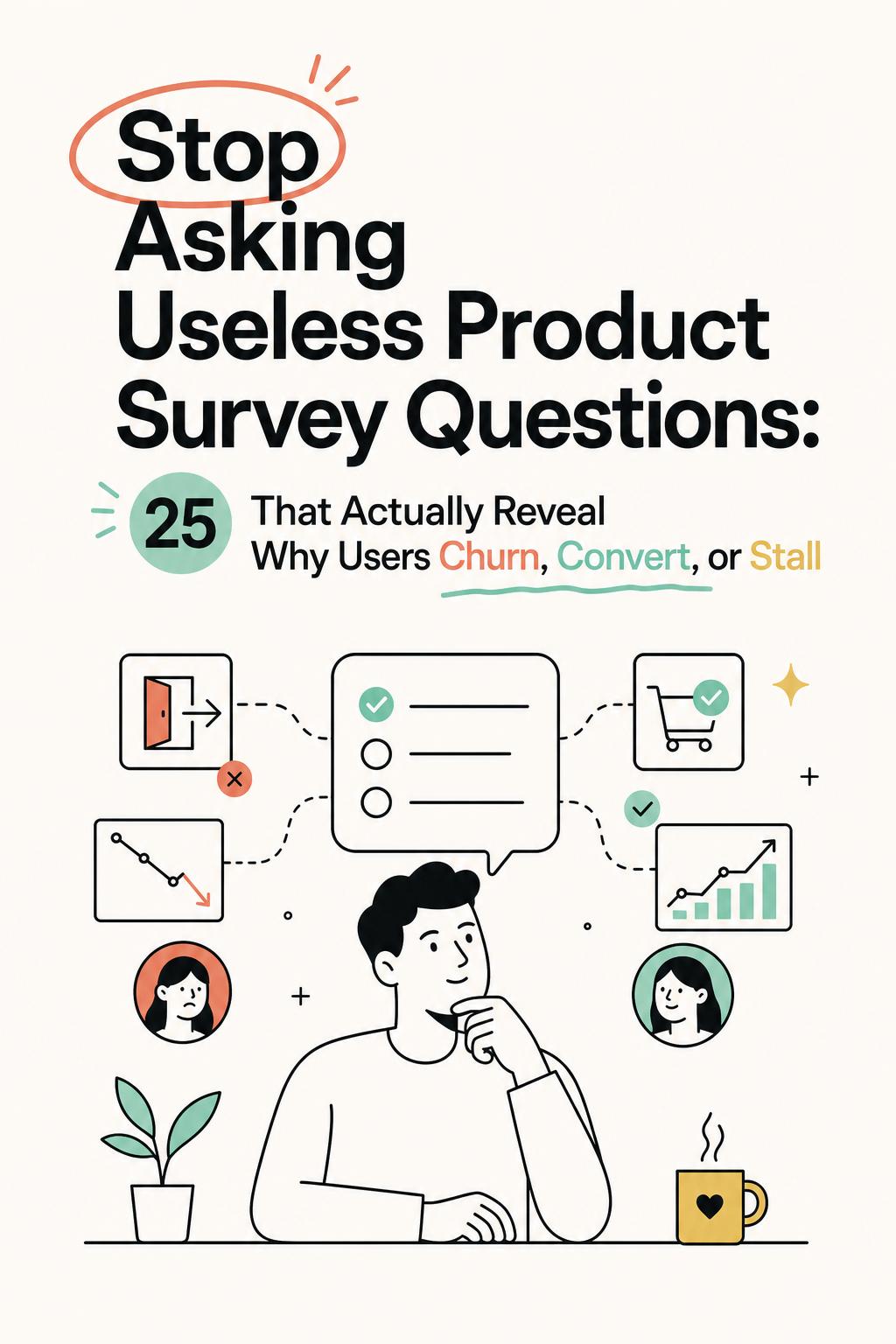
Stop Asking Useless Product Survey Questions: 25 That Actually Reveal Why Users Churn, Convert, or Stall
Here’s the uncomfortable truth: most product survey questions are designed to make teams feel informed, not to actually inform decisions. I’ve watched teams celebrate a 40% response rate and a clean-looking dashboard—while completely missing why activation dropped 18% the same month. The issue wasn’t lack of data. It was asking users the wrong questions at the wrong moment.
If your survey results tend to sound like this—“It’s good overall,” “More integrations please,” “No major issues”—you’re not learning anything actionable. You’re collecting polite noise. And polite noise is dangerous because it looks like insight.
The gap between what users say in surveys and what they actually do in your product is where most product mistakes are born. Closing that gap requires better questions—not more questions.
Why most product survey questions quietly fail
Bad product surveys don’t fail loudly. They fail by producing answers that sound reasonable but don’t map to decisions. The most common issue is that they ask users to generalize instead of recall.
- They ask for summaries instead of moments. “How satisfied are you?” forces users to average multiple experiences into one vague score.
- They rely on hypothetical behavior. “Would you use this feature?” consistently overestimates real adoption.
- They ignore timing. Asking about onboarding weeks later guarantees reconstructed, inaccurate answers.
- They mix user types. Power users and first-time users answering the same survey produce misleading averages.
- They prioritize volume over precision. A large dataset of shallow answers is harder to act on than a small set of context-rich responses.
I once audited a survey for a growth-stage SaaS company that asked users to rate “ease of use” across the product. The average score was 4.2 out of 5. Leadership concluded UX wasn’t a priority. But session data showed users repeatedly abandoning a critical workflow.
We replaced that one question with: “What were you trying to do the last time this didn’t work the way you expected?” Within 48 hours, patterns emerged. The issue wasn’t overall usability—it was one specific step that consistently broke user expectations. The difference was not better analysis. It was a better question.
The only 4 jobs a product survey question should do
If a question doesn’t clearly serve one of these four purposes, cut it.
- Capture real behavior — what the user actually did, recently.
- Explain motivation or friction — why that behavior happened.
- Measure impact — how much it matters to the user or business.
- Segment the user — who this insight applies to.
This framework forces discipline. It prevents surveys from becoming dumping grounds for “nice to know” questions that never influence product decisions.
25 product survey questions that actually drive decisions
These are not generic templates. Each one is designed to map directly to a product decision.
Onboarding and activation
- What were you trying to accomplish when you signed up?
- What nearly stopped you from completing setup?
- What step took longer than expected?
- What was unclear or confusing?
- Did you complete your intended task? If not, why?
These questions isolate friction in the exact moment it occurs. They outperform generic onboarding satisfaction scores every time.
Feature adoption
- What were you trying to do when you used this feature?
- How did you handle this task before?
- What felt missing or harder than expected?
- How often do you need this capability?
- What would make you use this again?
Adoption depends on replacing an existing behavior. If you don’t understand that baseline, you can’t improve usage.
Retention and churn
- What would you miss most if this product disappeared?
- What do you still need another tool to do?
- What nearly made you stop using the product recently?
- How confident are you this will meet your needs in 6 months?
- What would make this product essential?
Retention isn’t about satisfaction—it’s about dependency. These questions reveal whether your product is embedded in real workflows.
Roadmap prioritization
- What is the most frustrating part of this workflow?
- How are you solving it today?
- How often does this problem occur?
- What happens when it does?
- If we fixed one thing, what would save you the most time?
This replaces vague feature requests with concrete workflow breakdowns.
Pricing and value perception
- What part of the product delivers the most value?
- What feels unnecessary or underused?
- What would justify paying more?
- When would this feel too expensive?
- Where does this outperform alternatives—and where doesn’t it?
Value perception is comparative, not absolute. These questions force users to reveal tradeoffs.
The timing mistake that ruins otherwise good questions
A strong question asked at the wrong time is still a bad survey.
The highest-signal surveys are tied to product moments—not email blasts.
Best timing by use case
After onboarding: identify friction while memory is fresh
After repeated usage: understand habit formation
After feature drop-off: diagnose abandonment
At cancellation: capture real churn drivers
This is where most teams underinvest. They treat surveys as periodic instead of contextual.
In one project, we embedded a two-question intercept immediately after users abandoned a key workflow. Response volume dropped by 70% compared to email surveys—but insight quality increased dramatically. We identified a single blocking issue affecting 22% of users. Fixing it improved completion rates within weeks.
This is exactly the kind of use case where tools like UserCall stand out. Instead of static surveys, it enables intercepts triggered by real product behavior, then layers in AI-moderated interviews to go deeper. The key advantage is control—researchers can guide follow-ups, segment responses properly, and analyze qualitative data at scale without flattening nuance.
Why “feature request” questions are a trap
“What feature do you want next?” feels useful but consistently leads teams in the wrong direction.
Users describe solutions in terms of what they can imagine—not what actually solves their problem. This creates noisy, fragmented input.
I worked with a team that collected hundreds of feature requests for reporting improvements. Instead of building the most requested feature, we asked users what they were trying to do after exporting reports. The real issue wasn’t reporting—it was collaboration and sharing insights across teams.
The roadmap shifted from adding charts to improving workflow integration. That decision would not have emerged from feature voting.
A simple workflow for writing high-impact product survey questions
- Define the decision. What will change based on this survey?
- Identify the exact user moment. When does the behavior occur?
- Ask one behavioral question. Anchor in a real event.
- Add one diagnostic question. Identify friction or confusion.
- Add one impact question. Measure importance or frequency.
- Segment if necessary. Capture role or use case differences.
If your survey is longer than six questions, you’re probably diluting signal.
How to analyze responses without misleading yourself
The biggest mistake isn’t collecting bad data—it’s over-trusting it.
Not all responses should carry equal weight. Context matters more than volume.
- Recency: Did the user just experience this?
- Segment value: Is this a high-impact user group?
- Severity: Is this blocking behavior or minor friction?
In practice, a small number of high-severity issues from core users should outweigh a large number of low-impact complaints.
One pattern I always look for is workarounds. If users consistently export data, switch tools, or rely on manual processes, that’s where your product is failing silently. Surveys are one of the fastest ways to surface these gaps—if you ask directly.
The bottom line
Good product survey questions don’t sound impressive. They sound specific, grounded, and sometimes uncomfortably direct.
The goal isn’t to collect feedback. It’s to reduce uncertainty in product decisions.
If your current survey isn’t changing what you build, fix, or prioritize, the issue isn’t your users—it’s your questions.
And once you start asking better ones, the difference is immediate. Not more data. Better decisions.
Run the week on concept testing: 15 to 30 AI-moderated interviews, with quotes back in 48 to 72 hours.
These 25 questions work well for product teams specifically — but if you're also running broader satisfaction or CX surveys, our pillar guide on 50+ customer satisfaction survey questions by use case and stage covers what to ask across the entire customer journey. If typed-out answers keep coming back shallow, Usercall lets you ask these same questions as a conversation and get the follow-up detail forms can't capture.
Related: Concept testing questions · Concept testing research · CPG packaging · Concept testing examples
Related: onboarding feedback survey questions for activation and retention · survey questions for product teams beyond 'what features do you want' · product feedback software that actually improves decisions