
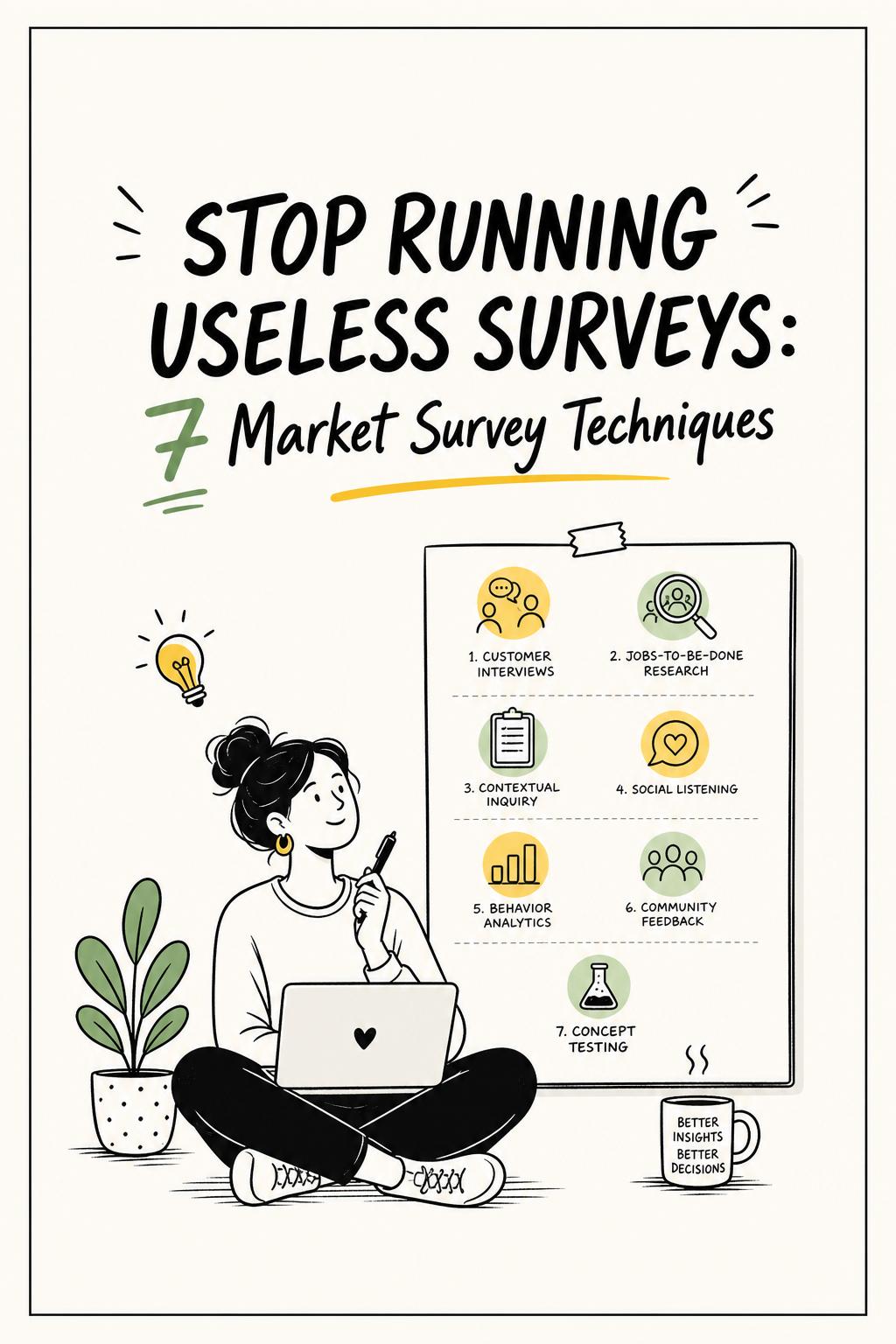
Stop Running Useless Surveys: 7 Market Survey Techniques That Actually Reveal Why Customers Decide
I’ve seen teams celebrate survey results that quietly killed their product strategy.
One company I worked with proudly reported that 72% of respondents said they would “likely use” a new feature. It made the roadmap. Six months later, usage sat below 5%. Nothing was broken. The survey worked exactly as designed—it just answered the wrong question.
This is the uncomfortable truth behind most techniques of market survey: they produce clean dashboards, confident stakeholders, and dangerously shallow insight. The problem isn’t that surveys are outdated. It’s that most teams use them to validate ideas instead of stress-testing decisions.
If you actually want to understand why customers buy, churn, hesitate, or ignore you, you need sharper survey techniques—ones that force tradeoffs, capture real behavior, and connect directly to decisions.
The Core Problem: Surveys Capture Opinions, Not Decisions
Most market survey techniques fail because they rely on stated preference instead of revealed behavior. People are great at expressing intent in theory and terrible at predicting what they’ll actually do under constraints.
That gap creates three consistent failure modes:
- Intent inflation: Customers overstate likelihood to adopt or purchase.
- Priority blur: Everything gets rated “important,” making differentiation impossible.
- Post-rationalization: Users explain decisions in ways that sound logical but weren’t the real driver.
Standard surveys amplify these issues because they optimize for ease of response, not accuracy of insight. If your survey feels frictionless to answer, there’s a good chance it’s also frictionless to fake—unintentionally.
The fix isn’t more responses. It’s better constraints.
7 Market Survey Techniques That Actually Produce Insight
These are the techniques I rely on when the goal is not reporting—but decision-making.
1. Behavioral Recall Surveys (What Actually Happened)
If you only use one technique, use this. Ask about the last real experience, not hypothetical behavior.
Instead of “How do you evaluate tools like this?” ask: “Think about the last time you chose a tool like this—what triggered the search, and what almost stopped you from choosing?”
This forces specificity. And specificity kills generic answers.
In a churn study I ran for a SaaS product, a standard exit survey showed “missing features” as the top reason. But when we reframed the survey around the last usage session, we found something else: users weren’t blocked by missing features—they never reached the point where those features mattered. Onboarding failed long before feature gaps became relevant.
That changed the roadmap completely.
2. Forced Tradeoff (MaxDiff) Techniques
If your survey allows respondents to say everything matters, your strategy will reflect that confusion.
Forced tradeoff techniques eliminate that by requiring respondents to choose what matters most—and least—across options.
This reveals real priorities instead of polite agreement.
I once ran a pricing study where users claimed to value “ease of use,” “automation,” and “customization” equally. After applying forced tradeoffs, customization dropped to the bottom for 80% of respondents. The team had been overbuilding flexibility that most users didn’t want.
3. Needs-Based Segmentation Surveys
Demographics don’t drive decisions. Context does.
The most useful segmentation surveys group users based on urgency, constraints, and decision mindset—not age or company size.
Effective segments often look like this:
- Users trying to move fast and willing to accept imperfections
- Users minimizing risk and requiring proof before acting
- Users optimizing for cost and tolerating friction
These segments directly map to product design, messaging, and sales strategy. Demographic segments rarely do.
4. Triggered In-Product Surveys (Moment-Based Insight)
Timing is more important than wording.
A survey sent days after an experience captures a cleaned-up memory. A survey triggered during the experience captures friction in its raw form.
This is where most teams underinvest. They run quarterly surveys instead of intercepting users at key moments—drop-offs, feature usage spikes, onboarding stalls.
Tools like Usercall are built specifically for this. It combines research-grade AI qualitative analysis with AI-moderated interviews and deep researcher controls, allowing teams to intercept users exactly when something meaningful happens in the product. Instead of guessing why a metric dropped, you can ask in the moment and follow up with depth.
That shift—from delayed feedback to real-time context—is one of the biggest upgrades in modern survey technique.
5. Tradeoff-Based Concept Testing
Most concept testing is flawed because it presents ideas in isolation. Real decisions don’t happen that way.
A stronger approach forces comparison and sacrifice:
- What would you stop using if this existed?
- What budget would this replace?
- What concerns would block adoption?
In one study, a new analytics feature tested extremely well—until we introduced competitive alternatives and switching costs. Interest dropped by nearly half. The concept wasn’t weak; it just wasn’t strong enough to displace existing behavior.
That distinction matters more than top-line appeal.
6. Message Comprehension Surveys
Most teams test whether messaging sounds good. That’s the wrong goal.
You should test whether messaging is understood correctly.
Ask respondents to explain, in their own words:
- What the product does
- Who it’s for
- Why it’s different
If they can’t answer accurately, your positioning isn’t working—no matter how “clear” it seems internally.
This technique consistently exposes gaps between intended messaging and actual perception.
7. Survey + Interview Hybrid Approach
Surveys show patterns. Interviews explain them.
Relying on open-ended survey responses as a substitute for qualitative research is one of the most common mistakes I see.
The better workflow:
- Use surveys to identify patterns and segments
- Select high-signal respondents
- Follow up with interviews to uncover causality
I’ve used this repeatedly in churn research. A survey might show “too expensive” as the top reason. Interviews often reveal the real issue: unclear ROI, low adoption, or internal misalignment. Price becomes the excuse, not the cause.
Without that second layer, teams solve the wrong problem.
A Simple Framework: Match Technique to Decision
The most effective survey programs aren’t built around methods—they’re built around decisions.
If your survey doesn’t map cleanly to a decision, it’s likely producing noise.
How to Design Surveys That Don’t Lie to You
Even strong techniques fail without disciplined execution. Here’s the workflow I use:
- Start with a decision: Define exactly what will change based on the results.
- Target the right moment: Survey users based on recent, relevant experience.
- Force prioritization: Avoid “rate everything” formats.
- Limit length: Shorter surveys produce higher-quality responses.
- Design analysis upfront: Know how you’ll compare segments before launching.
- Plan follow-up: Identify where qualitative depth is required.
One practical constraint I apply: if a question won’t directly influence a decision, it doesn’t belong in the survey. This alone cuts survey length by 30–50% in most cases.
Where AI Changes Market Survey Techniques
AI hasn’t fixed bad surveys—but it has changed what’s possible after you collect responses.
The biggest shift is in connecting structured survey data with unstructured qualitative insight at scale. Instead of manually reading hundreds of responses, AI can cluster themes, detect anomalies, and flag high-signal respondents for follow-up.
More importantly, AI enables continuous research loops. A triggered survey identifies friction. AI analyzes patterns. High-signal users are automatically routed into interviews. Insights feed directly into product decisions.
This turns surveys from static snapshots into dynamic systems.
But none of that matters if the underlying questions are weak. Technique still determines value.
The Real Goal: Fewer Illusions, Better Decisions
The best techniques of market survey don’t give you more data. They remove false confidence.
They force you to confront what customers actually do, not what they say sounds reasonable. They expose tradeoffs instead of hiding them. And they connect directly to decisions instead of generating reports.
If your surveys consistently confirm what you already believe, they’re not working. The most valuable surveys create tension—because they reveal something inconvenient but true.
That’s where real insight lives.
Run the week on concept testing: 15 to 30 AI-moderated interviews, with quotes back in 48 to 72 hours.
Better survey techniques only get you so far—pairing them with the right tools is what turns answers into decisions. Our guide to the 15 best market research tools in 2026 shows how top teams build a stack that goes past surface-level responses, and Usercall can help you get to the 'why' behind every answer through natural, voice-based conversations.
Related: Concept testing questions · Concept testing research · CPG packaging · Concept testing examples
Related: 21 market research survey questions that reveal what customers actually do · market survey methods that actually work · why online market research surveys are broken