
Your B2B Buyer Journey Is a Lie: Why Deals Stall (and How to Actually Fix It)
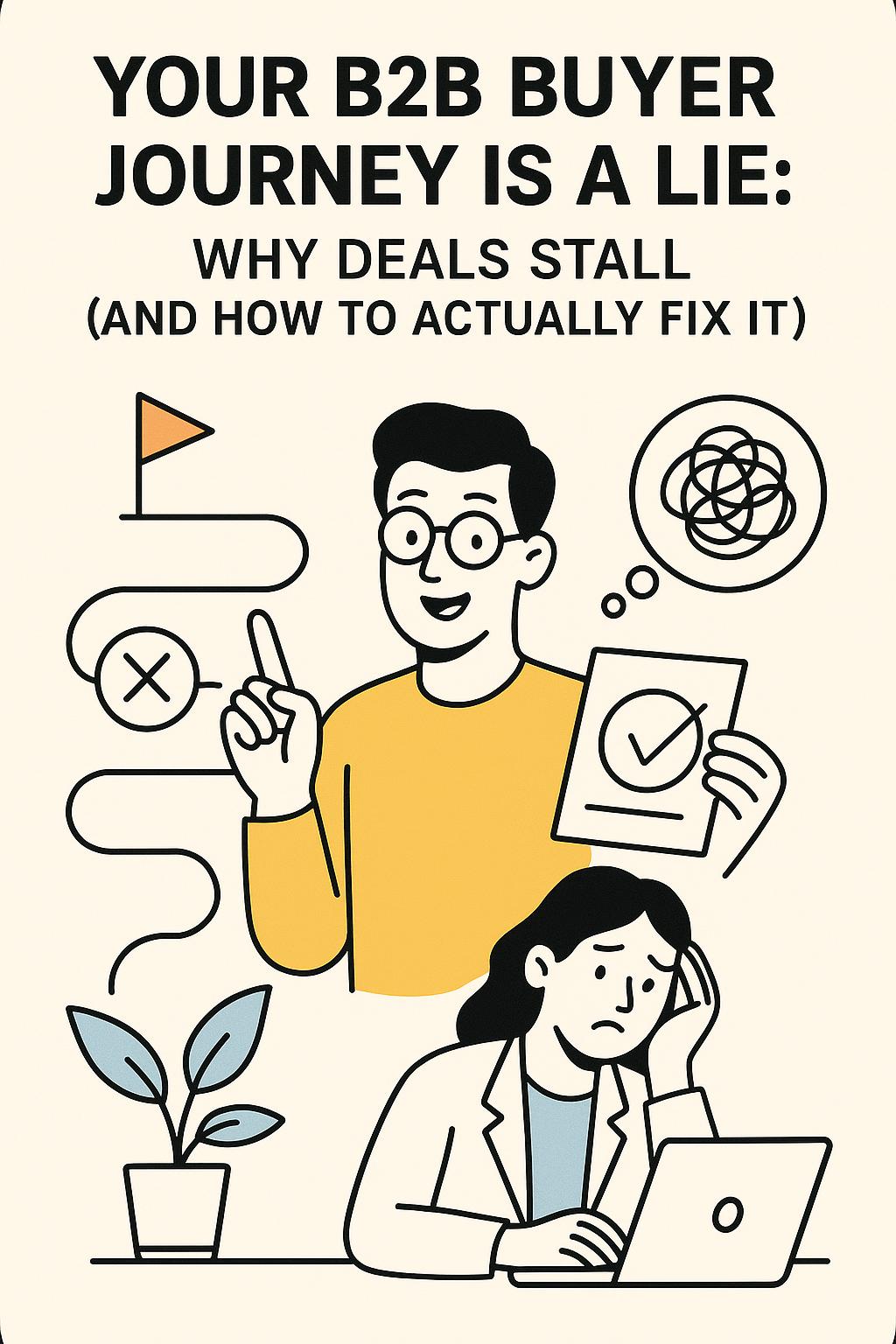
You don’t have a buyer journey problem—you have a visibility problem
Every team I’ve worked with says the same thing: “We know our B2B buyer journey.” They show me a clean funnel, polished stages, and conversion rates that look reasonable—until revenue misses target and no one can explain why.
Here’s the uncomfortable reality: your buyer journey map isn’t wrong—it’s just incomplete in the most dangerous way. It only reflects what your tools can see.
The real journey—the part that actually determines whether a deal closes—happens in Slack threads, internal meetings, and quiet moments of doubt your analytics will never capture. That’s where deals stall. That’s where momentum dies. And that’s exactly the part most teams ignore.
If your strategy is built on funnel metrics alone, you’re optimizing a shadow of the real decision process.
Why most B2B buyer journey models quietly fail
The traditional awareness → consideration → decision model survives because it’s easy to explain. But it breaks the moment you look at real buying behavior.
B2B decisions aren’t linear—they’re negotiated across stakeholders with competing incentives, incomplete information, and risk aversion. The “journey” is less like a funnel and more like a stalled committee.
Here’s where most teams get it wrong:
- They mistake engagement for intent: A demo request often signals curiosity—not commitment. Many buyers are just pressure-testing options for internal discussions.
- They ignore multi-threaded journeys: Your champion, finance, and end users are each on different journeys—and one skeptical stakeholder can override all momentum.
- They over-trust attribution: Attribution explains touchpoints, not decisions. It tells a story after the fact, not the reasoning in the moment.
- They miss “silent churn”: In B2B, deals rarely end with a clear “no.” They fade out when uncertainty outweighs perceived value.
I’ve seen teams double down on top-of-funnel spend because “pipeline looks healthy,” while late-stage deals quietly die due to unresolved internal concerns. The model didn’t fail—their visibility did.
The real B2B buyer journey: a chain of internal decisions
Stop thinking in stages. Start thinking in decisions.
A deal progresses only when multiple stakeholders independently resolve a set of core questions:
- Is this problem urgent enough to prioritize now?
- Is this solution credible and low-risk?
- Can I justify this decision to others internally?
- Will this create more work or reduce it?
If even one of these remains unresolved for a key stakeholder, the journey doesn’t “progress”—it stalls. This is why improving conversion rates often has nothing to do with better messaging or UX tweaks. You’re not removing friction—you’re ignoring it.
Where your analytics mislead you (and what to do instead)
Analytics tools are excellent at telling you what users did. They are fundamentally incapable of telling you why.
This becomes a critical blind spot at high-stakes moments:
- Users hit your pricing page and hesitate
- High-intent trials fail to activate
- Late-stage deals stall after internal reviews
Most teams respond by guessing—adjusting copy, redesigning pages, or tweaking pricing tiers. Occasionally it works. Often it doesn’t. Because the real issue lives outside the interface.
The shift is simple but uncomfortable: you need to capture decision context in the moment it happens.
This is where tools like UserCall change the game. Instead of relying on delayed surveys or secondhand sales feedback, you can trigger AI-moderated interviews at the exact moment of friction—when a user pauses on pricing, abandons onboarding, or drops off after a key action. You get structured, research-grade qualitative insight tied directly to behavioral signals.
That’s how you connect metrics to meaning—and finally understand the buyer journey as it actually exists.
A practical framework: mapping friction, not stages
If you want a buyer journey that reflects reality, stop mapping steps and start mapping breakdowns.
Step 1: Find momentum loss, not just drop-off
Look beyond conversion rates. Identify where deals slow down, not just where they end.
Step 2: Intercept at the moment of hesitation
Capture insights while context is fresh. Retrospective feedback is rationalized—real-time feedback is revealing.
Step 3: Segment by stakeholder role
Group insights by decision-maker type. Patterns emerge faster when you separate economic buyers from users.
Step 4: Define decision blockers explicitly
Label friction clearly: “unclear ROI,” “implementation anxiety,” “internal misalignment.” Vague insights lead to vague fixes.
Step 5: Design interventions that reduce risk
Winning solutions reduce perceived risk—not just increase perceived value. That might mean ROI calculators, onboarding guarantees, or internal pitch decks.
Anecdote: the onboarding fix that had nothing to do with onboarding
I worked with a B2B SaaS company where trial activation rates were stuck at 42%. The team assumed onboarding UX was the issue.
We ran in-the-moment interviews with users who stalled during setup.
The real blocker? Users didn’t have internal approval to connect their data. They weren’t confused—they were cautious.
The fix wasn’t better onboarding flows. It was adding security documentation, internal approval templates, and a “safe mode” demo environment.
Activation jumped to 61% in six weeks.
The journey didn’t improve because we optimized UX. It improved because we removed a hidden decision barrier.
The most underestimated stage: internal selling
The biggest gap in most B2B buyer journey models is what happens after initial interest—when your champion has to sell your product internally.
This is where deals are won or lost.
Common failure points include:
- No clear ROI narrative tailored to finance stakeholders
- Lack of materials for non-technical decision-makers
- Uncertainty about implementation time and risk
I’ve seen strong products lose to weaker competitors simply because the competitor made internal alignment easier. They didn’t have a better product—they had a better “internal sales kit.”
What high-performing teams understand about the B2B buyer journey
The teams that consistently win don’t rely on cleaner funnels. They build deeper visibility into decision-making.
- They treat qualitative insight as a continuous input, not a one-off project
- They instrument key moments with user intercepts to capture real intent
- They align product, marketing, and sales around shared buyer insights
- They optimize for decision confidence—not just conversion rates
They don’t ask “How do we move users to the next stage?”
They ask “What’s preventing this decision from feeling safe?”
If you remember one thing
Your B2B buyer journey is not a funnel. It’s a series of risk calculations happening across multiple մարդկանց you rarely hear from.
If you’re not actively capturing those hidden conversations, your strategy is built on guesswork—no matter how sophisticated your analytics look.
The teams pulling ahead right now aren’t the ones with better dashboards. They’re the ones who’ve figured out how to systematically uncover what their dashboards can’t see—and act on it.
Run the week on concept testing: 15 to 30 AI-moderated interviews, with quotes back in 48 to 72 hours.
Stalled deals are a symptom of a journey map that doesn't reflect how buyers actually decide. Our research-led guide to customer journey mapping walks through the interview techniques that expose the real friction points, and Usercall can run those buyer conversations for you so your sales and product teams work from the same evidence.
Related: Concept testing questions · Concept testing research · CPG packaging · Concept testing examples
Related: the B2B touchpoints most teams miss · why buyer journey mapping is broken · the real moments that drive conversion