
Brand Tracking Is Broken in Most Companies, and Nobody Wants to Admit It
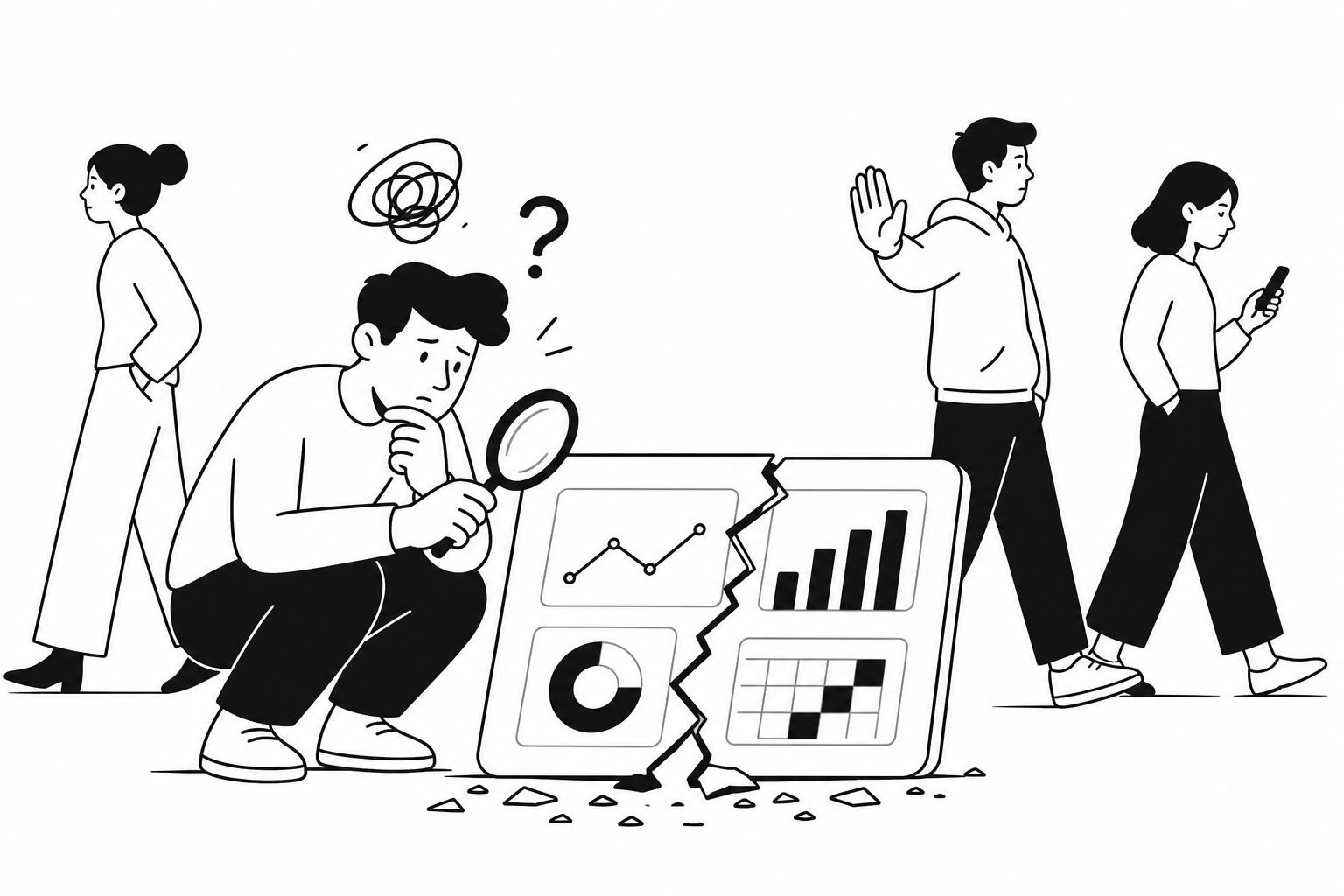
I've sat in more brand tracking readouts than I can count, and the pattern is always the same. Someone presents a slide with a line trending slightly up or slightly down, the room nods, and then everyone goes back to their desks with zero idea what to actually do differently. The tracker gets funded again next quarter because canceling it feels risky, even though nobody can point to a decision it changed.
That's the dirty secret of brand tracking. Most programs are optimized for producing a number, not for producing an answer. If you've ever sat through a QBR wondering why your brand health score moved two points and what you're supposed to do about it, you already know what I'm talking about.
I've built and rebuilt brand tracking programs at three different companies, and I've watched agencies charge six figures for dashboards that executives glance at once a quarter. This post is my honest breakdown of what brand tracking should actually do, where it goes wrong, and how to fix it without burning your budget or your credibility.
What Brand Tracking Is Actually Supposed to Measure
Brand tracking exists to answer one question: is our brand getting stronger or weaker in the minds of the people who matter to our business. That sounds simple, but most teams never define what "stronger" means for their specific business, so they default to generic metrics like awareness and favorability that don't connect to revenue or retention.
I once inherited a tracker that measured seventeen different brand attributes every quarter. When I asked the team which of those seventeen actually predicted customer behavior, nobody could tell me. We'd been paying an agency to collect data nobody had validated against outcomes. I go deep into what a tracking program should actually measure, and where teams get this fundamentally wrong, in this breakdown of what brand tracking actually measures. If you're building or auditing a program right now, start there before you spend another dollar on data collection.
The short version: pick three to five metrics that have a demonstrated relationship to business outcomes in your category, track them consistently, and resist the urge to add more just because a stakeholder asks for it. Every metric you add dilutes attention from the ones that matter.
Why Awareness Numbers Lie to You More Than Any Other Metric
Awareness is the metric everyone loves to report because it's easy to explain to a board. "We're at 34% aided awareness, up from 31% last year." Sounds good. Means almost nothing.
Here's the problem I've run into repeatedly. Aided awareness surveys ask people if they recognize a brand name from a list, and recognition is not the same as memory or relevance. I ran a study once where 40% of respondents claimed awareness of a brand that hadn't run any marketing in eighteen months. They weren't lying, they were pattern matching on a familiar-sounding name and clicking yes to move through the survey faster. Real brand memory looks different. It's unaided, it's contextual, and it usually requires asking people to explain in their own words what they remember and why, not just checking a box. I wrote a full piece on this because it's one of the most common blind spots in tracking programs. Check out why brand awareness research is lying to you and what customers actually remember for the methodology fix.
The practical takeaway: if your awareness numbers only come from a multiple choice checklist, you're measuring recognition bias, not brand strength. Pair quantitative awareness scores with open-ended recall questions, ideally through voice or interview-based research where people have to articulate their answer instead of clicking one.
The Seven Moments That Actually Build or Break Trust
Brand tracking tells you the score. It doesn't tell you why the score moved. That's where most programs stop, and it's the single biggest waste of research budget I see in this space. I worked with a fintech client whose trust score dropped six points in one quarter. The tracker flagged it. Nobody could explain it. We ran a round of follow-up interviews and found the entire drop traced back to a single change in their onboarding flow that made new users feel like they were being upsold before they'd even used the product. That's not something a tracker catches. That's something you find by talking to people about specific moments in their experience.
There are predictable touchpoints where trust gets won or lost, and if you're not measuring those moments directly, you're missing the actual mechanism behind your brand score. I laid out the full framework in this piece on the seven moments that decide whether customers trust your brand. If your tracker only measures outcomes and never the experiences that cause them, you're always going to be reactive instead of predictive.
The fix here isn't complicated. Layer qualitative moment-based research on top of your quantitative tracker. When a score moves, you should already have a hypothesis about which moment caused it, because you've been tracking those moments separately all along.
Should You Hire an Agency or Build This Yourself
This is the question I get asked most often, and the honest answer is that it depends on what you actually need the program to do. I spent four years on the client side of agency-run brand trackers, and I can tell you exactly what you're paying for: methodology design, fieldwork management, and a polished deck. What you're often not paying for is genuine strategic insight, because most agency analysts are juggling a dozen accounts and don't have time to dig past the topline numbers.
I remember one agency engagement where we paid nearly $150,000 a year for quarterly waves, and the "insights" section of every deck was three bullet points that restated the data without explaining any of it. When I pushed the account team for a deeper read, they admitted their analyst turnover meant nobody on the account had context from more than two quarters back. We were paying for continuity we weren't actually getting.
That's not true of every agency, there are excellent ones, but it's true often enough that you should go in with eyes open. I break down exactly what to watch for and what questions to ask before you sign a contract in this guide on hiring a brand tracking agency. The core issue is that most agencies are structured to deliver data, not answers, and those are very different products even though they're sold as the same thing.
If your team has research talent in house and just needs better tooling, building your own program with a mix of survey and voice-based qualitative tools is usually cheaper and faster to act on. If you have no internal research capacity at all, an agency can still make sense, but negotiate for named senior staff on your account and insist on a working session, not just a deck drop.
Choosing the Right Software Instead of Building From Scratch
If you decide to run tracking in house, the tooling decision matters more than people think. I've seen teams buy an enterprise brand tracking platform with a year-long implementation timeline when what they actually needed was a lighter tool they could stand up in a week and iterate on.
The market has shifted a lot in the last two years. There are now tools built specifically for continuous brand monitoring that combine survey data with social listening and qualitative signals, instead of forcing you to stitch together three separate vendors. I put together a comparison of the ten tools I'd actually recommend evaluating in this rundown of the best brand tracking software for ongoing monitoring, with notes on which ones are built for enterprise complexity versus which ones are better for lean teams that need speed.
Here's a simplified way to think about the tradeoffs when you're evaluating options:
| Priority | What to look for | What to avoid |
|---|---|---|
| Speed to insight | Tools with built-in qualitative analysis, not just raw survey exports | Platforms requiring a data team to interpret every wave |
| Cost efficiency | Usage-based or flat SaaS pricing | Agency retainers billed per wave with change fees |
| Depth of insight | Voice or open-ended response capture with theme extraction | Closed-ended surveys only |
| Team size fit | Self-serve setup for lean teams | Enterprise tools requiring dedicated admin headcount |
Whatever you pick, make sure it can capture qualitative context alongside the quantitative score. A number without a reason attached is a number you'll misinterpret eventually.
Writing Survey Questions That Don't Waste Everyone's Time
Even the best tracking strategy falls apart if the survey itself is badly written. I've reviewed brand surveys with leading questions, double-barreled items, and scales that don't match the construct they're supposedly measuring. Bad questions produce bad data no matter how sophisticated your analysis pipeline is downstream.
A common mistake I still see from experienced researchers: asking "How likely are you to recommend our brand to a friend or colleague based on quality and value?" That's two questions jammed into one, and you'll never know if a low score is about quality, value, or both. I put together a full set of question templates and a framework for structuring a brand survey properly in this guide with 20 essential brand survey questions and templates. Use it as a starting checklist before your next wave goes out, especially if you're revising a legacy survey that's been copy-pasted for years without anyone questioning whether the questions still make sense.
One tip that's saved me more than once: run your draft survey past five real customers in a short interview before you field it broadly. You'll catch confusing wording and bad assumptions in twenty minutes that would otherwise skew your data for an entire quarter.
Bringing It All Together
A brand tracking program that actually works has three components: a small set of validated metrics, a qualitative layer that explains why those metrics move, and a cadence that's frequent enough to catch problems before they compound. Most companies have one of these three. Almost none have all three. The fastest way to fix a broken tracker isn't a bigger survey or a fancier dashboard. It's adding a consistent qualitative layer, real conversations with real customers, so that every quantitative shift comes with a "here's why" attached instead of a shrug in the boardroom.
If you're rebuilding your brand tracking program this year, run the qualitative and quantitative sides together, not as separate projects six months apart. That's where the actual insight lives, and it's the difference between a tracker people glance at and a tracker that changes decisions.
Usercall runs AI-moderated voice interviews at scale, so you can layer real customer conversations onto your brand tracking data without waiting on agency timelines or burning a research budget on manual interviews. If you want the "why" behind your brand scores instead of just another number on a slide, that's exactly what we built it for.