
Focused Group in Research: How to Get Honest Insights Instead of Polite Agreement
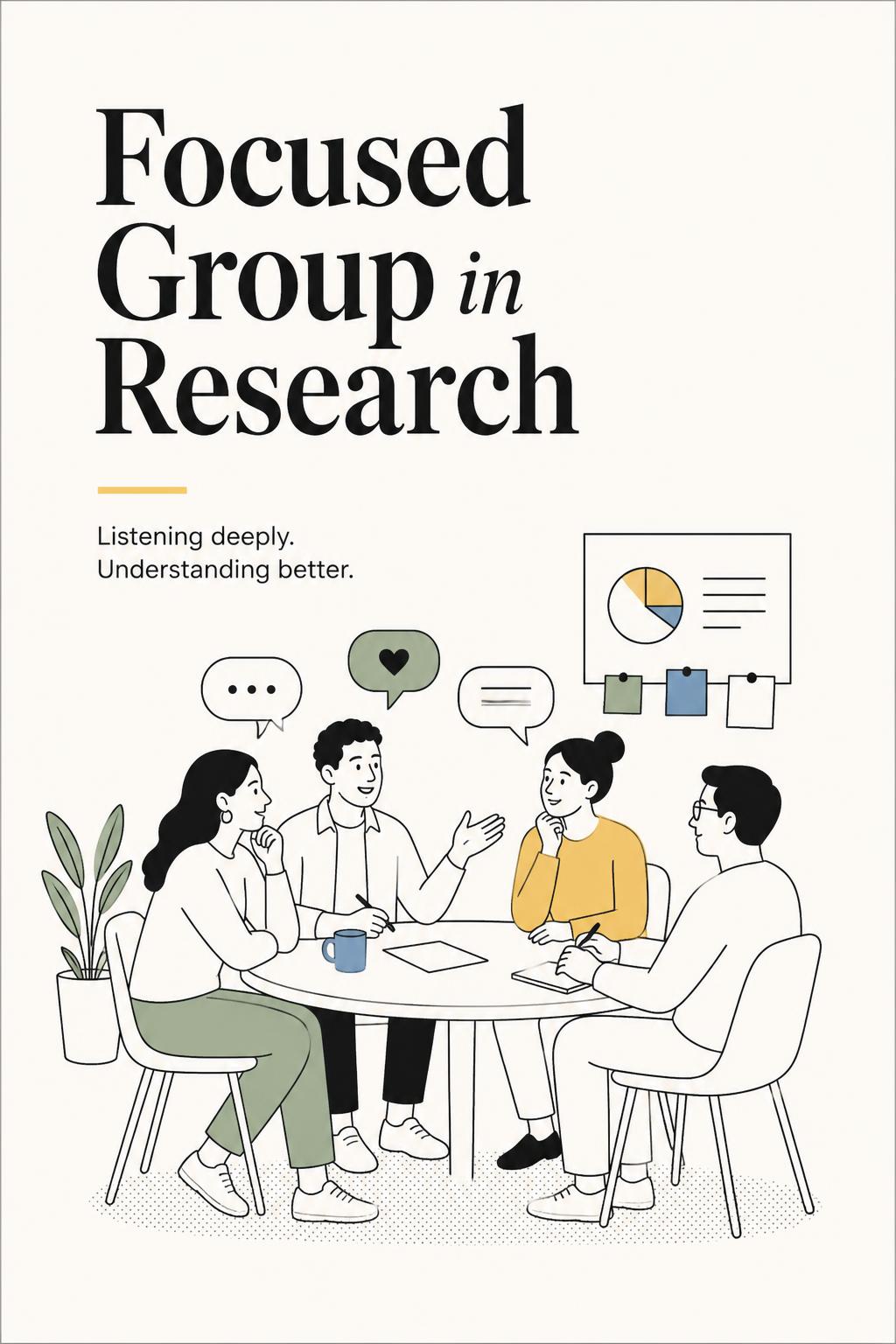
A focused group in research can make a weak product idea look brilliant. Put six polite participants in a room, show them a polished concept, ask whether they would use it, and most will find something positive to say. The team leaves encouraged. Three months later, adoption is flat because the group validated the idea people wished they would choose, not the behavior they actually follow under time pressure, budget limits, and workplace politics.
I have watched this happen when a product team mistook nodding for demand. Their concept tested well because participants liked the promise of automation. But the real workflow required managers to explain automated decisions to executives when something went wrong. In the group, nobody wanted to sound resistant to innovation. When we asked them to describe the last decision they had to defend, the actual barrier surfaced: they did not need more automation; they needed a clear audit trail, easy overrides, and protection from blame.
That is the real value of a focused group. It is not a fast way to collect opinions. It is a method for exposing the social, emotional, and practical tensions that surveys and product metrics routinely miss.
What a Focused Group in Research Should Actually Do
A focused group in research, more commonly called a focus group, is a guided discussion with a small group of people selected because they share a relevant experience, role, behavior, or decision context. Most effective groups include five to eight participants and last 60 to 120 minutes.
But the format matters less than the purpose. Focus groups are not built to prove market demand, rank a backlog, or predict conversion rates. They are built to reveal how people make sense of a problem in front of other people. That makes them exceptionally useful when buying, adoption, trust, identity, status, or group norms influence behavior.
Individual interviews are better for private experiences: financial anxiety, workplace frustration, confusing workarounds, or sensitive failures. Analytics are better for determining where users drop off. Usability tests are better for finding interface friction. A focused group earns its place when you need to understand shared language, contested beliefs, and the arguments people use to justify a choice.
For example, a one-to-one interview may reveal that a customer avoids reviewing their spending because it creates anxiety. A focused group may reveal that people reject budgeting tools that feel judgmental or paternalistic. The first finding concerns behavior. The second concerns positioning, tone, and the social meaning of your product.
Why Most Focus Groups Produce Weak Evidence
The common focus group format is designed for comfortable conversation, not useful insight. Researchers ask broad warm-up questions, introduce a finished concept too early, and then ask participants whether they like it. This approach fails because it turns participants into a temporary review panel.
- “Do you like it?” is a courtesy trap. Participants know a team invested time in the concept. They offer encouragement, not the resistance they would show in real life.
- Early concepts anchor the entire discussion. Once people see your proposed solution, they start responding to your framing instead of describing their own needs, workarounds, and decision criteria.
- One confident participant can manufacture consensus. The first strong opinion often becomes the group’s reference point, particularly when less experienced participants are reluctant to disagree.
- Mixed segments create false averages. New users, power users, churned customers, and decision-makers often have opposing needs. Combining them may create an interesting conversation but an unusable conclusion.
- Articulate explanations are mistaken for behavioral truth. People are skilled at explaining their choices after the fact, even when those choices were shaped by habit, inertia, fear, or internal politics.
The deeper problem is that teams use focus groups to answer questions the method cannot answer. Six people cannot tell you whether 20% or 60% of your market will buy. They can tell you why a seemingly attractive offer feels risky, vague, embarrassing, expensive, or hard to defend.
The Better Model: Research the Tension Behind the Decision
The strongest focus groups are organized around a tension, not a feature. A tension is the conflict a person is already managing between two worthwhile but incompatible outcomes.
Consider a team exploring AI-generated meeting summaries. The shallow question is, “Would you use automatic summaries?” The more revealing tension is, “How do managers move faster without being held accountable for a summary that misses a critical commitment?” That question produces stories about review behavior, trust thresholds, liability, and the circumstances in which people will accept or reject automation.
Before writing your discussion guide, define the decision tension using this framework:
- The decision: What are people choosing, postponing, abandoning, or working around?
- The trigger: What event makes this problem urgent enough to require action?
- The tradeoff: What do they gain by acting, and what do they fear losing?
- The workaround: What do they use today instead, including manual processes, spreadsheets, colleagues, or competing products?
- The social consequence: Who sees the decision, challenges it, benefits from it, or blames them if it fails?
This model prevents a common research mistake: treating friction as the core problem when it is merely a symptom. A customer may complain that an approval process takes too long. The actual issue may be that they cannot see who is responsible for the next step. Removing clicks will not solve the problem if the product still leaves them exposed when a deadline slips.
Recruit People Who Can Disagree for Useful Reasons
Recruitment determines whether your focused group produces insight or vague commentary. Demographic variety can be valuable, but behavioral relevance is more important. People should share enough context to understand the subject quickly, while differing in ways that make their perspectives meaningfully comparable.
If you are researching churn in a B2B analytics product, do not recruit a single group of “users.” Run separate groups for recently churned accounts, retained accounts with falling usage, and expanding accounts. Their views should not be averaged together. Churned customers may identify broken expectations. Retained customers may reveal switching costs. Expanding customers may show the moments where value becomes undeniable.
Screen for recent behavior, not self-reported interest. “Uses project management software” is weak recruitment criteria. “Changed project management tools within the last 90 days and participated in the buying decision” is much stronger. Recency gives participants access to details: the trigger event, the internal objections, the alternatives considered, and the moment the decision became irreversible.
In a study for a subscription service, I rejected a broad screener that recruited people who described themselves as “price conscious.” We instead recruited people who had cancelled a subscription in the previous 45 days. That constraint narrowed the pool, but it changed the discussion completely. Participants could describe the cancellation moment in detail: the email they ignored, the charge they noticed, and the exact point where the service stopped feeling worth defending.
A Moderation Workflow That Gets Beyond Polite Answers
The moderator should not act like a host protecting a pleasant discussion. The moderator should create enough safety for disagreement and enough structure to make decision logic visible.
Start with a specific past event
Ask participants to reconstruct the last time they encountered the situation you are studying. “Tell me about the last time you had to get approval for an unexpected purchase” is far better than “How do you feel about purchasing approvals?” Follow the sequence: what happened first, who was involved, what they tried, what delayed them, and what happened afterward.
Map the current workaround before showing anything new
Ask participants to describe the tools, messages, handoffs, and shortcuts involved today. Workarounds often reveal the product opportunity more clearly than complaints. A spreadsheet used alongside your software may not mean users dislike modern tools. It may mean they need a level of visibility, ownership, or exportability your product does not yet provide.
Show concepts late and keep them deliberately unfinished
Do not open with a polished prototype. A polished design encourages visual critique and politeness. A rough concept signals that correction is welcome. Ask what feels missing, what would make the idea unsafe to use, and what condition would need to be true before they changed their current behavior.
Create independent thinking before discussion
Before asking the group to compare concepts or identify barriers, give everyone two minutes to write privately. Then ask participants to share their answers. This small step reduces anchoring and exposes the gap between individual reaction and public agreement.
In one consumer research group, participants initially agreed that price was the main reason they cancelled a service. Their private written responses told a different story: four of seven said they simply forgot what value they were receiving. The team had been planning a discount experiment. Instead, they tested an in-product usage recap and a clearer explanation of plan value. The issue was not only price; it was invisible value.
Force real tradeoffs
People will ask for speed, control, customization, simplicity, lower cost, and more support at the same time. Your job is to make the tradeoff explicit. Ask, “Would you still want this if setup took 15 extra minutes?” “If you could only keep one of these protections, which one would matter?” “What would make you refuse to use this even if it saved time?” The answers reveal priorities far better than feature ratings.
How Many Focus Groups Are Enough?
There is no honest universal number. For a narrow audience and a tightly defined decision, two or three groups per meaningful segment can reveal repeated patterns and important disagreement. For a new market, complex B2B buying process, or sensitive topic, expect to run additional rounds as new hypotheses emerge.
Use decision risk as your guide. If you need language for a landing page, a small set of focused groups may generate strong hypotheses. If the findings will determine a major repositioning, pricing strategy, or product investment, focus groups should be one evidence layer among behavioral data, support conversations, sales calls, usability sessions, and individual interviews.
Turn Discussion Into Decisions, Not a Quote Dump
A transcript full of memorable quotes is not analysis. Quotes can make a presentation persuasive, but they do not explain whether an issue is widespread, intense, situational, or strategically important. The standard for a useful finding is a mechanism.
“Users want more control” is a weak finding. “Operations managers accept automated routing only when they can inspect the reason for a decision, override it without escalation, and show an audit trail to leadership” is a strong finding. It identifies the user, the trust condition, the product requirement, and the risk your experience must reduce.
For each finding, capture the segment, the observed tension, the current workaround, the evidence of intensity, the condition for behavior change, and the implication for product or messaging. Do not bury disagreement. If novice users want more guidance while experienced users find the same guidance intrusive, that is not messy data. It is a segmentation decision waiting to be made.
Use AI to Extend the Research, Not Replace Judgment
AI can remove much of the slowest qualitative work: transcription, first-pass coding, theme comparison, retrieval of relevant moments, and synthesis across sessions. That is especially valuable when you need to connect a handful of focus groups with dozens of interviews, support tickets, or open-text survey responses.
But AI cannot determine whether a participant’s concern about “control” is really about distrust, accountability, status, or fear of being blamed. A researcher must still interpret contradictions, context, emotional cues, and the incentives affecting what people say in a group.
The Test of a Strong Focus Group
A good focused group in research should make your team less comfortable with an easy assumption and more precise about what customers need to change behavior. You should leave with more than a list of requested features. You should understand the tension customers are managing, the workaround they protect, the risk they refuse to take, and the proof your product must provide.
Do not judge the session by whether participants liked your concept. Judge it by whether they exposed the hidden rule your product has been violating. That is where the real research value begins.
Getting past polite agreement requires rethinking not just your questions but your entire research format. Our pillar guide on focus group research covers the recurring failure patterns and what actually works across formats. If you want honest, tension-revealing feedback without managing group dynamics, Usercall runs structured 1:1 conversations that get straight to real customer thinking.
Related: how to conduct a focus group that produces real insight · the research method teams misuse · interviews vs. focus groups compared