
Customer Experience Is Broken and Your Dashboard Is the Last One to Know
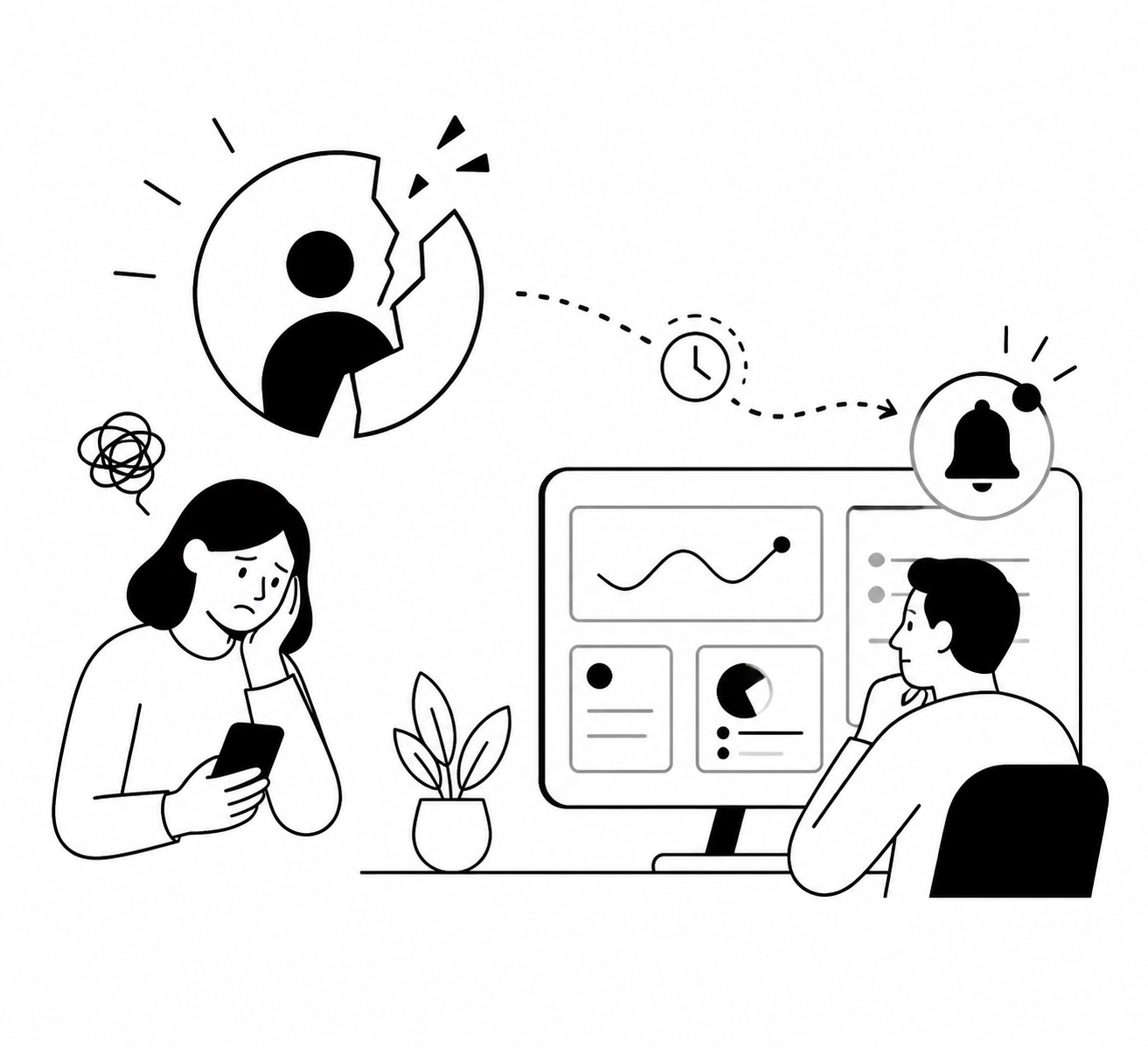
I've sat behind one-way glass watching a customer describe, calmly and in detail, why she was about to cancel a $40,000 annual contract. Her NPS score from three weeks earlier had been a 9. That gap between what people tell you in a survey and what they actually feel is the entire customer experience problem in miniature. Most CX programs are built to measure satisfaction, not understand it, and that distinction is costing companies customers they didn't even know they'd lost until the churn report landed.
I've spent over a decade running qualitative research for product and CX teams, and I keep seeing the same pattern. Teams invest in dashboards, scores, and survey tools, then wonder why churn keeps climbing despite "healthy" metrics. The problem isn't measurement. It's that most measurement systems are structurally incapable of catching the moments that actually determine whether someone stays or leaves.
Why Most Customer Experience Programs Are Optimizing for the Wrong Thing
Every CX team I've worked with starts with good intentions and the wrong scoreboard. They pick a metric, usually NPS or CSAT, set a target, and build an entire operating rhythm around moving that number. The problem is that a single score can't tell you why someone is frustrated, only that they are, roughly, on a scale of 1 to 10.
I worked with a mid-size SaaS company that had spent two years chasing a five-point NPS increase. They hit the target. Retention didn't move. When we finally ran structured interviews with recently churned accounts, the real story emerged: onboarding felt fine, support felt fine, but customers had quietly given up trying to get a specific integration working and just stopped mentioning it. Nobody was unhappy enough to complain. They were just tired enough to leave.
This is the core failure mode I break down in why most CX efforts fail and what actually works. The short version: CX improvement isn't a scorecard exercise, it's a listening exercise, and most teams stopped listening the day they started scoring.
Your Metrics Are Lying to You, and Not on Purpose
Here's an uncomfortable truth about CX metrics: they measure sentiment at a single point in time, usually right after an interaction, when people are least likely to be thinking about the slow accumulation of friction that actually drives loyalty or defection. A customer who just got a fast, polite support response will rate that interaction highly even if they've been quietly frustrated with your product for months. I call this the "transaction trap." You're measuring the transaction, not the relationship. And relationships are what churn.
I broke this down in detail in why your CX metrics lie and what actually drives loyalty, but the pattern is consistent across every industry I've researched: the accounts most likely to churn often have decent transactional scores right up until the day they leave. If you're only looking at the dashboard, you will always be surprised.
The deeper issue is what I've started calling the "hidden reason" problem. Customers rarely tell you the real reason they're disengaging, partly because they don't always know it themselves, and partly because most feedback channels aren't designed to surface it. I go into this in the hidden reason customers quit before your dashboard sees it. The short answer: by the time a metric moves, the decision to leave was usually made weeks earlier, in a moment nobody was measuring.
AI Is Being Bolted Onto CX Without Fixing the Underlying Problem
Every CX vendor I talk to now has an AI story. Most of them are solving the wrong problem faster. Auto-summarizing support tickets, auto-tagging sentiment, auto-routing complaints, these are useful, but they optimize the same shallow layer of data that was already misleading you before AI got involved. I've reviewed a lot of "AI customer experience" rollouts, and the pattern I see most often is teams using AI to process more of the same low-signal data instead of using it to go deeper into the data that actually matters, like open-ended conversation.
I wrote a full breakdown of where teams get this wrong and how to actually fix it in what most teams get wrong about AI customer experience. The teams getting real value from AI in CX are using it to have more conversations, analyze them faster, and surface patterns across hundreds of interviews, not to skip the conversation altogether.
There's a more specific trap I've seen repeatedly in support organizations: AI systems that mark a conversation "resolved" because the customer stopped replying, when in reality the customer gave up. I covered this exact failure in the costly AI mistake that makes customers feel more ignored. A closed ticket is not the same as a solved problem, and any AI system that conflates the two will make your CX metrics look better while your actual customer experience gets worse.
A Quick Framework for AI in CX
| Use Case | Good AI Application | Risky AI Application |
|---|---|---|
| Support tickets | Summarizing conversation for agent handoff | Auto-closing tickets based on inactivity |
| Feedback analysis | Extracting themes from open-text responses | Scoring sentiment as the sole quality signal |
| Interviews | Moderating open-ended conversations at scale | Replacing all human follow-up with static surveys |
| Churn prediction | Flagging accounts for qualitative follow-up | Treating the prediction score as the final answer |
Ecommerce Has a Version of This Problem That's Even Harder to See
In ecommerce, the moment of experience failure often happens before a single support ticket is ever created. Someone lands on a product page, gets confused about sizing, hesitates on shipping cost, or just doesn't trust the return policy, and leaves. No complaint, no support ticket, no NPS survey. Just a closed tab. I ran a project for a DTC brand where we recruited people who had added items to cart and abandoned within the last 48 hours, and interviewed them within a day of that behavior. The reasons they gave bore almost no resemblance to what the analytics dashboard suggested. It wasn't price. It was uncertainty about fit, expressed in a dozen different ways, none of which showed up as a clean funnel drop-off reason.
This is the exact dynamic I mapped out in the hidden reason shoppers leave before they buy. If your ecommerce CX strategy is built entirely on funnel analytics and post-purchase surveys, you are missing the entire pre-purchase experience, which is where most of the actual damage happens.
Enterprise Software Has Its Own Silent Churn Problem
Enterprise software experience is a different beast, but the underlying issue is the same: the people who are frustrated are often not the people filling out your satisfaction surveys. I spent time researching user frustration with SAP implementations, and the pattern was almost comically consistent. IT leadership reported the rollout as successful. The actual end users, the people doing data entry and running reports every day, described the experience in terms usually reserved for tax audits. The disconnect exists because enterprise software feedback loops are structured around procurement relationships, not daily users. The person who signs the renewal contract rarely does the work the software was bought to support.
I dug into what's actually driving this frustration and what to fix first in the real reason users hate SAP and what to fix first. If you're running CX research for enterprise software, you need to be talking to end users directly, not relying on the account relationship to surface problems it's structurally incapable of seeing.
Customer Service and Customer Experience Are Not the Same Thing
This confusion costs companies more than almost any other CX mistake I see. Customer service is a component of customer experience, not a substitute for it. You can have a fast, friendly, highly-rated support team and still be bleeding customers because the product experience itself is frustrating, the pricing feels unfair, or the onboarding sets the wrong expectations. I worked with a company that had genuinely excellent support metrics, sub-two-minute response times, high CSAT, glowing reviews of individual agents, and a churn rate that kept climbing anyway. The support team was doing a great job responding to symptoms of a disease nobody was treating.
I unpacked this distinction and what actually moves the needle in how customer service experience is quietly killing your growth. The teams that fix this stop measuring service quality in isolation and start asking why customers needed to contact support in the first place. Every ticket is a research prompt, not just a task to close.
IT and B2B Teams Have the Same Blind Spot, Just Less Visible
B2B and internal-facing IT experiences get almost no research attention compared to consumer-facing CX, which is strange given how much revenue and productivity rides on them. I've run studies inside companies where "customer experience" for an internal tool was treated as a training problem, when the actual issue was that the tool itself required workarounds nobody had documented. The metrics available in most IT CX contexts, ticket volume, resolution time, uptime, are operational health indicators, not experience indicators. They tell you the system is running. They don't tell you whether the people using it feel competent, frustrated, or quietly building their own workaround spreadsheet.
I go deeper into why these metrics hide the real problem in why IT customer experience is failing and your metrics are hiding it. The fix isn't a new dashboard. It's direct conversation with the people actually using the system day to day, without IT staff in the room shaping the answers.
What Actually Works: Building a CX Research Practice, Not Just a Metrics Program
After years of watching CX programs succeed and fail, the difference almost always comes down to whether the team treats research as a continuous practice or a quarterly check-in. The companies that get this right build a rhythm of ongoing qualitative conversation into their operations, not just an annual survey cycle. Here's the practical shift I recommend to every team I advise:
- Stop treating NPS and CSAT as diagnostic tools. Use them as triggers for follow-up conversation, not conclusions.
- Talk to customers at the moment of the behavior you care about, not weeks later in a quarterly survey.
- Interview churned and about-to-churn customers specifically. They will tell you things happy customers never will.
- Separate "resolved" from "actually satisfied" in every support and success workflow.
- Give frontline teams a direct channel to flag patterns, not just individual tickets.
None of this requires an army of researchers. It requires a system that makes ongoing conversation cheap enough and fast enough to run continuously, which is a very different constraint than it was even five years ago.
The Tools Landscape Has Changed More Than Most Teams Realize
The tooling available for CX research in 2026 looks nothing like it did even three years ago. Traditional survey platforms are still useful for tracking directional sentiment at scale, but they were never built to explain the "why" behind a score. Agency-run qualitative research still produces excellent depth, but it's slow and expensive enough that most teams only do it once or twice a year, which means it's structurally incapable of catching problems as they emerge. I put together a comparison of what's actually worth adopting in 12 proven customer experience tools for 2026, covering everything from analytics platforms to AI-moderated interview tools. The short version: the biggest shift is the emergence of tools that can run structured, open-ended conversations at scale and analyze them automatically, closing the gap between "we ran one round of interviews last quarter" and "we have a live pulse on why customers are actually behaving the way they are."
The Real Fix Isn't a Better Dashboard
Every example in this post points to the same conclusion. Dashboards tell you what happened. They rarely tell you why. And in customer experience, the why is the only thing that's actionable. You can't fix a friction point you haven't identified, and you can't identify it by staring at an aggregate score that's already three steps removed from the actual human moment that caused it. The teams winning at CX right now aren't the ones with the most sophisticated scoring models. They're the ones who've made it cheap and fast to have real conversations with real customers, continuously, and who've built the discipline to act on what they hear instead of just reporting it up the chain.
If you're serious about fixing customer experience instead of just measuring it, you need a way to run structured, voice-based conversations with customers at scale, without waiting months for an agency or burning your team's time on manual interview scheduling and analysis. That's exactly what Usercall was built for. It runs AI-moderated voice interviews that surface the themes and quotes hiding behind your metrics, so you catch the reasons customers are leaving before your dashboard ever does. Try it and see what your customers have actually been trying to tell you.