
AI for Market Research: Why Most Teams Get Faster Insights—and Worse Decisions
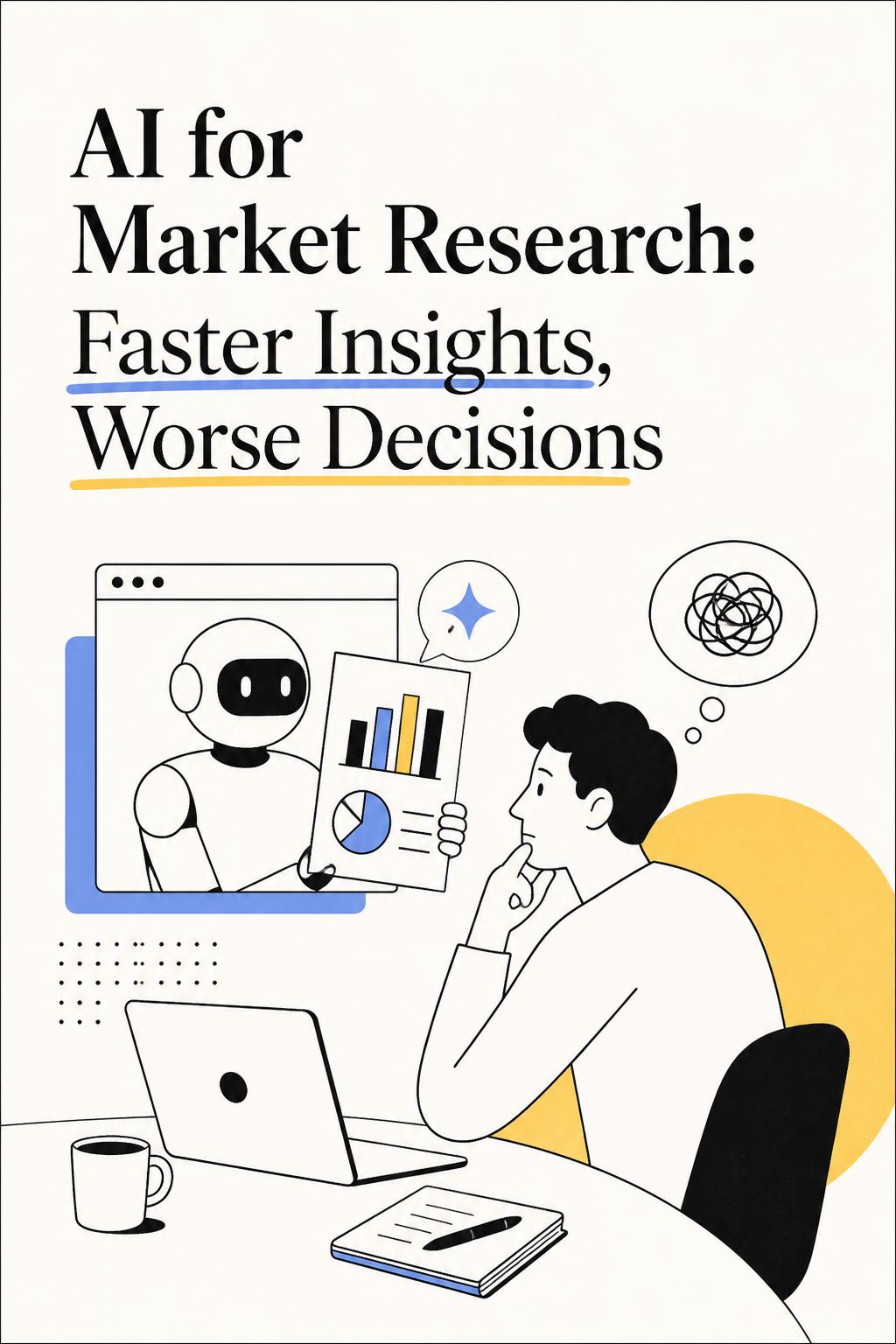
AI for market research has created a dangerous illusion: that research is now fast because a tool can summarize 50 interviews before lunch. It is fast. But a fast summary of shallow questions, biased participants, and post-rationalized opinions is not insight. It is a polished version of the same assumptions your team started with.
I have watched product teams spend weeks debating an AI-generated finding such as “customers want simplicity,” only to discover that “simplicity” meant three different things to three different buyer groups. For new users, it meant less setup. For procurement, it meant fewer security reviews. For experienced operators, it meant fewer manual exceptions. The team nearly built a cleaner interface for a problem that was actually about implementation risk.
My view is blunt: AI should not be used primarily to make market research cheaper. It should be used to make customer evidence harder to ignore, easier to interrogate, and directly useful for a decision. The teams getting value from AI are not automating research judgment. They are using AI to find the tension between what customers say, what they do, and what the business needs to decide next.
Most AI market research fails because it automates the weakest step
The default workflow is familiar. Upload transcripts, survey comments, reviews, or call notes. Ask AI for themes. Copy the themes into a presentation. Add a few representative quotes. Call it customer insight.
This workflow fails because theme extraction is not the same as explanation. Frequency is not the same as importance. And a customer’s stated preference is often not the reason they changed behavior.
Consider the phrase “I need better reporting.” It might mean a manager cannot prove team performance to leadership. It might mean an analyst is manually combining data every Friday. It might mean a buyer does not trust the numbers enough to make a budget decision. All three people ask for reporting. They have entirely different jobs, risks, buying triggers, and definitions of success.
Automated summaries tend to collapse those differences into a convenient but useless conclusion: “Reporting is a top customer need.” That statement does not tell a product manager what to build, a marketer what to say, or a researcher what to test.
Common AI approaches also fail for three predictable reasons:
- They reward consensus. The most repeated answer is elevated, while the contradictory answer that reveals a valuable segment or broken assumption gets buried.
- They lose decision context. A comment about price is treated as a pricing problem even when the real issue is unclear value, procurement friction, or a missing proof point.
- They produce findings without consequences. “Customers value ease of use” sounds credible but does not specify what the company should stop, start, test, or prioritize.
The better use of AI for market research begins before data collection. It starts with a decision that has real consequences.
Start with the decision tension, not a research topic
Weak briefs begin with topics: “Understand our brand,” “Learn what users think about onboarding,” or “Explore pricing perception.” These briefs invite broad, agreeable answers and generic outputs.
Strong research starts with a tension between evidence and belief. For example: “Activation is down 14%, but users who complete setup report high satisfaction.” Or: “Enterprise prospects praise our platform in demos yet select the incumbent during procurement.” Or: “Customers say price is too high, but discounting has not improved conversion.”
A tension forces the team to consider competing explanations. That is where AI becomes useful. Rather than asking it to summarize everything, ask it to help evaluate which explanation has the strongest evidence.
Before launching a study, write a one-sentence decision statement: We need to decide whether to change X, because Y is happening, and the consequences of being wrong are Z. If a research project cannot produce a different action, it is not yet a research priority.
In one B2B study I ran for a workflow SaaS company, the leadership team wanted to know why qualified prospects stalled after a strong product demo. Sales believed the issue was price. Product believed the issue was missing enterprise features. We recruited 22 recent losses across three company sizes and rebuilt each buying journey from trigger to final decision. The pattern was neither price nor features. Buyers worried that implementation would expose inconsistent internal processes that their teams had been avoiding. The incumbent felt safer because it was already embedded in those imperfect workflows. That changed the response: instead of discounting or rushing a feature, the company added implementation diagnostics, clearer migration proof, and a lower-risk pilot structure.
That is what useful market research does. It identifies the real barrier, not the easiest explanation.
The evidence-to-decision framework for AI market research
Good AI market research has three layers: evidence, interpretation, and action. Teams often jump from raw transcripts to recommendations, skipping the interpretation work that separates a finding from a guess.
Layer 1: Evidence
Evidence includes what people said, what they did, the situation they were in, and the alternatives available to them. A transcript alone is incomplete. Attach relevant context where possible: customer segment, lifecycle stage, role, product usage, purchase status, account size, and the behavioral event that triggered the research.
AI is highly effective at organizing evidence, retrieving relevant moments, comparing cohorts, detecting recurring language, and identifying outliers. But every consequential finding should remain traceable to source material. If a stakeholder asks, “Who said this, under what conditions, and how often?” the researcher should be able to answer.
Layer 2: Interpretation
Interpretation explains the mechanism behind the evidence. The goal is not “customers mentioned integrations.” The goal is “operations leaders use integration coverage as a proxy for implementation risk because manual reconciliation creates accountability problems after launch.”
The second version is actionable because it reveals the underlying logic. It also prevents a common product mistake: responding to every request literally. The right answer may not be to build five more integrations. It may be to show workflow compatibility earlier, improve migration support, or clarify which systems are already supported.
Layer 3: Action
An insight earns its place only when it changes a decision. A product team may change the order of onboarding steps. Marketing may replace a generic productivity claim with a risk-reduction message. Sales may qualify for a specific operational trigger. Research may test whether a segment has a different job than the current product experience supports.
- Define the business decision, owner, deadline, and cost of being wrong.
- List the two to four most plausible explanations for the observed problem or opportunity.
- Recruit participants based on the decision context, not only broad demographics or job titles.
- Use AI to collect, organize, compare, and challenge evidence across relevant segments.
- State the mechanism behind each pattern, including evidence that weakens the conclusion.
- Translate the strongest pattern into a specific action and a measurable follow-up test.
Ask AI to find contradictions, not just themes
Consensus feels reassuring, especially when executives want a simple answer. But the highest-value research usually appears in the exception.
Suppose small-business owners describe your product as “easy,” while mid-market teams describe it as “limited.” A weak synthesis says sentiment differs by company size. A stronger interpretation asks whether each group hired the product for a different job. Small teams may value speed and self-service. Mid-market teams may need auditability, permissions, and confidence that the process will survive growth. The product may not have a satisfaction problem. It may have a segmentation and positioning problem.
Use AI prompts and analysis workflows that deliberately surface disconfirming evidence:
- Which respondents rejected the dominant theme, and what was different about their context?
- Where did people use the same language while describing different underlying needs?
- Which complaints appeared only after a certain usage milestone, company size, or workflow change?
- What behavior conflicts with what respondents claim to value?
- Which segment has an urgent, underserved problem rather than simply the loudest opinions?
This is the difference between AI summarization and research-grade AI analysis. A summary compresses. Research should preserve enough context to explain why groups differ and whether that difference should change strategy.
AI-moderated interviews work when scale needs depth
Surveys are useful for measuring the prevalence of a known question. They are poor at discovering why a behavior occurred. Traditional interviews provide depth but are constrained by moderator time, time zones, recruiting windows, and inconsistent probing.
AI-moderated interviews are valuable when a team needs both structured depth and broader coverage. They can ask a consistent core set of questions, probe a respondent’s mention of a competitor or workaround, and gather richer evidence across dozens or hundreds of participants without forcing every conversation into a rigid script.
They are not a substitute for expert human moderation in every situation. I would not rely on an AI moderator alone for highly sensitive healthcare, employee relations, trauma, or politically charged research where trust and subtle emotional cues are central. But for rapid concept testing, churn research, win-loss studies, message exploration, onboarding diagnosis, and post-task feedback, AI moderation can materially improve the speed and breadth of qualitative learning.
Use product behavior as the trigger for market research
Product analytics shows where users struggle. It almost never explains why. This is where many teams waste time: they see a funnel drop, send a quarterly survey, and receive broad opinions from people who may not remember the event.
Instead, trigger research close to the behavior. If a user abandons a data connection step, ask what they expected, what felt risky, and what they tried next. If a customer downgrades after a monthly reporting cycle, ask what changed in their workflow and which alternative they considered. If a visitor exits a pricing page after viewing annual terms, investigate what decision criterion was unresolved before asking whether the price was too high.
I used this approach in a subscription product study with a five-day fieldwork window. The company assumed that free users were failing to convert because the paid plan cost too much. We interviewed recent converters, highly engaged free users, and customers who had canceled within their first month. The actual problem was timing. Free users could see that the paid plan offered more, but they could not identify a moment when upgrading became necessary. The company changed its upgrade prompt to appear after a high-intent action rather than presenting a generic feature comparison. The research did not prove that price never mattered. It showed that price was not the first constraint to solve.
The standard is not a better report—it is a better decision
The strongest use of AI for market research is not a deck with more quotes, cleaner themes, or faster turnaround. It is a decision that changes because the team understands the customer’s real tradeoff.
Require every final finding to include four elements: the evidence, the mechanism, the segment it applies to, and the action it supports. Then name what would disprove it. This small discipline prevents AI-generated certainty from becoming organizational fiction.
AI can make research dramatically faster. That is precisely why teams need a higher bar for rigor. Use it to investigate tensions, preserve context, find contradictions, and connect customer language to actual product and market choices. Otherwise, you are not doing better market research. You are simply producing generic answers at machine speed.
Run the week on concept testing: 15 to 30 AI-moderated interviews, with quotes back in 48 to 72 hours.
Speed isn't the goal—decisions grounded in real customer reasoning are. If you're building out your research stack, check our comparison of the 15 best market research tools in 2026 to see where AI-moderated interviews fit alongside surveys and analytics. Usercall runs AI-moderated interviews that probe for the 'why' behind answers instead of just summarizing them.
Related: Concept testing questions · Concept testing research · CPG packaging · Concept testing examples
Related: what AI market research does well (and can't do yet) · the best AI market research tools · how AI-powered market research can lead you to the wrong answer