
 Table of Contents
The fastest way to lose a customer experience budget is to walk into an executive meeting with an NPS chart and say, “Customers are unhappy.” I have watched it happen repeatedly. The CX lead is right about the problem, the research is often excellent, and the investment still gets cut. Why? Because an unhappy customer is a concern; a customer who abandons a $30,000 purchase, opens three avoidable support tickets, or downgrades after a billing surprise is a financial event.
That distinction is the entire customer experience ROI problem. Most teams measure whether customers liked an interaction. The teams that get funded show how a specific interaction changes customer behavior and, therefore, revenue, retention, or cost to serve. They do not defend “CX” as a broad good. They identify an expensive point of friction, prove the mechanism behind it, and make a conservative case for fixing it.
My position is simple: customer experience ROI is not a satisfaction-score exercise. It is the financial value of removing preventable customer effort at moments where trust, money, or commitment is on the line. If your ROI model cannot name the exact customer behavior that will change, it is probably a story—not a business case.
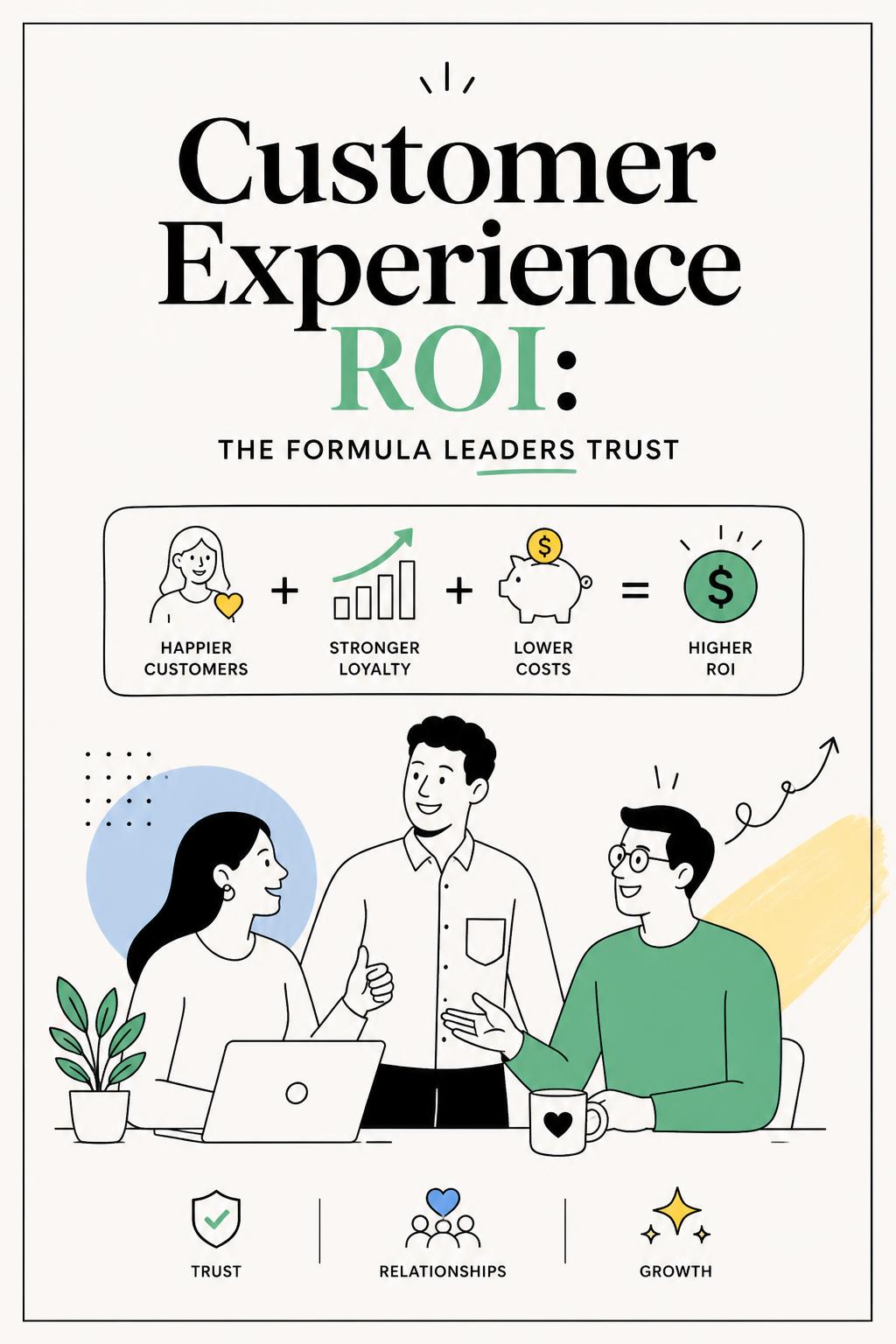
Customer experience ROI measures the financial return from an experience improvement after accounting for the full cost of making that improvement.
Customer Experience ROI = (Financial benefit of the experience change − Total cost of the change) ÷ Total cost of the change
The formula is easy. The intellectual work is deciding what belongs in “financial benefit” and what evidence justifies the estimate. In most organizations, customer experience ROI comes from four measurable outcomes:
Not every experience initiative produces all four. That is where weak business cases go wrong. A clearer returns process may reduce contacts and chargebacks but not increase conversion. A better trial onboarding flow may improve paid conversion but increase support demand temporarily as more customers become active. Credible CX leaders state these tradeoffs upfront instead of inflating every initiative into a universal growth engine.
NPS and CSAT are not useless. They are just frequently misused. A score can reveal that something is changing, but it does not tell a leader what to fund next. A five-point NPS decline could reflect a price increase, a product outage, poor fit from a new acquisition channel, or a broken workflow. It cannot, by itself, establish which customer action created financial loss.
The same problem affects broad journey maps. Teams often create detailed maps with dozens of pain points, color-code them by severity, and call the output a prioritization strategy. It is not. A red pain point experienced by thousands of low-value visitors may be less important than a subtle concern faced by 50 enterprise buyers during security review.
I saw this firsthand at a B2B software company where the product team wanted to fix the most complained-about issue: a cumbersome password-reset flow. The support volume was large, and the frustration was real. But research with sales, customers, and lost prospects showed that the company was losing larger contracts for a different reason: procurement teams could not quickly understand data residency and access controls. The password issue affected many users; the trust gap blocked deals worth six figures. The team shifted focus, created a clearer security journey, and reduced late-stage sales friction without building an expensive password redesign that would have produced modest financial impact.
Complaint volume is not ROI. Severity is not ROI. Even correlation between satisfaction and retention is not ROI. The missing ingredient is a credible causal chain.
Start every customer experience ROI analysis with one question: what does the customer do differently because this experience is difficult, confusing, slow, or untrustworthy?
Then build the friction-to-value chain:
This model forces discipline. It also exposes an important truth: some painful customer experiences are not worth fixing immediately. A rare problem with a costly technical solution may deserve transparent communication and a workaround, not a major roadmap commitment. Customer-centered does not mean financially careless.
Consider a SaaS company with 60,000 monthly trial signups. Product analytics shows that 18% of trial users encounter an email-verification failure. The team initially assumes this is a minor technical annoyance because some users eventually return and complete the process.
Interviews reveal something more expensive. Legitimate users at larger companies interpret the unexplained rejection as a warning that the product will be difficult to deploy and support internally. They do not merely abandon a form; they question whether to invest their team’s time at all.
The affected group is 10,800 trials per month. Comparable users who do not encounter the failure convert to paid accounts at 31%, while affected users convert at 22%: a nine-percentage-point gap. The research team does not attribute the entire gap to verification. Some users may be lower intent for unrelated reasons. Instead, it estimates that a redesigned flow with domain guidance, a clear explanation, and a recovery path could recover 30% of the gap.
The calculation is: 10,800 affected trials × 9% conversion gap × 30% recoverable share = 292 additional paid accounts per month. If first-year gross profit per account is $420, the annual gross-profit opportunity is approximately $1.47 million.
Assume the full implementation cost is $180,000. That includes research, design, engineering, security review, QA, and launch monitoring. The first-year customer experience ROI is approximately 717%.
More importantly, the initiative remains attractive under conservative assumptions. At only 15% recovery of the conversion gap, it still generates a meaningful return. This is the standard an ROI model should meet: it should survive skepticism, not depend on optimistic arithmetic.
Analytics can tell you where customers leave. It is much less reliable at explaining why they leave. A drop-off at identity verification might mean the form is too long, the instructions are unclear, the customer lacks the needed document, the process feels unsafe, or the customer is simply not ready to buy. Each explanation requires a different investment.
In a study I led for a financial-services product, the business had a clear hypothesis: identity verification was underperforming because the process required too many fields. We interviewed customers who had abandoned at that point and observed them moving through the flow. The real issue was trust, not form length. Customers were willing to provide sensitive information, but they were asked to upload a government document immediately after vague language stating that verification was “secure.” Several participants assumed their data would be retained indefinitely or reused for marketing.
The team did not remove compliance steps. Instead, it explained why the document was needed, when it would be reviewed, how long it would be retained, and what customers could do if verification failed. Completion increased because the company fixed the meaning of the moment, not just its number of clicks.
This is where research-grade AI qualitative analysis and AI-moderated interviews can be particularly valuable. Usercall enables teams to intercept users at key product analytics moments—such as a drop-off, repeated error, cancellation, or stalled activation—and investigate the reason while the experience is still fresh. Its researcher controls matter because customer experience ROI depends on high-quality evidence: the right participant segments, purposeful follow-up probing, transparent synthesis, and the ability to inspect what customers actually said rather than accept a generic summary.
The best prioritization lens is not “what hurts most?” It is where does friction create the greatest avoidable economic exposure? Evaluate each opportunity using four factors: reach, value at risk, causal confidence, and fixability.
Reach measures how many customers encounter the issue. Value at risk measures the financial consequence when they do. Causal confidence reflects how strong your evidence is that the issue drives the outcome. Fixability asks whether a realistic intervention can reduce the problem within acceptable cost and time constraints.
A password-reset issue might affect 5,000 people a month but impose low value at risk if most recover in minutes. A confusing explanation of data security might affect only 40 prospects monthly but derail enterprise contracts worth hundreds of thousands of dollars. The second issue can be the higher-ROI investment even when it barely appears in the support dashboard.
Prioritize moments where customers are making a commitment, recovering from a failure, or deciding whether to trust you with their money, data, time, or professional reputation. Those are the points where small experience improvements often have outsized commercial effects.
Too many teams announce success after a redesign because the interface looks better and survey feedback sounds positive. That is not enough. Define the measurement plan before engineering begins so the organization agrees on what success means.
Customer experience ROI is strongest when it is treated as a learning system, not a one-time funding document. Every launch should improve the organization’s ability to predict which frictions matter financially and which do not.
Executives rarely need convincing that customers deserve a good experience. They need evidence that a specific customer problem is worth solving ahead of competing investments. The winning argument is not “customers are frustrated.” It is “this friction causes this behavior, among this valuable segment, at this cost—and here is the conservative return from removing it.”
That is the real discipline behind customer experience ROI. Find the moments where effort becomes abandonment, confusion becomes delay, and uncertainty becomes lost trust. Then measure the financial leak, investigate the human reason behind it, and fix the mechanism—not just the metric.
