
Hiring a Brand Tracking Agency? Most Will Give You Data—Not Answers
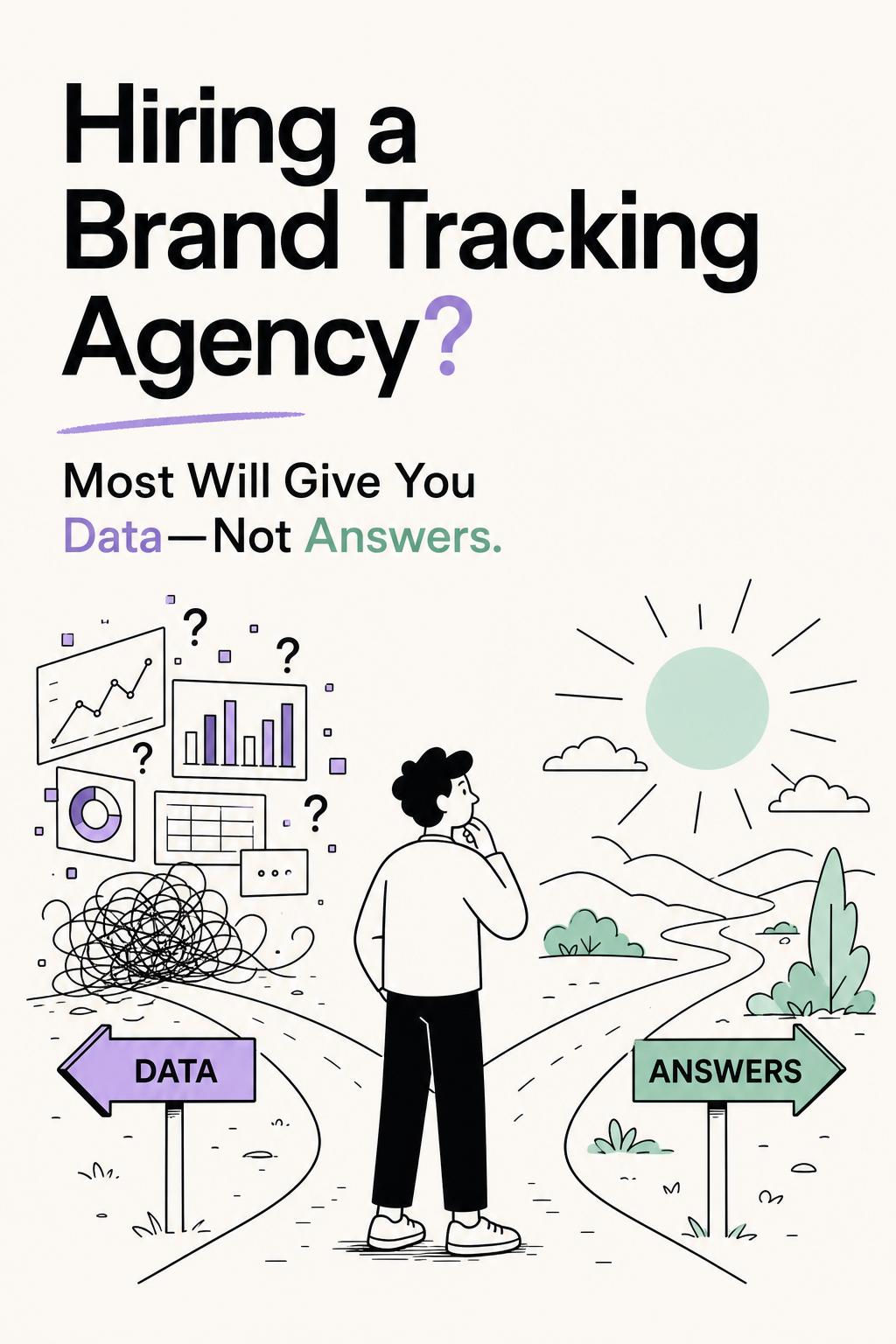
Here’s the uncomfortable reality: most companies don’t fire their brand tracking agency because it’s wrong—they fire it because it’s useless. The dashboards look clean. The trend lines are statistically sound. Awareness is up two points, consideration is down three. Everyone nods in the meeting, and then… nothing changes. No one knows what to do next.
I’ve sat in too many of those rooms. The problem isn’t that brand tracking is broken. It’s that most agencies stop at measurement when the real job is explanation. If your agency can’t tell you why your brand moved—or didn’t—you’re not tracking brand health. You’re just documenting confusion.
If you’re searching for a brand tracking agency, you’re likely trying to solve a real tension: something in your market isn’t behaving the way your internal narrative says it should. This is exactly where the difference between average and exceptional agencies becomes obvious.
The Core Failure: Tracking “What” Instead of Explaining “Why”
Most brand tracking agencies are built for consistency, not insight. They optimize for repeatable surveys, stable metrics, and clean reporting cycles. That sounds good in theory. In practice, it creates a dangerous blind spot.
You end up with precise answers to the wrong questions.
Here’s how that plays out in real life:
- Metrics move without context. Consideration drops, but no one knows if it’s pricing, positioning, or competition driving it.
- Segments get flattened. High-intent buyers and casual awareness audiences are blended into one misleading average.
- Behavior is ignored. Survey responses say “high interest,” but funnel data shows abandonment.
- Insights arrive too late. By the time quarterly data lands, the market has already shifted again.
One of the biggest mistakes I see is teams overreacting to small movements without understanding their source. A three-point dip in preference can trigger expensive brand campaigns when the real issue is something far more tactical.
In one SaaS study I ran, preference declined slightly over two waves. Leadership immediately blamed brand positioning. We pushed for fast qualitative follow-up with recent evaluators. Within a week, we uncovered the real issue: a confusing pricing page made the product feel 2–3x more expensive than competitors, even though it wasn’t. The tracker surfaced the symptom. It completely missed the cause.
What a High-Performance Brand Tracking Agency Actually Does
A strong agency doesn’t just measure brand health—it builds a system for diagnosing it. That means combining structured quant tracking with flexible, high-speed ways to investigate changes.
The best agencies share a few defining traits:
- They treat metrics as entry points, not endpoints. Every shift triggers investigation, not just reporting.
- They segment aggressively. They know a loyal customer and a switching prospect should not be analyzed the same way.
- They identify drivers, not just trends. They can tell you which beliefs actually influence consideration and conversion.
- They integrate behavioral data. They connect what people say with what they do.
- They move fast when something changes. They don’t wait for the next wave to figure it out.
This is where most traditional agencies fall short—they’re not designed for speed or depth outside the survey.
The Missing Layer: Real-Time “Why” Behind Brand Metrics
If you want brand tracking to actually drive decisions, you need a way to investigate changes in real time. This is where modern research workflows—and the right tooling—change the game.
Instead of relying solely on periodic surveys, leading teams are layering in continuous qualitative insight tied to real user behavior.
For example:
- Intercept users when they abandon a pricing page to understand perceived value gaps.
- Trigger interviews after onboarding drop-off to diagnose expectation mismatch.
- Follow up with recent switchers to understand competitive framing shifts.
This is exactly where platforms like Usercall stand out. It enables research-grade AI-native qualitative analysis and AI-moderated interviews, but with actual researcher control over targeting, logic, and depth. More importantly, it allows you to intercept users at critical product or funnel moments—so you’re not guessing why metrics moved, you’re observing the reasons in context.
This closes the biggest gap in traditional brand tracking: the disconnect between perception and experience.
A Practical Framework: How to Make Brand Tracking Actually Useful
If your current tracker isn’t driving decisions, you don’t necessarily need a new agency—you need a better system. Here’s the framework I use with teams:
- Measure: Track a focused set of core metrics consistently—awareness, consideration, preference, trust, and key associations.
- Diagnose: Break changes down by audience type, lifecycle stage, and exposure.
- Explain: Use qualitative methods to uncover the beliefs and experiences driving those changes.
- Act: Translate insights into specific actions across messaging, product, pricing, or channel strategy.
Most agencies stop at step one. Good ones get to step two. The best ones operationalize all four.
How to Evaluate a Brand Tracking Agency (Without Getting Distracted by Dashboards)
Dashboards are the easiest part of brand tracking—and the least important. What matters is how an agency thinks.
When evaluating options, ask questions that expose their approach to ambiguity:
- What happens when a key metric moves unexpectedly?
- How do you determine what’s actually driving change?
- How do you connect survey data with real customer behavior?
- What decisions should this tracker enable every quarter?
If the answers revolve around “monitoring trends” or “waiting for more data,” that’s a red flag. You want an agency that investigates, not just observes.
I once worked with a consumer subscription brand evaluating agencies. One presented a beautifully designed dashboard with automated reporting. Another walked through how they’d diagnose a sudden drop in perceived value within two weeks using targeted follow-ups and behavioral triggers. The first won on presentation. The second would have actually solved problems.
What Great Output Looks Like (And Why It’s Rare)
A weak brand tracking report tells you what changed. A strong one tells you what to do.
For example, instead of:
“Consideration decreased by 4% among target consumers.”
You should get something closer to:
“Consideration dropped primarily among high-intent evaluators exposed to competitor messaging emphasizing simplicity. Your product is now perceived as more powerful but harder to adopt, especially in mid-market segments.”
Those are completely different levels of insight—and they lead to very different actions.
Here’s how that difference typically shows up:
Reports movement
Focuses on totals
Waits for next wave
Recommends more awareness
Explains drivers
Segments insight
Investigates immediately
Recommends targeted action
The frustrating part is that many teams don’t realize what they’re missing because they’ve never seen the second column done well.
Agency vs. In-House vs. Hybrid: The Smarter Setup
You don’t have to choose between a brand tracking agency and internal research capability. In fact, the best setups combine both.
Use agencies for:
- Sampling scale and consistency
- Benchmark design and longitudinal tracking
- Fieldwork execution
Layer in internal or tool-driven research for:
- Rapid qualitative follow-ups
- Behavior-linked insights
- Experimentation and iteration
I saw this work extremely well with a product-led growth company where the formal tracker ran twice a year. That cadence alone was too slow. So we added continuous intercept interviews tied to key funnel events. Within one quarter, we identified that a drop in perceived value wasn’t a brand issue—it was confusion around plan limits during onboarding. Fixing that had a bigger impact than any campaign could have.
The Bottom Line: Don’t Hire an Agency to Measure—Hire One to Explain
If you remember one thing, make it this: brand tracking is only as valuable as the decisions it enables.
A dashboard won’t fix your brand. A trend line won’t change your strategy. And a statistically significant shift won’t matter if no one knows what caused it.
The right brand tracking agency will challenge your assumptions, investigate anomalies, and connect perception to reality. It will tell you when the problem isn’t your brand at all—and when it is.
Most importantly, it will help you answer the only question that actually matters: what should we do differently now?
That’s the difference between tracking brand health and actually improving it.
If you’re building or replacing your stack rather than hiring an agency, our guide to the best brand tracking software and brand monitoring tools breaks down which platforms fit which team size and budget.
An agency can hand you charts, but only the right process turns those charts into decisions. Read brand tracking is broken in most companies, and nobody wants to admit it for a broader look at where these engagements go wrong, and see how Usercall fills the gap between data and answers.
Related: what brand tracking is actually supposed to measure · comparing brand tracking software options