
 Table of Contents
The patient did not miss her specialist appointment because she forgot. She missed it because, after her primary care visit, nobody clearly told her whether the referral had been submitted, whether insurance approval was still pending, or whether the specialist would call her. Three weeks later, the health system recorded a “no conversion” referral. The patient recorded a different story: “I assumed they decided it was not serious.”
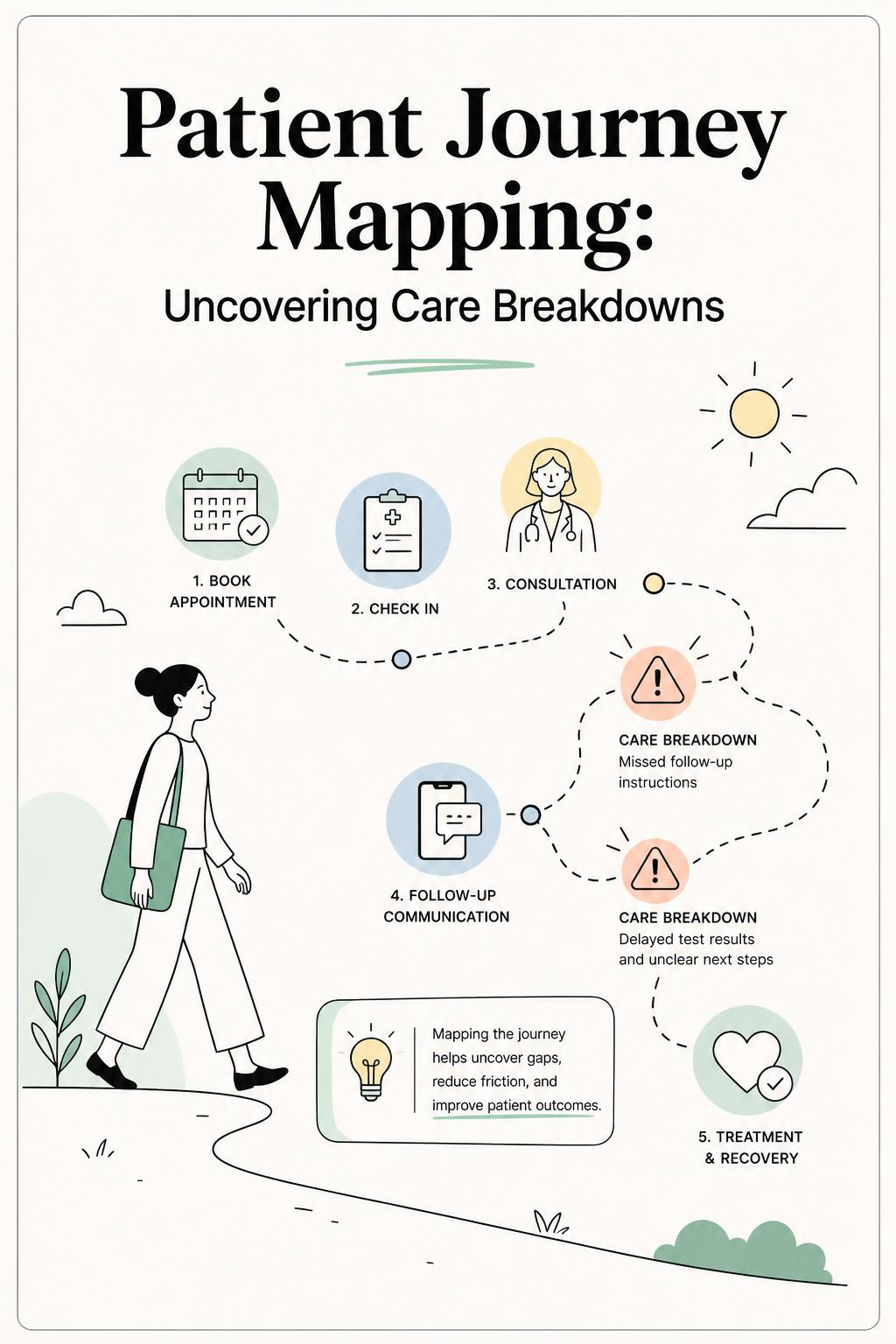
That is the central problem with most patient journey mapping. Organizations map visible touchpoints—website, call center, appointment, portal, follow-up—while the real failure happens in the spaces between them: uncertainty, silence, repeated explanations, unclear ownership, and decisions patients must make without enough information. A beautiful journey map that does not reveal those moments is not insight. It is a process diagram with emojis.
As a qualitative researcher, I have a strong view on this: patient journey maps should not be used to document everything that happens. They should be used to find the few moments where a patient’s ability to progress through care becomes fragile. Those moments are where trust drops, treatment is delayed, contact volumes rise, and clinical outcomes begin to diverge.
A patient journey map is a research-backed view of how a person moves from a health concern to care, treatment, follow-up, or ongoing management. But that definition is too polite. In practice, a useful patient journey map is an accountability tool. It shows where the healthcare organization has quietly shifted work, risk, or confusion onto the patient.
The map should answer questions that operational dashboards cannot answer on their own:
That distinction matters. A dashboard can show that 42% of referrals are not completed within 30 days. It cannot tell you whether patients are blocked by authorization requirements, unclear urgency, transportation, a lack of appointment visibility, fear of a diagnosis, or an assumption that somebody else will contact them. Patient journey mapping is how you uncover the mechanism behind the metric.
The standard approach usually begins with a workshop. Stakeholders list stages, channels, and departmental handoffs. Someone adds an emotional curve. A few survey quotes are placed on the map. The output looks credible because it contains detail, but it rarely changes a meaningful decision.
This approach fails for three reasons.
First, it maps the organization’s workflow instead of the patient’s reality. Departments see their own handoff as a completed task: a referral was sent, an order was placed, a message was delivered. Patients experience the handoff as a question: “What am I supposed to do now?” Completion inside the system does not equal clarity outside it.
Second, it treats every touchpoint as equally important. They are not. A frustrating password reset and a confusing post-discharge medication instruction are both friction, but they carry radically different consequences. Patient journey mapping must distinguish inconvenience from risk.
Third, it relies too heavily on retrospective recall. Patients often reconstruct difficult experiences into a simplified story. They may say an appointment was “easy to book” because they eventually succeeded, while omitting the three calls, lunch-break scheduling attempts, and help from a family member required to get there.
A better approach starts with a sharper premise: the journey is not a sequence of touchpoints. It is a chain of decisions made under varying levels of information, stress, time pressure, and confidence.
For every stage in a patient journey, evaluate four dimensions: progress, confidence, effort, and consequence. This is more useful than a generic satisfaction score because it reveals why a seemingly small interaction creates disproportionate harm.
Progress: Can the patient tell whether they are moving toward the care they need?
Confidence: Do they understand what is happening, what comes next, and who is responsible?
Effort: How much time, cognitive load, advocacy, travel, paperwork, repetition, or caregiver coordination is required?
Consequence: What happens if the patient delays, misunderstands, cannot complete the step, or gives up?
Consider a patient waiting for imaging results. A system may send a technically accurate notification saying, “Your results are available in the portal.” From an operational perspective, the task is complete. But if the patient cannot interpret the result, does not know whether a clinician has reviewed it, and is unsure what symptoms warrant urgent action, progress is low, confidence is low, and consequence may be high. The message did not close the loop; it opened a new period of uncertainty.
This framework gives teams a much better prioritization rule: fix moments where consequence is high and patient confidence is low. These moments are often not the loudest complaints, but they are where continuity of care is most vulnerable.
Most healthcare journey maps begin when a patient contacts the organization. That is too late. The patient journey often begins when someone notices a symptom, receives a screening reminder, gets concerning advice from a family member, or tries to decide whether a problem is serious enough to justify care.
It also does not end when the visit is over. For many conditions, the most difficult work happens between visits: filling a prescription, scheduling a test, understanding dietary instructions, monitoring symptoms, arranging transport, getting time off work, and deciding whether a new concern is worth escalating.
I led interviews for a regional health system focused on older adults discharged after short inpatient stays. The hospital’s discharge satisfaction data was strong, and leaders initially assumed the experience was working. In 18 caregiver interviews, however, a different pattern emerged. The discharge moment was not the failure point. The first evening at home was. Caregivers described reconciling medications, searching for equipment, interpreting fatigue, and debating whether a symptom justified calling anyone. One caregiver called it “being sent home with a quiz nobody gave us the answers to.”
The team had invested heavily in discharge instructions. The research showed that the intervention needed to move beyond discharge: a caregiver-specific checklist, a plain-language escalation guide, and proactive outreach during the first 24 hours. The key lesson was simple: map the period when responsibility shifts, not merely the moment when the organization completes its task.
Stakeholders are valuable sources of hypotheses, but they are not substitutes for patient evidence. Clinicians often understand clinical pathways deeply but may underestimate how much jargon, timing, and emotional state affect comprehension. Operations leaders may see call volume but not the underlying uncertainty driving those calls. Product teams may see funnel exits but not know whether patients left because of usability, privacy concerns, insurance confusion, or fear.
A strong patient journey mapping study combines several evidence types:
In one specialty-care study, leaders believed patients dropped out because the wait for an appointment was too long. We interviewed 22 patients who had been referred but had not completed a consultation. Wait time mattered, but it was not the dominant issue. The larger problem was that patients did not know whether the referral had been accepted, whether the condition was urgent, or whether they needed to initiate scheduling. Several expected a call that was never part of the workflow. Improving capacity would have helped at the margins. Clarifying ownership and status would have prevented the drop-off.
This is why qualitative research is indispensable: it identifies the story patients tell themselves when the system is silent.
Traditional patient interviews conducted weeks after an event remain useful, but they have a serious limitation: memory smooths friction. Once a person finally gets an appointment or receives treatment, they may forget the uncertainty that nearly caused them to stop.
Use timely research at critical decision points. Invite patients to share feedback after abandoning a booking flow, receiving a result, completing intake, missing a referral, or reading a care-plan message. These are not generic satisfaction prompts. They are targeted attempts to understand why behavior occurred at the exact moment the data becomes ambiguous.
Usercall is particularly useful for this kind of research because it supports research-grade AI-native qualitative analysis and AI-moderated interviews with deep researcher controls. Teams can trigger user intercepts at key product analytics moments and ask targeted follow-up questions while the context is still fresh. That makes it possible to connect an observed behavior—such as a scheduling exit or repeated portal visit—to the patient’s actual reasoning rather than an internal guess.
The critical safeguard is rigor. AI can help collect, organize, and surface patterns across large volumes of qualitative feedback. It should not replace thoughtful segmentation, review of source responses, or the researcher’s responsibility to distinguish a recurring pattern from a memorable outlier.
The map is not the deliverable. The deliverable is a prioritized set of interventions that improves patient progress without creating new burden elsewhere.
For each major breakdown, write a clear intervention hypothesis. Avoid vague recommendations such as “improve communication.” Instead, specify who needs what information, when they need it, in which channel, and what action it should enable.
For example, if patients repeatedly call about test results, the answer may not be “send more reminders.” A better intervention may explain when review will occur, what the result status means, who will contact the patient, and what to do if symptoms change. That reduces unnecessary contact while making the patient safer and more confident.
A patient journey map is useful when it makes the organization confront a difficult truth: patients are often asked to coordinate a system they do not understand, while sick, anxious, busy, or dependent on others for help.
Do not judge the map by its visual polish or number of touchpoints. Judge it by whether a team can identify the three highest-risk breakdowns, explain why they happen for specific patient segments, assign an accountable owner, and test an improvement within weeks. The strongest patient journey mapping does not merely create empathy. It exposes where empathy must become operational change.
