
AI Product Management: What It Actually Looks Like When You Strip Away the Hype
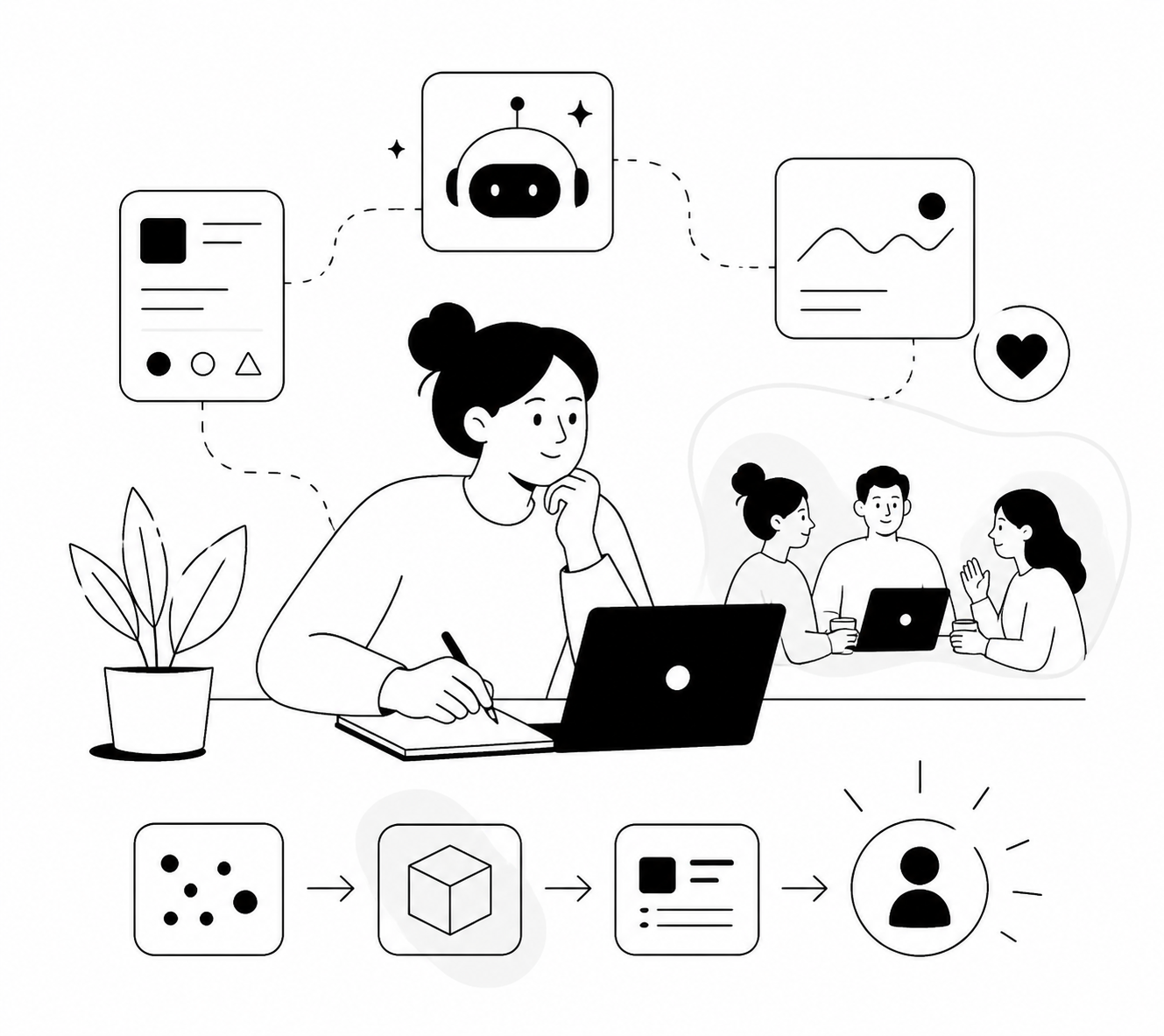
I sat in on a product review last year where the PM opened with "ChatGPT wrote our roadmap this quarter." The room laughed, then went quiet, because half of them weren't sure if it was a joke. That's where we are with AI product management right now. Everyone's using it. Almost nobody has a real system for it. And the gap between "I use AI tools sometimes" and "AI is embedded in how I make product decisions" is where good PMs are pulling ahead of mediocre ones.
I've spent over a decade running qualitative research and advising product teams on how they gather and act on customer insight. In the last two years, I've watched AI shift from a novelty (summarize this interview transcript) to something structural (run this interview, synthesize the theme, flag the outlier). Most of what's written about AI product management is either breathless hype or vague hand-wringing about job security. Neither is useful. This is a practical breakdown of what's actually working, what's overhyped, and where the human judgment still has to show up.
What AI Product Management Actually Means Today
Strip away the buzzwords and AI product management is really three things happening at once: AI as a research assistant, AI as a synthesis engine, and AI as a prioritization aid. It is not, despite what some vendors will tell you, an autonomous product manager making roadmap decisions on your behalf. I have not seen a single credible case of that working, and I've looked.
What I have seen work well: PMs using AI to process customer feedback ten times faster than a human team could manually. PMs using AI-moderated interviews to talk to fifty customers in the time it used to take to schedule five. PMs using AI to draft first-pass PRDs, competitive analyses, and user stories that a human then edits down to something actually useful.
The pattern here matters. AI is compressing the time between "we have a question" and "we have an answer." It is not replacing the judgment required to decide which questions matter in the first place.
Where AI Actually Moves the Needle for PMs
I've broken this down by lifecycle stage because that's how PMs actually think about their work, not by tool category.
| PM Activity | Where AI Helps | Where Humans Still Have to Lead |
|---|---|---|
| Discovery / research | Running and transcribing interviews at scale, surfacing themes across dozens of conversations | Deciding who to talk to and what the research question actually is |
| Feedback synthesis | Clustering support tickets, NPS comments, and interview quotes into themes | Judging which themes are strategically important versus just loud |
| Prioritization | Scoring features against usage data, sizing opportunity based on frequency of mention | Weighing tradeoffs against company strategy and technical debt |
| Spec writing | Drafting PRDs, user stories, edge cases from a rough outline | Catching what the AI missed because it doesn't know your codebase or your customers |
| Stakeholder comms | Summarizing research findings into slide-ready insights | Reading the room and knowing which stakeholder needs which framing |
Notice the pattern. AI is extremely good at compression and pattern recognition across large volumes of unstructured data. It is not good at knowing what matters to your specific business, and it never will be, because that requires context AI doesn't have unless you feed it, and even then, judgment calls still sit with a human.
How AI Is Actually Changing the Product Manager Role
The biggest shift I've watched isn't in the tools, it's in the shape of the job. PMs used to spend a huge chunk of their week on low-value synthesis work: reading through 40 support tickets, manually coding interview transcripts, building slides that summarize what customers said. That work is disappearing, and it should. Nobody got promoted for being good at manual transcript coding. What's replacing it is a higher bar for judgment. If AI can generate ten possible feature specs in ten minutes, the PM's value shifts entirely to knowing which one is right. If AI can synthesize a hundred interviews into five themes, the PM's job becomes deciding which theme is actually a strategic bet worth making. I go deeper into this shift, including the specific skills that matter more now and the ones that are becoming table stakes, in this full guide on AI for product managers. If you're trying to figure out where to actually spend your remaining time as a PM once AI eats the busywork, that's the place to start.
The Research Gap AI Alone Doesn't Close
Here's an anecdote that still bothers me. A product team I worked with fed six months of support tickets into an AI summarization tool and got back a tidy report: "Users want faster load times." Confident, clean, wrong. When we actually got on calls with a sample of those customers, the real issue was that the product's onboarding created a mental model where users expected instant results, and when they didn't get it in three seconds they assumed something was broken, even though the actual load time was completely reasonable. The fix wasn't performance engineering. It was a loading state redesign and a expectation-setting tooltip. That's a completely different roadmap item, and no amount of AI summarization of existing text data would have caught it, because the answer required watching people react in real time, not just reading what they wrote in a support ticket. This is the core limitation people gloss over. AI is excellent at synthesizing what's already been said. It cannot ask a good follow-up question about something that was never captured in the first place. That's still fundamentally a human research skill, or now, an AI-moderated interview skill, where the AI is running the conversation live and adapting in real time, not just summarizing static text after the fact.
Building an AI-Augmented Research Workflow That Doesn't Break
Most teams adopt AI tools piecemeal. One person uses an AI note-taker. Another uses ChatGPT to draft specs. Nobody's connected the dots into an actual workflow, so insights get lost between tools and half the team doesn't trust what the AI produced because they don't know where it came from. Here's the workflow I recommend to product teams trying to do this properly:
- Define the research question before you touch any tool. AI makes it dangerously easy to generate a lot of analysis on the wrong question. Spend the first 15 minutes writing down exactly what decision this research needs to inform.
- Use AI-moderated interviews for scale, not just AI transcription for speed. There's a meaningful difference between AI that summarizes a conversation you had, and AI that actually runs the conversation, asks adaptive follow-ups, and lets you talk to 50 customers in a week instead of 8.
- Have AI cluster themes, but manually review the outliers. The most valuable insight in a research project is almost always the thing that only two people said. AI synthesis tools optimize for frequency, which means they naturally bury the outlier. Go read the raw quotes yourself.
- Link every theme back to a quote. If your synthesis output doesn't show you exactly which customer said what, you cannot defend the finding in a roadmap meeting when someone pushes back, and someone always pushes back.
- Keep a human in the loop for prioritization. AI can score and rank. It cannot weigh a strategic bet against your company's specific risk tolerance and competitive position.
Common Mistakes I See Teams Make
I want to be specific here because most advice on this topic is too generic to actually act on. The first mistake is treating AI output as ground truth instead of a first draft. I've seen PMs present AI-generated theme summaries in a board meeting without ever reading the underlying quotes, and get caught flat-footed when a stakeholder asks "can you show me an example of a customer saying that?" They couldn't. The second mistake is using AI to talk to the same five customers faster instead of using it to talk to fifty customers you never had time to reach before. Speed without expanded reach just gives you the same biased sample, quicker. The third mistake is skipping the research question entirely and just asking AI to "find insights" in a pile of data. Insights relative to what decision? AI will happily generate something that sounds like an insight even when there's no decision attached to it. That's how you end up with a slide full of "users value simplicity" style findings that nobody can act on. The fourth, and this one is subtle, is assuming AI removes bias from research. It doesn't. If your interview questions are leading, an AI moderator will ask them just as leadingly as a human would, just faster and at greater scale. Bad research design scaled up is still bad research, just with more false confidence attached to it.
How to Actually Evaluate AI Tools for Product Management
There are a lot of tools claiming to do "AI product management" right now and most of them are a thin ChatGPT wrapper on top of a feature you already had. Before adopting anything, I ask three questions:
- Does it actually generate new data, or just summarize data you already have? Summarization tools are useful but limited. Tools that run live AI-moderated conversations, adapt questions in real time, and let you reach customers you'd otherwise never talk to are doing something fundamentally more valuable.
- Can you trace every insight back to a source? If a tool gives you a clean theme without a linked quote, be suspicious. Themes without evidence are just opinions wearing a lab coat.
- Does it scale without losing nuance? Plenty of tools can process volume. Fewer can process volume while still catching the outlier response that changes your roadmap. Test this directly. Run the same messy, ambiguous piece of customer feedback through the tool and see if it flattens it into something generic or actually surfaces the tension in what the customer said.
Where This Is Heading
I don't think we're heading toward AI product managers replacing human ones. I think we're heading toward a much smaller pool of PMs who are dramatically more effective, because the busywork that used to consume 60% of the job is gone. The PMs who struggle in this environment won't be the ones who refuse to use AI. They'll be the ones who use it as a crutch for judgment instead of a tool for speed. Research, synthesis, and prioritization are converging into a single continuous loop instead of separate quarterly projects, and the PMs who build a real workflow around that, instead of bolting AI onto their old process, are the ones I'd bet on.
If you're trying to build that loop for your own team, Usercall runs AI-moderated voice interviews at scale, links every theme it surfaces directly back to the customer quote it came from, and lets you talk to dozens of customers in the time it used to take to schedule a handful. It's built for exactly the workflow described above: fast enough to keep up with a product team, rigorous enough that you can defend the findings in the next roadmap meeting. Try it on your next research question and see what it surfaces.