
Why Customers Return Products (And How to Find Out)
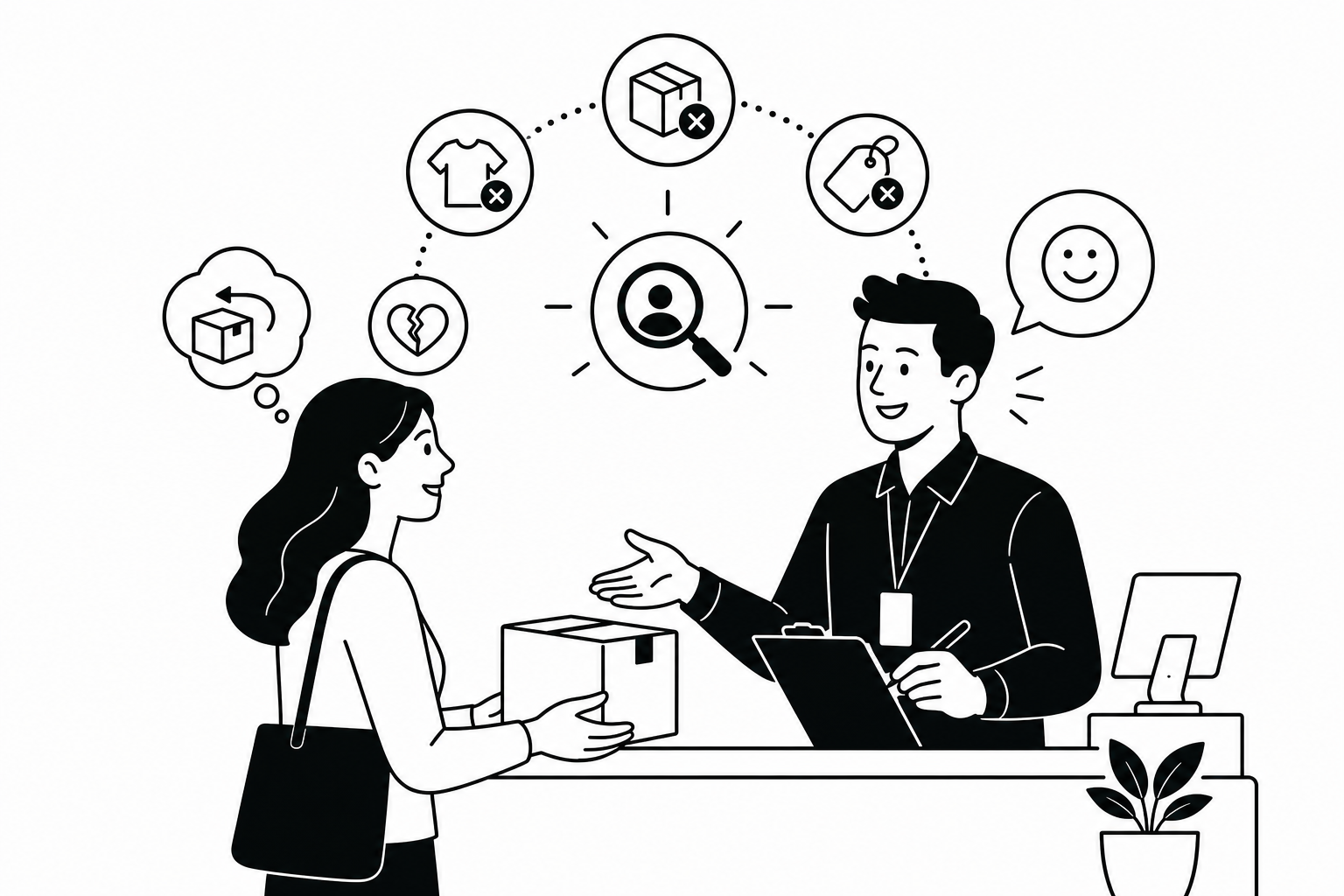
Most return data is structurally misleading. A customer clicks “didn’t fit,” “not as expected,” or “arrived too late,” and brands treat that as truth when it’s usually just the fastest available excuse. If you want real product return reasons, you have to study the decision before the refund form flattened it.
Why Return Reason Codes Fail
Return portals capture administrative reasons, not behavioral ones. They’re built to route inventory, trigger refunds, and reduce support load. They are not built to tell you why expectation and reality broke apart.
I’ve watched teams obsess over neat dashboards that said 34% of returns were “wrong size,” then spend a quarter tweaking size guides while return rate barely moved. When we finally interviewed 22 recent returners, the problem wasn’t sizing accuracy at all. The product photography made the fabric look structured; customers expected a tailored fit and received something softer and drapier.
The same thing happens across categories. “Defective” can mean poor onboarding, “arrived too late” can mean low urgency plus buyer’s remorse, and “changed my mind” often means the product lost a comparison battle after delivery. The code is the last click in the workflow, not the first cause in the decision.
There’s another failure point: most brands treat every return as a product problem. That’s lazy. Some returns are merchandising problems, some are shipping promise problems, some are acquisition problems, and some are completely rational customer behavior from discount-driven buyers who were never likely to keep the item.
The Real Job Is Mapping the Expectation Gap
Products get returned when lived experience falls short of imagined experience. That gap starts long before unboxing. It forms across ads, product pages, reviews, influencer content, shipping promises, packaging, first use, and comparison with alternatives already in the home.
When I led research for a 14-person DTC home goods brand, the team was convinced returns were a quality issue because “looks different in person” kept appearing in support tickets. We ran a mixed study: 18 return interviews, 40 intercepted non-return interviews, and a review of product page traffic by acquisition source. The result was blunt: Meta ads were attracting style-led buyers with one expectation, while the PDP copy was reassuring practical buyers with another. Return rates were 11 points higher on the ad set that over-indexed on aspirational imagery.
That’s why I don’t bucket product return reasons by the portal menu first. I bucket them by where the expectation gap was created and where it became undeniable.
Five places return reasons usually originate
- Acquisition mismatch: the ad, influencer, or landing page sold a use case the product can’t consistently deliver.
- Merchandising ambiguity: sizing, material, color, scale, compatibility, or setup effort were technically described but not concretely understood.
- Operational friction: delays, damaged packaging, hard setup, or missing components made the product feel lower quality than it is.
- Comparative disappointment: the item was judged against a competitor, an older version, or another product already owned.
- Emotional reversal: guilt, budget pressure, partner influence, or buyer’s remorse got rationalized as a product issue.
That framework changes what you fix. Instead of “reduce defective returns,” you ask: where did we create a belief the product couldn’t survive?
Ask About the Decision Timeline, Not the Return Form
The best interviews reconstruct the moment the customer stopped wanting to keep the item. If you ask, “Why did you return it?” you’ll get a tidy summary. If you ask for the timeline, you’ll get the real sequence: what they expected, what happened first, what they compared it to, and when the return became inevitable.
I use timeline-based interviews because they expose causality. The turning point is rarely the same as the official reason. A customer may select “too small,” but the actual trigger was trying it on after seeing a friend’s recommendation photo that implied a different silhouette.
Questions that uncover real product return reasons
- What made you buy this product now instead of waiting?
- Before it arrived, what were you picturing it would be like?
- What did you notice in the first 10 minutes after opening it?
- When did you first think, “I might not keep this”?
- What did you compare it to: another brand, an older product, something you saw online?
- What would have needed to be different for you to keep it?
- When you chose the return reason in the portal, how close was that to the full story?
These questions work because they force memory retrieval around events, not opinions. If you need stronger behavioral prompts, I’d start with customer research questions that expose real behavior rather than the soft, polite versions most teams rely on.
For scale, this is exactly where I like Usercall. You can run AI-moderated interviews with deep researcher controls, trigger them after a return starts or right after delivery, and collect research-grade qualitative analysis across far more customers than a small CX or insights team could call manually. That matters because return reasons are messy; patterns only get obvious when you can compare dozens or hundreds of conversations, not five anecdotes from support.
Intercept Customers at the Moment the Story Is Still Fresh
Post-hoc research decays fast. Wait three weeks and customers rationalize. Ask within hours of return initiation, failed setup, or low product usage, and you capture the actual friction before it gets compressed into a generic reason code.
The highest-yield programs don’t depend on one quarterly survey. They place intercepts at key product and operational moments: after delivery, after first use, after a return is initiated, and after a return is completed. This gives you the “why” behind your metrics instead of just another chart showing return rate by SKU.
One apparel client I advised had a 28-person team and a nasty mystery: first-time buyers returned at nearly double the rate of repeat buyers, but only on two hero products. Budget was tight, and they couldn’t run live interviews at volume. We set up triggered interviews for first-time purchasers 48 hours after delivery and another intercept for initiated returns. The insight was painfully specific: new buyers were choosing based on lifestyle imagery, while repeat buyers already understood the brand’s fit logic. The fix was not better fabric; it was a rewritten PDP, side-by-side fit visuals, and ad creative that showed movement instead of static poses. Returns dropped 9% on those products in six weeks.
If you’re building a broader listening system around this, voice of customer research should include returners as a distinct audience, not just promoters and churned customers. Returners often expose the sharpest mismatch between your story and your product reality.
Segment Returners Ruthlessly or You’ll Fix the Wrong Problem
Averaged return reasons produce averaged decisions, and averaged decisions usually miss. The right segmentation is not demographic first. It’s decision context first.
I care more about first-time versus repeat buyers, paid social versus direct traffic, single-item versus multi-item orders, and high-intent versus discount-led purchases. Those cuts tell you whether the return was created by promise, product, or customer type.
Segments that usually reveal actionable differences
- First-time customers versus repeat customers
- Acquisition source by campaign promise or creative angle
- Single-SKU orders versus basket-building orders
- Full-price buyers versus promotion-driven buyers
- Returns initiated immediately versus after multiple days of use
- Products with high review ratings but high return rates
That last segment is one of my favorites because it exposes a brutal truth: a product can be widely liked and still be badly sold. High reviews plus high returns usually means the product works for the right buyer, but your acquisition or merchandising is attracting the wrong one.
Surveys can help here if you use them surgically. A short post-return survey can quantify which hypotheses are worth deeper interviewing, especially if you ask concrete questions instead of satisfaction fluff. These customer survey questions are a better starting point than the usual “How satisfied were you?” dead end.
The Best Fixes Change Promise, Context, or Fit — Not Just the Product
Most brands over-correct the product and under-correct the expectation-setting. If a return reason is created in the ad, on the PDP, or during first use, redesigning the item may be the most expensive and slowest possible response.
Good return reduction work starts with intervention mapping. If customers expected softer fabric, change the description, imagery, and comparison language. If assembly created panic, add a 45-second setup video in packaging and on the confirmation page. If color mismatch drives regret, improve visual references and show the product in different lighting.
Only one category of return reason is solved purely by more analysis: none of them. You need an operating loop. Capture the reason, interview for the real cause, identify where the expectation gap was introduced, change the promise or experience, and then watch whether return rates move for that segment.
If you want examples of what a real feedback loop looks like beyond static dashboards, these VoC program examples show the difference between collecting feedback and actually changing decisions.
The practical takeaway is simple. Stop asking what reason customers selected and start asking what belief collapsed. Product return reasons become useful only when you can trace them back to the expectation gap that created them. Once you do that, returns stop being a finance metric and start becoming one of the clearest sources of product and merchandising truth you have.
Returns are just one signal of a bigger churn problem — the same interview techniques that uncover return reasons can reveal why customers stop buying altogether. Check out our playbook on customer exit interviews for a step-by-step approach, or use Usercall to automate these conversations at scale.
Related: why users abandon checkout · 12 real reasons customers leave · how to investigate customer churn