
 Table of Contents
A company can spend $500,000 on a rebrand and still lose customer trust because its password-reset email arrives 20 minutes late, its pricing page withholds the real cost, or its support team cannot answer a basic question without escalating it. This is the uncomfortable truth behind brand experience strategy: customers do not experience your brand through the polished story you intended. They experience it through the moments when they are impatient, uncertain, spending money, or trying to solve a problem.
That is why so many brands sound distinctive in a campaign and feel interchangeable in real life. Their identity exists in presentations; their experience is governed by disconnected product requirements, sales targets, support policies, and operational shortcuts. The result is not merely inconsistency. It is broken trust. When a company says it is simple, premium, transparent, or customer-first, customers immediately look for proof in the parts of the experience where those qualities are costly to deliver.
My view as a qualitative researcher is blunt: brand is not the promise you publish. Brand is the conclusion customers reach after your company makes their life easier, harder, safer, or more confusing. A useful brand experience strategy designs that conclusion deliberately.
A brand experience strategy is the system that translates brand positioning into specific, repeatable customer experiences. It aligns how the company wants to be known with what customers encounter across product, onboarding, pricing, communications, sales, service, and recovery when something goes wrong.
This is not another name for visual identity. A logo, color system, and tone-of-voice guide can create recognition, but they cannot create credibility on their own. Credibility comes from the evidence customers receive. A fintech app that claims to make money management less stressful cannot hide a declined transaction behind vague error copy. A B2B platform that claims to be an expert partner cannot make a buyer chase four internal teams for a security answer. A premium retailer cannot treat a return as an administrative burden.
The strategic question is not, “How should every touchpoint look?” It is, “What should customers reliably believe about us after they interact with us when the stakes are highest?”
The first failure is treating a brand experience strategy as a marketing project. Marketing writes a compelling promise, design creates a cohesive system, and product or operations are asked to “bring it to life.” This sequence guarantees weak execution because the teams responsible for consequential moments did not help define the promise in operational terms.
The second failure is mapping every touchpoint and prioritizing none. Journey maps often become exhaustive inventories: awareness, consideration, trial, purchase, onboarding, usage, renewal, support. They describe the customer journey but do not identify where brand perception actually changes. A customer does not form an equal opinion from every email, screen, and call. Their judgment shifts sharply in moments of uncertainty, commitment, failure, and relief.
The third failure is confusing high satisfaction with a strong brand. A customer may rate a support interaction highly because an agent solved an issue quickly, while still seeing the company as opaque or difficult to work with. Customer satisfaction measures performance at a moment. Brand experience research must uncover the meaning assigned to that moment.
I saw this in a study for an enterprise workflow product with a 78% onboarding completion rate. The team considered that a clear success. In 18 interviews with newly activated administrators, I found that experienced users were completing setup by skipping configuration choices they did not understand. They got live quickly, then discovered avoidable integration problems during their first reporting cycle. Their shorthand description of the company was, “Easy until it matters.” The completion metric was healthy. The brand experience was not.
A strong brand experience strategy connects three things: what you claim, what customers observe, and what they remember. I call this the Promise-Proof-Memory model.
The gap between promise and memory is where brand value leaks away. A company may promise transparency but force customers to book a sales call to understand pricing. It may promise empowerment but require a support agent to approve a routine account change. It may promise human service but make customers repeat their issue to three different people. In each case, the company has supplied more powerful evidence than its messaging ever could.
The goal is not to make every interaction delightful. That is an expensive and often meaningless ambition. The goal is to make the most important interactions unmistakably consistent with your intended position.
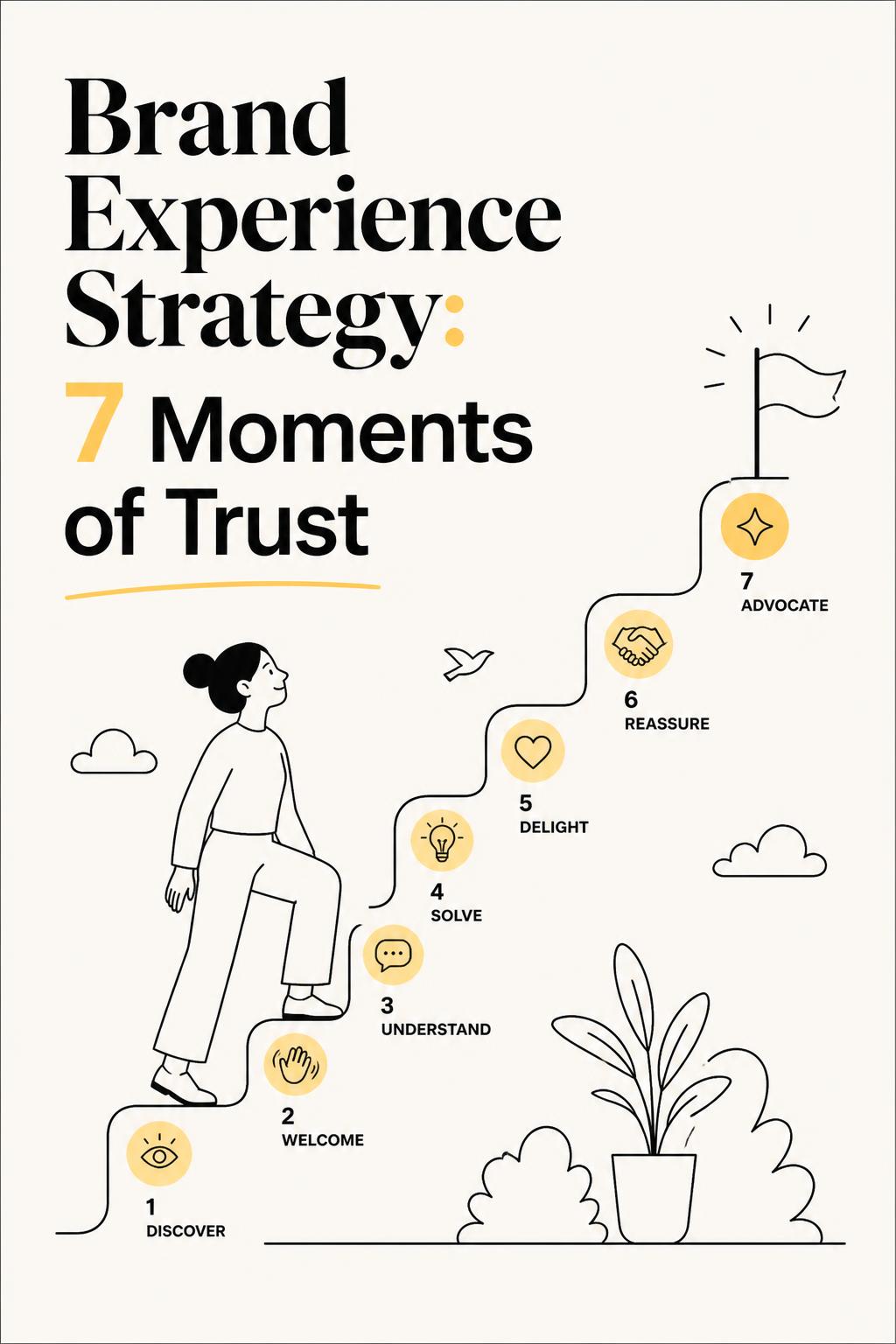
Most teams should begin with seven moments that disproportionately shape customer trust. Not every business will have the same priorities, but these are where brand promises are commonly tested.
These are belief-change moments. They deserve more research and design attention than routine interactions because customers are actively deciding what your company is like.
In a research project for a mobile banking product, users praised the app’s clean design but described the brand as “controlling.” The reason was not the interface. Customers could not temporarily increase a transfer limit without calling support, even after completing identity verification. The bank framed the policy as protection; customers experienced it as a lack of trust. The redesign gave users a secure self-service option, explained the relevant risk in plain language, and made the change reversible. That preserved safeguards while changing the emotional meaning from restriction to control.
A brand experience strategy becomes useful only when it changes decisions. The practical mechanism is a set of three to five signature behaviors: actions your company does consistently because they prove the brand position.
For example, a software company that wants to own “expert guidance without complexity” might define these signature behaviors: explain advanced options in context rather than burying them in documentation; show customers the consequence of a choice before they commit; state product limitations clearly; and route urgent questions to knowledgeable specialists rather than generic first-line support.
Notice that these are not brand adjectives. They are operational commitments. They create tradeoffs. Clear pricing may reduce sales-team flexibility. Better in-product explanations may lengthen a flow. Routing support to specialists may cost more. If the commitments require no tradeoff, they are probably too vague to differentiate the brand.
Use a simple decision filter before approving major product, policy, or service changes: does this increase or reduce the belief we want customers to hold? A brand positioned around simplicity should be skeptical of a feature that adds choice without improving confidence. A brand positioned around premium expertise should resist automated support flows that leave high-value customers feeling dismissed.
Do not begin in a brand workshop. Begin with customer evidence. Workshops are useful for alignment, but they are poor substitutes for seeing where customers’ expectations collide with the experience you actually provide.
Behavioral analytics can show that users abandon a workflow, downgrade a plan, or contact support after a product release. It cannot reliably tell you what that behavior means. Were users confused, unconvinced, anxious about risk, unwilling to pay, or simply unable to find a feature? Those explanations imply very different brand problems and very different solutions.
Research-grade AI-native qualitative analysis is valuable here when it accelerates synthesis without stripping researchers of control. Usercall can help teams run AI-moderated interviews with deep researcher controls, analyze recurring patterns across open-text feedback and interview evidence, and intercept users at key product-analytics moments. That makes it possible to ask why someone abandoned a setup flow or changed behavior while the context is still fresh. The objective is not automated sentiment scoring. It is finding the language, tensions, and edge cases that explain how customers interpret the experience.
Track operational metrics, but do not stop there. Review the words customers use in support conversations, sales calls, interview transcripts, cancellation feedback, and public reviews. Are they describing your company as clear, reliable, empowering, rigid, expensive, responsive, confusing, or worth the effort? Those are not soft signals. They are the market’s working definition of your brand.
A successful brand experience strategy changes this language over time. If your goal is to be known for clarity, customers should independently mention that they understood what would happen, what it would cost, and what to do next. If your goal is to be known for expert partnership, they should mention feeling guided rather than merely served.
The standard is demanding but simple: can customers recognize your brand’s character when something is inconvenient, uncertain, or broken? If the answer is no, invest less in declaring what the brand stands for and more in designing the proof. That is where trust is earned, memory is formed, and brand experience strategy becomes a competitive advantage rather than a presentation deck.
Mapping trust-defining moments is only half the battle—you also need to know if your tracking system can actually detect when those moments break down. For a deeper look at why most measurement setups miss this, read our guide on how brand tracking is broken in most companies, and nobody wants to admit it. If you want to pair qualitative moment-mapping with ongoing perception data, Usercall can help you connect the two.
Related: what brand tracking actually measures · the questions your brand survey should be asking
