
How to Improve Client Experience (Stop Fixing Surface Problems and Fix What Actually Breaks Trust)
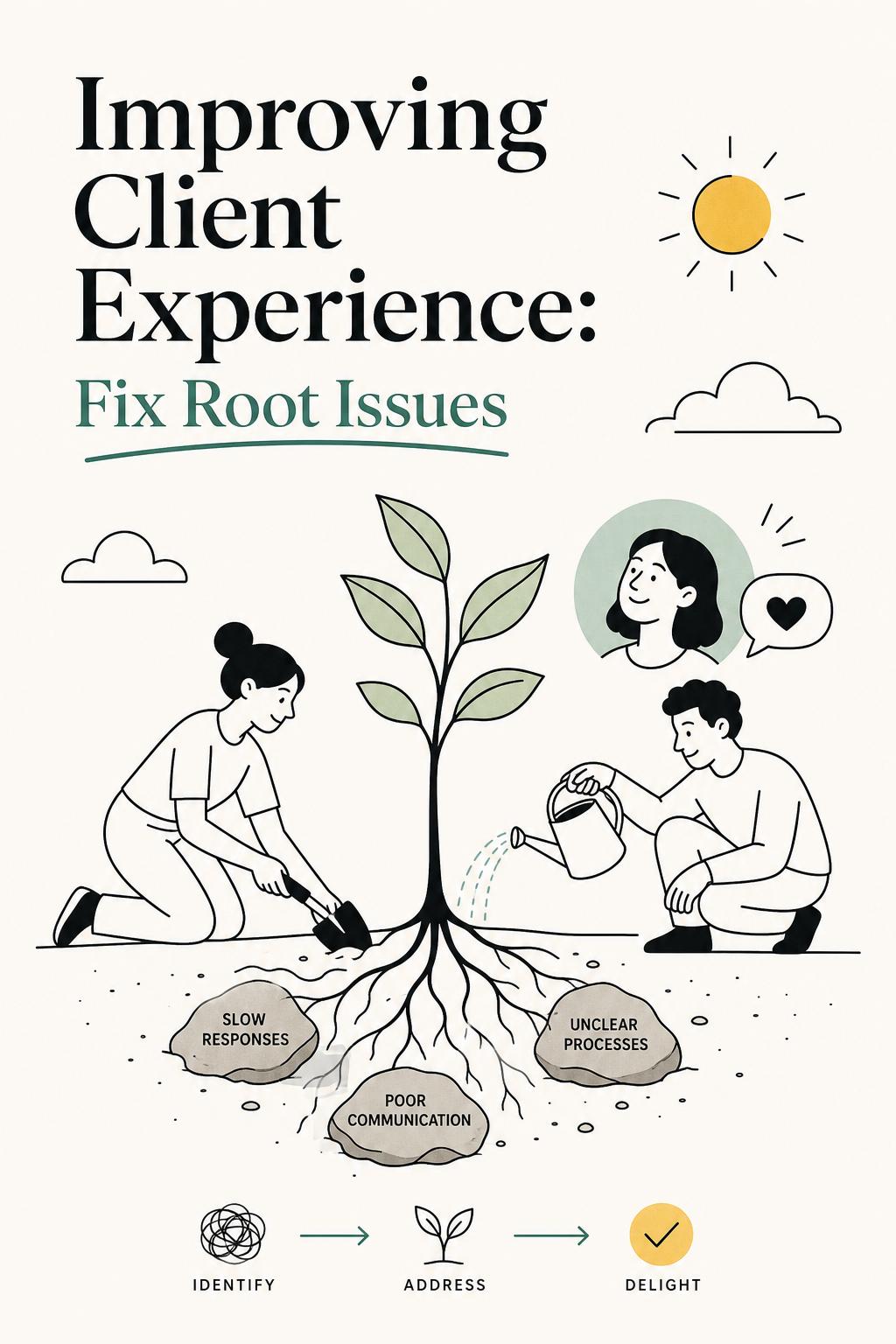
Most teams trying to improve client experience are solving the wrong problem—and they do it really well.
I have sat in too many rooms where leadership celebrates faster response times, cleaner onboarding decks, and higher CSAT… while churn quietly stays flat. On paper, the experience is improving. In reality, clients are still leaving for the same reasons.
The uncomfortable truth is this: client experience rarely fails because of obvious friction. It fails because of silent doubt. The kind clients never explicitly report. The kind your dashboards cannot see.
If you want to improve client experience in a way that actually moves retention, expansion, and referrals, you need to stop polishing interactions and start diagnosing where trust breaks.
Why most client experience strategies quietly fail
Let’s be blunt. The standard advice for improving client experience is not wrong—it is just incomplete to the point of being misleading.
“Respond faster.”
“Personalize communication.”
“Map the journey.”
“Train your team.”
All reasonable. None sufficient.
These approaches fail because they assume:
- All touchpoints matter equally
- Clients will clearly articulate what is wrong
- Improving satisfaction automatically improves retention
In practice, none of those hold.
Clients do not leave because your emails were slightly slow. They leave because, at some point, they stopped feeling confident in your ability to drive their outcome—and never fully regained that confidence.
And here is the critical part: by the time a client expresses dissatisfaction, the decision is often already made.
Client experience is really about confidence—not satisfaction
If you only take one idea from this, make it this one: client experience is a system for maintaining confidence under uncertainty.
Through hundreds of interviews, I have found that clients continuously (and often subconsciously) evaluate three questions:
- Do they understand what I am actually trying to achieve?
- Are they in control of the process and the risks?
- Can I confidently explain the value of this work to my stakeholders?
When any of these answers becomes shaky, experience degrades—even if your service quality is objectively “good.”
This is why you can have high NPS and still lose key accounts. Satisfaction is a snapshot. Confidence is a trajectory.
The hidden moments where client experience actually breaks
Most journey maps are too linear to be useful. They smooth over the exact moments where things fall apart.
Instead, I focus on what I call confidence cliffs—points where the client must make a judgment without full information.
These are the moments that disproportionately shape client experience:
- Post-sale handoff: When what was sold meets what is actually delivered
- Early onboarding: When clients invest effort before seeing value
- First failure or delay: When expectations collide with reality
- Executive visibility moments: When clients must justify your work internally
- Renewal framing: When value must be clearly defensible
If you are not explicitly researching these moments, you are missing the highest-leverage opportunities to improve client experience.
A research-driven workflow to improve client experience
Most teams collect feedback. Very few generate insight that leads to meaningful change. Here is the workflow I use to close that gap.
1. Start with behavioral signals—not opinions
Do not begin with surveys. Begin with friction in the data.
Look for:
- Drop-offs during onboarding
- Delayed approvals or responses
- Declining stakeholder engagement
- Repeated support escalations
- Reduced usage or scope contraction
These are leading indicators of experience breakdown.
This is where tooling matters. Platforms like UserCall allow you to trigger in-the-moment user or client intercepts tied to these behaviors—capturing insight exactly when friction occurs. Combined with AI-moderated interviews and research-grade qualitative analysis, you move from vague feedback to structured understanding of what is actually breaking.
2. Anchor interviews in real decisions
Generic questions produce generic answers. You need to anchor conversations in real moments.
Ask things like:
- “Tell me about the last time you had to justify this work internally.”
- “When did you first feel unsure about the direction of this project?”
- “What was happening the last time you chased us for an update?”
- “Where did our process create extra work for you?”
This is how you uncover hidden effort, misaligned expectations, and political pressure inside the client organization.
3. Prioritize by trust impact—not frequency
Not all problems are equal. Some annoy. Others erode trust.
Use this lens:
Only a handful of issues will fall into that last category. Those are the ones that matter.
4. Redesign the interaction—not just the communication
Most teams respond to problems by improving messaging. That is rarely enough.
If onboarding is confusing, clearer emails will not fix it. If clients feel unsupported, more frequent updates will not fix it.
You need to change the structure of the experience:
- Turn kickoff calls into decision-alignment sessions with explicit success metrics and risks
- Replace status updates with progress narratives tied to business outcomes
- Introduce milestone-based value delivery instead of front-loaded effort
- Trigger proactive check-ins based on behavioral signals, not timelines
What I have learned from real client experience research
A few patterns show up consistently across industries—and they are rarely what teams expect.
Anecdote 1: In a B2B SaaS study, a company believed slow response times were their biggest issue. After interviewing 14 clients across churned and retained accounts, we found response time only mattered when the client was already under pressure internally. The real issue was that updates lacked clarity and did not help clients explain the situation upward. We redesigned updates to include impact, ownership, and next decisions. Support satisfaction improved—but more importantly, renewal confidence increased.
Anecdote 2: In another case, onboarding completion rates were above 80%, so leadership assumed things were working. Interviews revealed clients were brute-forcing onboarding—working late, pulling in colleagues, guessing requirements. The experience “worked” operationally but felt chaotic. We reduced initial effort by about 40% and restructured onboarding around early value milestones. Post-onboarding engagement increased significantly.
Anecdote 3: One enterprise client team asked for better personalization. What we found instead was “context loss.” Every new stakeholder from the vendor side required clients to re-explain goals and constraints. The fix was a shared, evolving account narrative. That single change reduced friction more than any personalization effort could.
A 30-day plan to improve client experience
If you want something actionable, this is the fastest way I know to drive meaningful improvement:
- Identify 2–3 confidence cliffs using behavioral data
- Conduct 10–15 targeted interviews across different account health levels
- Analyze for hidden work and uncertainty—not just surface complaints
- Map root causes (expectations, ownership, process, timing)
- Redesign one critical interaction per cliff
- Track leading indicators like engagement, approval speed, and stakeholder involvement
This is not a massive transformation. It is a focused intervention where it matters most.
What to measure if you actually want results
If you are still relying on quarterly surveys, you are reacting too late.
Track signals of growing confidence:
- Faster time-to-value after onboarding
- Increased participation from senior stakeholders
- Fewer repeated clarification questions
- Shorter time between issue detection and meaningful response
- More proactive, strategic conversations initiated by clients
These are the indicators that your client experience is actually improving—not just feeling better on surveys.
The real goal: eliminate doubt at critical moments
Here is the bottom line. You do not need to make every interaction delightful. You need to make critical moments feel controlled, clear, and defensible.
The fastest way to improve client experience is not to improve everything. It is to identify where clients begin to doubt you—and fix those moments with precision.
Because once doubt sets in, no amount of friendliness, speed, or polish will fully recover the relationship.
But if you can consistently reinforce confidence where it matters most, everything else—retention, expansion, advocacy—starts to follow.
To see how trust-breaking moments fit into a complete strategy, take a look at our customer experience CX strategy guide. If you want to find exactly where trust is eroding with your own clients, Usercall turns real conversations into clear, actionable evidence.
Related: how hidden trust gaps are costing banks their customers · a CX framework focused on real retention drivers · delivering personalization that actually builds trust