
Customer Journey Touchpoints: Why Most Maps Fail (And How to Find the Moments That Actually Drive Decisions)
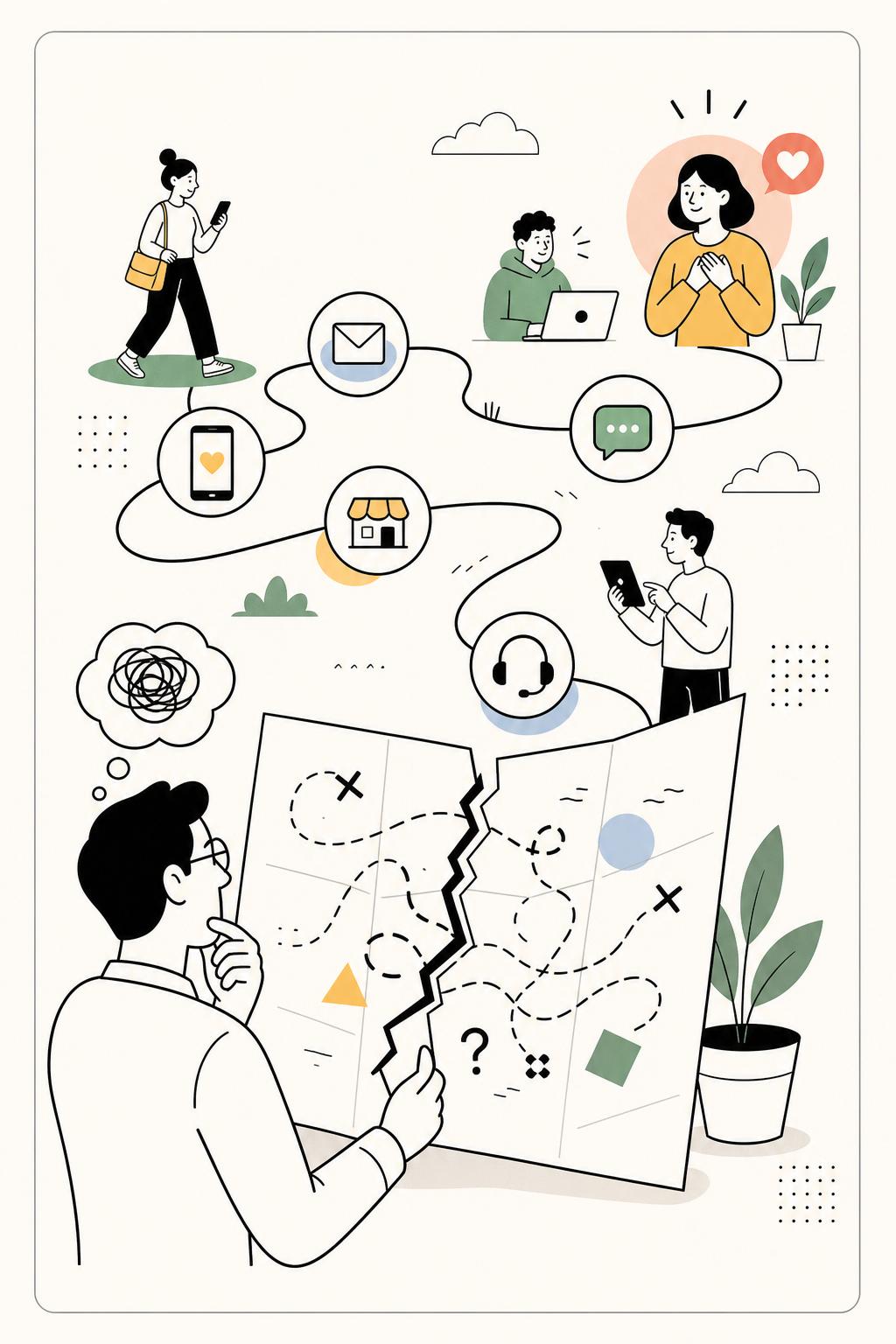
Most teams don’t have a touchpoint problem—they have a prioritization problem. I’ve sat in too many journey mapping workshops where teams proudly present 30, 40, even 60 “customer journey touchpoints”… and still can’t explain why conversion is stuck, onboarding fails, or churn creeps up every quarter.
Here’s the uncomfortable truth: documenting more touchpoints doesn’t get you closer to understanding customers. It usually does the opposite. When everything is labeled important, nothing actually is. And the touchpoints that truly drive behavior—the moments where customers hesitate, commit, or quietly disengage—get buried under a sea of low-impact interactions.
If you’re searching for “touchpoints customer journey,” what you actually need isn’t a bigger map. You need a sharper lens. Because the difference between high-performing teams and everyone else isn’t how many touchpoints they track—it’s how precisely they identify the few that change outcomes.
The real definition of customer journey touchpoints (that most teams miss)
A customer journey touchpoint is not just any interaction. It’s a moment that meaningfully shifts what a customer believes, feels, or does next.
That distinction sounds subtle, but it changes everything.
Most teams define touchpoints operationally: page visits, emails, demos, support tickets, ads. That’s easy to list—but strategically weak. Because customers don’t experience journeys as a sequence of channels. They experience them as a series of decisions.
And decisions are driven by perception shifts, not interactions alone.
For example, a pricing page isn’t important because it exists—it’s important if (and only if) it changes how a customer evaluates cost, risk, or value. A support interaction isn’t critical because it happens—it’s critical if it restores trust or confirms doubt.
When you redefine touchpoints this way, your map shrinks—but your insight sharpens.
Why most customer journey touchpoint maps fail
Let’s be blunt: most journey maps are artifacts, not decision tools. They look polished, align stakeholders temporarily, and then quietly collect dust.
Here’s why they fail in practice:
- They capture activity, not impact. Teams map what happens, not what actually changes behavior.
- They assume linear journeys. Real customers loop, stall, compare alternatives, and revisit decisions.
- They average away reality. Different segments experience completely different journeys, but maps flatten them into one.
- They ignore emotional weight. A minor friction at the wrong moment matters more than a major one at the right time.
- They don’t connect to metrics. No link to conversion, retention, or product usage means no accountability.
The biggest issue? They’re built from the company’s perspective. Internally logical. Externally irrelevant.
Customers don’t care about your funnel stages. They care about whether continuing feels worth it.
The only touchpoints that matter: decision moments
If you want a more useful model, stop organizing touchpoints by funnel stage and start organizing them by decision pressure.
In my work, I focus on what I call decision moments—points in the journey where a customer must actively decide whether to continue, commit, or disengage.
These moments typically show up when customers:
- Encounter uncertainty they can’t quickly resolve
- Feel a mismatch between expectation and reality
- Need to justify the decision to others
- Must invest time or effort before seeing value
- Experience friction that interrupts momentum
Everything else is background noise.
In one SaaS project, we mapped 45 touchpoints across the lifecycle. But when we analyzed decision moments through interviews and behavioral data, just four explained most outcomes:
- First exposure to pricing complexity
- Internal handoff between evaluator and decision-maker
- First attempt to use real data in the product
- First unresolved support issue
Forty-five mapped touchpoints. Four that actually mattered.
This is the gap most teams never close.
A better framework: mapping touchpoints by decision energy
Instead of asking “What are our touchpoints?”, ask:
Where does the customer need to spend the most mental, emotional, or organizational energy?
I call this decision energy, and it’s the fastest way to identify high-leverage moments.
High decision-energy touchpoints are where customers:
- Struggle to interpret information
- Doubt whether the product will work for them
- Feel risk (financial, reputational, or effort-related)
- Need stakeholder alignment
- Hit friction without clear recovery
These are the moments where small improvements drive outsized results.
For example, if activation is low, the problem usually isn’t “onboarding length.” It’s that users hit a high-energy moment—like data setup or configuration—before they trust the product enough to proceed.
Until you reduce that energy cost, nothing else matters.
How to identify high-impact touchpoints (step-by-step)
This is the workflow I use with product and research teams when metrics don’t match expectations:
- Start with a business problem. Pick a конкрет outcome: trial drop-off, poor activation, churn spike.
- Reconstruct the behavioral timeline. Use analytics, CRM data, and session patterns to map what actually happened before the outcome.
- Anchor interviews to specific moments. Ask: “Walk me through the exact moment you decided to stop.”
- Identify perception shifts. Where did confidence drop? Where did doubt appear?
- Score touchpoints. Rank by impact, frequency, emotional intensity, and fixability.
- Instrument the moment. Add intercepts or research triggers at those exact points.
This last step is where most teams fall short. They run research detached from behavior.
Tools like Usercall change that dynamic. It’s built for research-grade qualitative insight with precise control over when and where feedback is captured. Instead of sending generic surveys, you can trigger AI-moderated interviews exactly when users hit critical touchpoints—like abandoning onboarding or hesitating at pricing—and actually understand the “why” behind the metric in context.
That’s the difference between collecting opinions and capturing decisions in real time.
What teams measure vs. what actually matters
One of the biggest blind spots in touchpoint analysis is confusing activity metrics with customer meaning.
Most teams optimize the middle column. High-performing teams investigate the right column.
Three hard lessons from real research
1. The “problem touchpoint” is rarely where the problem starts.
I worked on a churn study where leadership was obsessed with improving the cancellation page. Interviews showed customers had emotionally churned weeks earlier after repeated small failures. By the time they reached cancellation, nothing we said would change their mind.
2. Friction is often misdiagnosed.
In an onboarding study, we thought drop-off was due to complexity. It wasn’t. Users hesitated because they didn’t trust the product with real data yet. Once we introduced a safe sandbox experience before data import, activation improved significantly.
3. Support is a hidden high-impact touchpoint.
In a product-led company, support was treated as a cost center. But interviews revealed it was the single strongest driver of retention for high-value users. Not because of resolution speed—but because of how trust was handled.
These insights don’t show up in dashboards. They show up when you study decision moments directly.
How to actually improve customer journey touchpoints
If you want your touchpoint work to drive outcomes—not just alignment—focus on reducing friction and increasing confidence at critical moments:
- Fix expectation gaps early. Misaligned discovery touchpoints create downstream churn.
- Reduce uncertainty, not just add persuasion. Customers don’t convert because they’re convinced—they convert because they feel safe proceeding.
- Reorder experiences around value. Let users see results before asking for effort.
- Design for recovery, not perfection. Failures happen—how you respond defines retention.
- Instrument key moments. Capture insight at the exact point decisions are made.
This is where most teams unlock disproportionate gains—not by redesigning everything, but by fixing the few moments that matter most.
The bottom line
Customer journey touchpoints are not a checklist. They’re a set of bets about where behavior changes.
The teams that win aren’t the ones with the most detailed maps. They’re the ones who understand which moments carry the most decision weight—and focus relentlessly on improving those.
Because in the end, customers don’t experience your journey as a series of steps.
They experience it as a series of decisions.
Run the week on concept testing: 15 to 30 AI-moderated interviews, with quotes back in 48 to 72 hours.
To see how these decision-driving touchpoints fit into a full, research-backed mapping process, read the customer journey mapping guide. If you need to validate which touchpoints actually matter to your customers, Usercall's AI-led interviews can surface that evidence directly from the people making the decisions.
Related: Concept testing questions · Concept testing research · CPG packaging · Concept testing examples
Related: the B2B touchpoints most teams miss entirely · why buyer journey mapping usually falls short · the real moments that drive conversion in the customer decision journey