
AI Customer Experience: What Most Teams Get Wrong (And How to Actually Fix It)
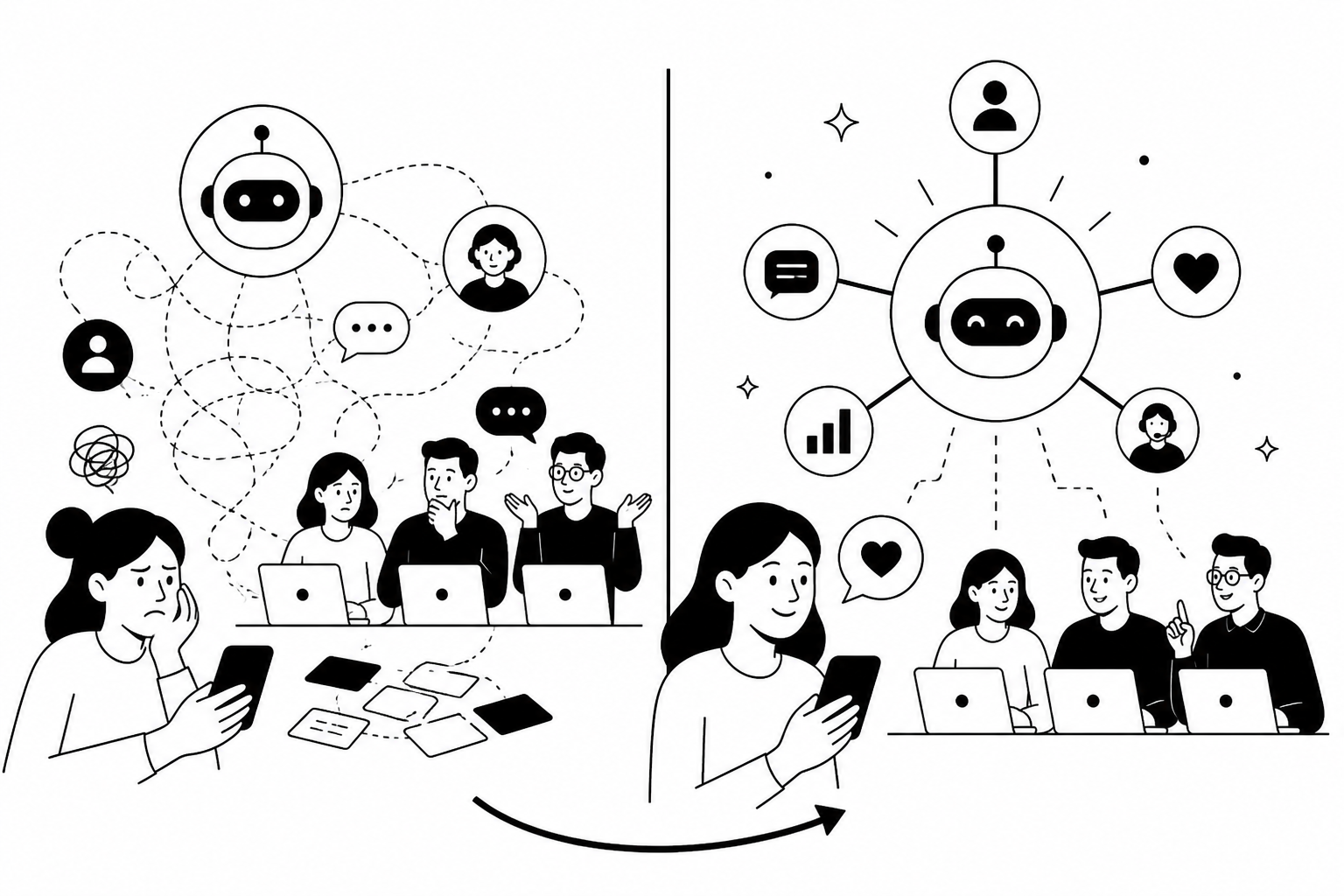
Here is something I see constantly in my work with product and research teams: a company spends six figures on a customer experience program, runs quarterly NPS surveys, builds dashboards full of sentiment scores, and still cannot answer the question that actually matters. Why are customers leaving? Not the proxy answer. The real one.
AI is supposed to fix this. And in some ways it genuinely can. But most teams are deploying AI customer experience tools in a way that recreates the same fundamental problem with better graphics. They are still measuring surface reactions instead of understanding underlying decisions. They are still collecting data at scale without gaining insight at depth.
I have spent over a decade running qualitative research programs for companies ranging from early-stage B2B SaaS to large consumer brands. The biggest shift I have seen in recent years is not the arrival of AI. It is the arrival of AI being misused in ways that feel like progress but are actually moving teams further from the truth about their customers. This post is my attempt to reframe what AI customer experience should actually mean, and how to build a program that generates real competitive advantage.
The Core Problem With Most AI Customer Experience Programs
When most teams say "AI customer experience," they mean one of three things: automated chat support, sentiment analysis on reviews and tickets, or personalization engines that serve different content to different users. All three of these are legitimate applications. None of them, on their own, tell you why customers behave the way they do.
Sentiment analysis is a perfect example. I worked with a SaaS company that had built an impressive AI pipeline ingesting support tickets, G2 reviews, Slack community messages, and churn surveys. Their model was flagging "frustrated" and "satisfied" customers with reasonable accuracy. What it could not do was explain what was driving the frustration or sustaining the satisfaction. The labels were accurate. The understanding was missing.
The problem is structural. AI systems trained to classify and quantify feedback are optimized for scale, not for the kind of exploratory understanding that produces real insight. They tell you what customers said. They cannot reliably tell you what customers meant, what they were trying to accomplish, or what would have changed their decision.
This is where consumer insights analysis needs a different approach entirely. Counting feedback at scale is not the same as understanding what actually drives customer decisions. The teams winning at AI customer experience have figured out how to combine the scale benefits of AI with the depth that only comes from real qualitative understanding.
What "AI-Moderated" Actually Means for Research Quality
One of the most significant developments in the last few years is the emergence of AI-moderated interviews. This is different from survey automation or chatbot flows. A well-designed AI moderator can conduct a genuine exploratory interview, follow unexpected threads, probe for specifics, and adapt its questioning based on what a participant says. Done well, it produces qualitative data that is richer than most surveys and scalable in ways that human moderation cannot match.
The key word there is "done well." I have seen AI interview tools that are essentially branching survey logic dressed up in conversational language. The questions are fixed, the probes are pre-scripted, and the "AI" is mostly just a delivery mechanism. That is not moderation. That is a survey with a chatbot interface.
Genuine AI moderation means the system can recognize when a participant introduces a new concept that was not anticipated in the discussion guide, and pursue it. It means the system can distinguish between a superficial answer and a substantive one, and ask follow-up questions accordingly. It means the resulting transcripts contain the kind of unprompted language that researchers prize because it reveals how customers actually think, not just how they respond to our pre-formed hypotheses.
When AI moderation works this way, it solves a real problem in customer experience research. Traditional qualitative research is slow and expensive, which means most teams do it rarely and at small scale. AI moderation makes it possible to run continuous, always-on qualitative research that captures changing customer perceptions in near real-time. That is a genuinely new capability, not just an efficiency improvement.
The Research Methodologies That Actually Inform CX Strategy
Most customer experience programs are built on a narrow methodological base. NPS surveys. CSAT scores. Support ticket analysis. Occasionally, some user testing. This works fine if your goal is monitoring, but it fails completely if your goal is understanding.
The teams I have seen build genuinely effective AI customer experience programs draw on a much wider range of approaches. Customer research methodologies that reveal what customers actually need include jobs-to-be-done interviews, diary studies, concept testing, and retrospective decision interviews, among others. Each of these produces a different type of insight, and the best programs layer several of them rather than relying on any single method.
Here is a simplified view of how different methodologies map to CX questions:
Research MethodBest CX Question It AnswersAI ScalabilityJobs-to-be-done interviewsWhy did customers hire or fire this product?High with AI moderationRetrospective decision interviewsWhat made them choose us over alternatives?High with AI moderationDiary studiesHow does the experience evolve over time?Medium, with AI analysisNPS / CSAT surveysHow satisfied are customers right now?Very high, but shallowUsability testingWhere does the product create friction?MediumWin/loss interviewsWhy did we win or lose specific deals?High with AI moderation
The pattern here is important. The methods that answer the deepest CX questions, the ones about decisions and motivations and trade-offs, are also the ones that benefit most from AI moderation. They are currently underused because they are expensive and slow when done manually. AI changes that calculus significantly.
Why AI Thematic Analysis Is Not Enough
Every team I talk to has discovered that AI can identify themes in qualitative data. You drop in a set of transcripts, the AI finds clusters, you get a list of topics with representative quotes. It feels like insight. It often is not.
The problem with theme identification is that it is fundamentally descriptive. It tells you what came up frequently. It does not tell you what matters. And in customer experience research, those two things are very different. The thing customers complain about most loudly is rarely the thing that actually determines whether they stay or go. The theme that appears in 40% of your interviews might be background noise. The concern that surfaced in only 8% of interviews might be the one that predicts churn with high reliability.
I ran a research program for a B2B SaaS company a few years ago where the AI thematic analysis was pointing clearly at "onboarding friction" as the dominant theme. That was real. But when we dug into the qualitative data more carefully and ran a second round of targeted interviews, we found that onboarding friction was a proxy complaint. The real issue was that customers had been sold on a capability the product could not quite deliver in their specific context. Fixing onboarding would not have fixed churn. Fixing the sales-to-product alignment would have.
This is why AI market research needs to go beyond theme identification and focus on what actually makes customers buy, stay, and leave. Themes are a starting point for analysis, not an endpoint. The AI's job is to surface structure in the data so that a skilled researcher can find the actual story underneath.
Building a Continuous AI Customer Experience Program
One of the most common mistakes I see is treating customer experience research as a project rather than a program. Teams run a big study, generate a deck full of findings, share it at an all-hands, and then wait another year before doing it again. Meanwhile, the customer population is evolving, the competitive landscape is shifting, and the insights from that study are going stale within months.
AI makes continuous research genuinely achievable for teams that could never afford it before. Here is how I think about building a continuous AI customer experience program:
The economics here are important. A traditional qualitative research program at the scale I am describing would require a significant agency budget and months of lead time for each wave. AI-moderated research compresses both the cost and the timeline dramatically, which is what makes continuous programs viable for teams that are not sitting on massive research budgets.
The Role of AI CX Services Versus Building Internal Capability
Many teams I speak with are wrestling with a build-versus-buy question in a new form. Should they invest in AI customer experience services from an agency or consultancy? Or should they build the capability internally using tools that give them more direct control over the research process?
My honest answer is that most teams should be doing more of this internally than they currently do, for a specific reason. Customer experience insight is most valuable when it is embedded in the team that needs to act on it. When insight comes entirely from an external agency, there is always a translation layer. The agency understands what they found. The internal team understands what they need to decide. Getting those two things to connect cleanly is hard, and a lot of value gets lost in that gap.
That said, the traditional argument against internal research programs has been cost and expertise. Both of those barriers are lower than they used to be. Customer experience services that rely on surveys are not solving the churn problem that most teams actually face. The teams seeing real results are the ones doing qualitative research at scale, and AI tools are making that accessible without requiring a team of PhD researchers.
The hybrid model I recommend to most teams: use AI-powered tools to run continuous qualitative research internally, and bring in external expertise for specific high-stakes studies where you need methodological depth or an outside perspective. This gives you the best of both approaches without the full cost of either.
What Good AI Customer Experience Research Actually Produces
After all of this, what should a team that is doing AI customer experience research well actually have? Not a dashboard. Not a theme cloud. Not a quarterly report with 40 findings.
They should have a clear, constantly updated understanding of three things:
First, what jobs their customers are actually hiring their product to do, in their customers' language, not the language of the product team. Second, what the critical moments in the customer journey are where experience has an outsized effect on the decision to stay or go. Third, what the genuine competitive alternatives are in their customers' minds, including the option of doing nothing differently.
When a team can answer those three questions with confidence and recency, they are in a position to make CX decisions that actually move retention, expansion, and advocacy metrics. Everything else is just reporting.
The combination of AI moderation for data collection and skilled qualitative analysis for interpretation is what gets teams there. Neither half works without the other. But when both are in place, the result is a customer experience program that actually generates the insight it promises.
Start Running Qualitative Research at Scale
If your team is relying on surveys and sentiment scores to understand your customer experience, you are working with incomplete information. Usercall gives you AI-moderated voice interviews that surface the real motivations, language, and decision drivers behind your customers' behavior, at a scale and speed that traditional qualitative research cannot match. If you are ready to stop guessing at why customers stay and leave, start a study at usercall.co and see what your customers are actually telling you.
Run the week on concept testing: 15 to 30 AI-moderated interviews, with quotes back in 48 to 72 hours.
AI can only fix what your team actually understands about the customer experience—for the underlying reasons dashboards fall short in the first place, check out Customer Experience Is Broken and Your Dashboard Is the Last One to Know. If you're ready to pair AI with real customer conversations instead of guesswork, Usercall can help you get there.
Related: Concept testing questions · Concept testing research · CPG packaging · Concept testing examples
Related: the costly AI mistake that makes customers feel ignored · why your CX metrics are lying to you · proven customer experience tools worth evaluating