
Brand Research Tracking Is Broken. Here's How to Fix It Without Burning Your Budget on Agencies
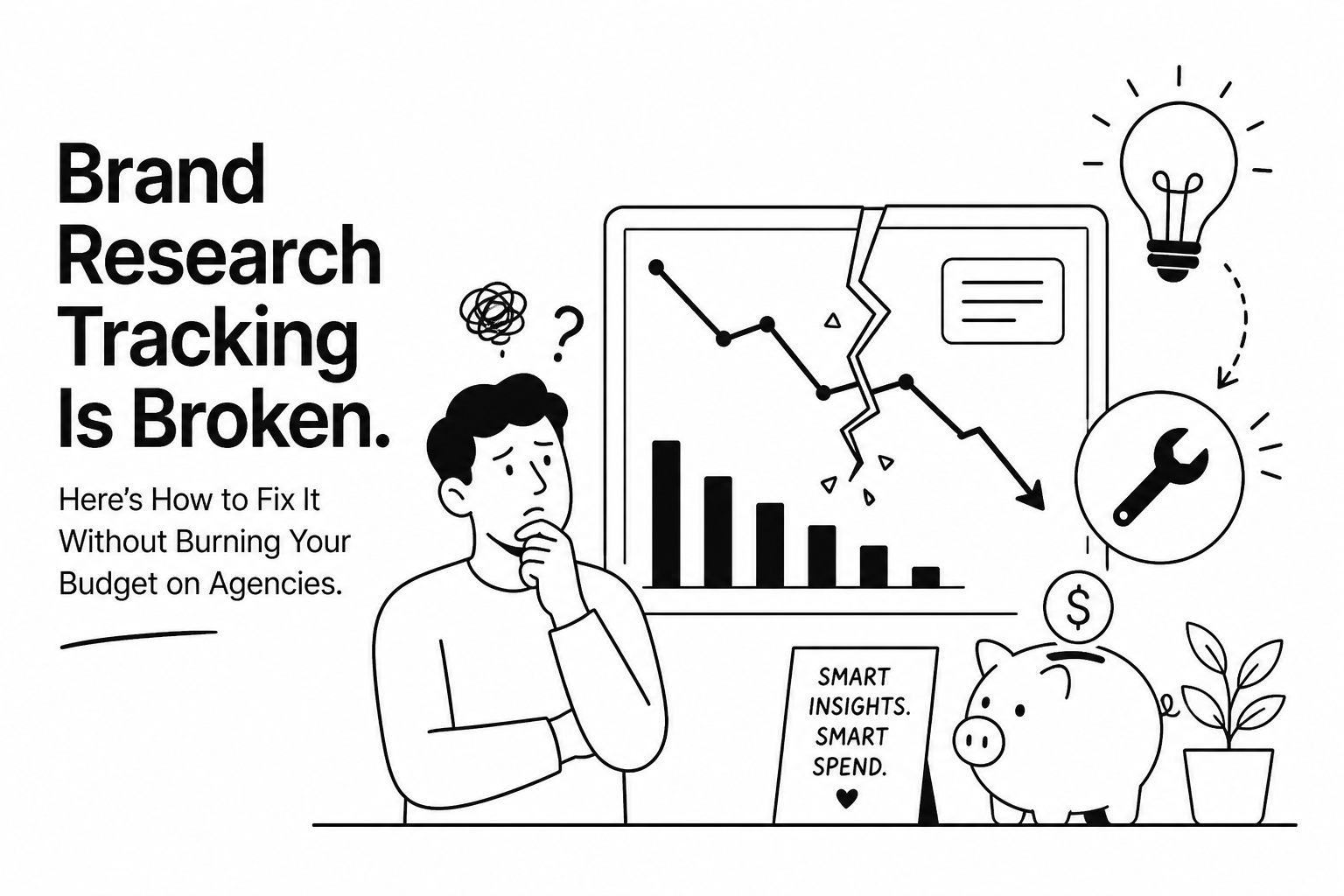
Most brand tracking studies I've reviewed over the past decade tell you exactly what happened six months ago. They rarely tell you why, and they almost never tell you what to do next. I've sat in enough steering committee meetings where a brand health dashboard shows a two-point dip in "consideration" and nobody in the room can explain it, because the survey that generated that number never asked anyone to explain anything.
That's the core problem with how most companies approach brand research tracking. They treat it as a measurement exercise instead of a learning system. They track scores, not stories. And scores without stories are just numbers you report upward, not insights you can act on.
I've run brand tracking programs for consumer tech companies, helped agencies rebuild their tracking methodology after clients started questioning the ROI, and more recently, helped teams replace parts of their tracking stack with AI-moderated qualitative interviews that run continuously instead of quarterly. What follows is what I've learned about doing this well, and what I've learned about doing it badly.
What Brand Research Tracking Actually Measures (and What It Misses)
Brand tracking, in its classic form, is a repeated survey. You ask the same questions to a fresh sample every quarter or every month: awareness, consideration, preference, NPS, sometimes brand attribute association. You plot the trend lines. You present them to leadership as if they mean something on their own.
The problem is that trend lines are outputs, not explanations. A five-point drop in "trust" tells you that something changed in how people feel about you. It does not tell you what changed, who it changed for, or what you should do about it. I once worked with a fintech client whose brand trust score dropped sharply after a product update. The tracking survey flagged the drop perfectly. It took us three weeks of follow-up qualitative work to figure out that a UI change had accidentally hidden the security badge that reassured first-time users. A single well-placed pixel change caused a measurable brand perception shift, and no quantitative tracker on earth would have told us that on its own.
This is why I tell teams that brand research tracking without a qualitative layer is half a system. You need the quant to tell you when something moved. You need the qual to tell you why, and increasingly, you need that qual layer to run continuously, not as an occasional deep-dive that happens after the quant already went stale.
The Problem With Traditional Brand Equity Studies
Brand equity studies are the gold standard that most marketing teams default to, and I think that's a mistake more often than people want to admit. These studies are expensive, they're slow, and they're built on a methodology that assumes stated preference maps cleanly onto actual purchase behavior. It doesn't, not reliably.
I've seen brand equity scores that looked fantastic on a slide deck while the same company's win rate against a specific competitor kept sliding for two straight quarters. The equity study measured favorability. It didn't measure the actual decision moment where a buyer chose someone else. That gap between what people say about your brand in a survey and what they actually do when they're making a real purchase decision is where most brand tracking programs quietly fail. I dig into exactly how this disconnect happens and what to measure instead in this breakdown of why brand equity studies mislead teams, and it's become one of the most useful diagnostic pieces I point clients to when their tracking numbers stop matching their sales numbers.
The fix isn't to abandon equity metrics entirely. It's to stop treating them as the whole picture. Equity scores are a thermometer. They tell you the temperature. They don't tell you why the room is cold.
Why Consumer Behavior Data Matters More Than Brand Recall
Here's an uncomfortable truth I've had to explain to more than one CMO: brand recall and purchase behavior are only loosely correlated. People can recognize your brand perfectly, rate it favorably, and still buy your competitor because of something that never shows up in a standard tracking questionnaire, like a friend's recommendation, a pricing quirk they noticed at checkout, or friction in a category they didn't even realize they cared about until they hit it.
I worked on a research design for consumer buying behavior with a DTC skincare brand that had strong recall and mediocre conversion. Their tracking study said brand health was fine. Their revenue said otherwise. When we ran structured interviews with people who had researched the brand but bought elsewhere, we found a pattern that no survey question had ever surfaced: shoppers assumed the brand was "for younger skin" based entirely on the Instagram feed, despite the actual product line skewing toward mature skin concerns. That perception gap was costing them a huge chunk of their addressable market, and it lived entirely outside their tracking survey's question set because nobody had thought to ask about it.
This is the argument I make constantly: you cannot design a good tracking survey until you understand the actual decision architecture behind the purchase. You need qualitative work to map out what actually drives the choice before you can quantify it accurately. I go deep on this in this guide to brand and consumer behavior research, which covers how to structure that discovery work so your tracking metrics end up measuring things that actually predict behavior instead of things that are easy to ask about.
Building a Continuous Brand Tracking System That Works
The biggest structural fix I recommend to almost every team is moving away from the quarterly wave model entirely. Quarterly tracking creates a lag between when something changes in the market and when you find out. By the time your Q3 wave shows a dip, the thing that caused it happened in July, and you're only now starting to investigate in October.
A better model runs light qualitative touchpoints continuously, alongside a slower quantitative cadence. This means recruiting a rolling sample of customers, prospects, and lapsed users, and running short AI-moderated voice interviews every week or two instead of a giant survey every ninety days. You get a constant stream of open-ended signal that you can triangulate against your quant trend lines.
I set this up for a B2B SaaS client who had been running annual brand studies with an agency for years. We kept a lightweight quarterly quant pulse for trend continuity, but replaced their expensive annual deep-dive interviews with a continuous stream of thirty AI-moderated interviews a month, split across current customers, churned customers, and competitive switchers. Within two quarters they had caught a positioning problem with a specific buyer persona that their annual study had missed for three years running, simply because nobody had been listening in real time.
What to Track: Metrics That Actually Predict Behavior
Not all brand metrics are equally useful. Some correlate strongly with future behavior. Others are vanity numbers that move around for reasons that have nothing to do with your actual market position.
MetricWhat It Tells YouBehavioral Predictive ValueUnaided awarenessWhether people think of you unpromptedLow to moderateConsideration set inclusionWhether you're in the shortlist when buyers compareHighReason for rejection (qualitative)The specific objection that knocked you out of a dealVery highNet Promoter ScoreGeneral sentiment among current customersLow on its ownSwitching triggers (qualitative)What actually caused a customer to leave or arriveVery highBrand attribute associationWhich adjectives people connect with youModerate, useful for positioning
Notice the pattern. The highest predictive value metrics are almost all qualitative. Consideration set inclusion is close because it's tied directly to the actual moment of choice. Everything else on the low end of that table is a proxy that's easy to survey but weakly tied to what people actually do next.
If I were rebuilding a tracking program from scratch today, I'd spend less time optimizing the wording of a five-point awareness scale and more time systematically capturing rejection reasons and switching triggers every single month. That's where the actionable insight lives.
How to Run Brand Tracking Without an Agency Price Tag
I've worked both sides of the agency relationship, as the person commissioning the study and as the person delivering it, and I can tell you plainly that a huge amount of what agencies charge for in brand tracking is project management and recruitment logistics, not analytical genius. The actual interview guides and analysis frameworks are things any capable in-house researcher can build with the right tools.
What used to require a six-figure annual retainer, a research ops team, and a three-month lead time can now be run continuously with AI-moderated interviews that recruit, screen, interview, and synthesize themes automatically. I've moved multiple clients off of agency-run tracking studies entirely, keeping the agency relationship only for the occasional large-sample quant wave, while running all the qualitative tracking in-house on a rolling basis. The cost dropped by roughly seventy percent and the insight velocity went up dramatically, because nobody was waiting for a report deck that took six weeks to produce.
The honest reason agencies resist this shift is obvious. Continuous, cheap, in-house tracking threatens a business model built on quarterly deliverables. That's not a knock on the researchers at those agencies, many of whom are excellent. It's a structural incentive problem, and it's worth naming when you're deciding how to budget your own tracking program.
Common Mistakes in Brand Tracking Programs
I made the mistake of letting a tracking survey run unchanged for four years at one company, purely to preserve trend continuity. By year three, half the questions referenced product features that no longer existed. We were protecting a trend line that had quietly stopped measuring anything real. Comparability matters, but not more than relevance.
Putting It All Together
Good brand research tracking isn't a quarterly report. It's a continuous listening system that pairs quantitative trend data with qualitative depth, updated often enough that you catch problems while they're still small and cheap to fix. It measures things that actually predict behavior, like consideration set inclusion and rejection reasons, instead of vanity metrics that are easy to chart but hard to act on. And it doesn't require an agency retainer to run well, it requires the right structure and the right tools.
If you're rebuilding your tracking program, start by asking which of your current metrics have ever actually predicted a change in revenue or win rate. If the honest answer is none of them, that's your signal to rethink the whole system, not just the questionnaire.
Usercall runs AI-moderated voice interviews at the scale and speed you need to make continuous brand tracking actually work, without the agency price tag or the quarterly lag. If you want to see how teams are pairing it with their existing quant tracking to catch brand shifts in weeks instead of months, it's worth a look.