
 Table of Contents
Here’s the uncomfortable reality most teams avoid: your customer decision journey map is probably wrong—and it’s quietly costing you revenue.
I don’t mean slightly off. I mean structurally flawed in a way that leads you to fix the wrong problems. You see a 40% drop-off on your pricing page, so you tweak pricing. You see low activation, so you redesign onboarding. But when you actually talk to customers, you hear something completely different: “I wasn’t sure this would work for my team,” or “I didn’t want to be the one who chose the wrong tool.”
That’s the real customer decision journey—and it doesn’t show up in your funnel.
Customers aren’t moving step-by-step toward a decision. They’re managing risk. And every moment in the journey is a question: “Is this safe enough to move forward?”
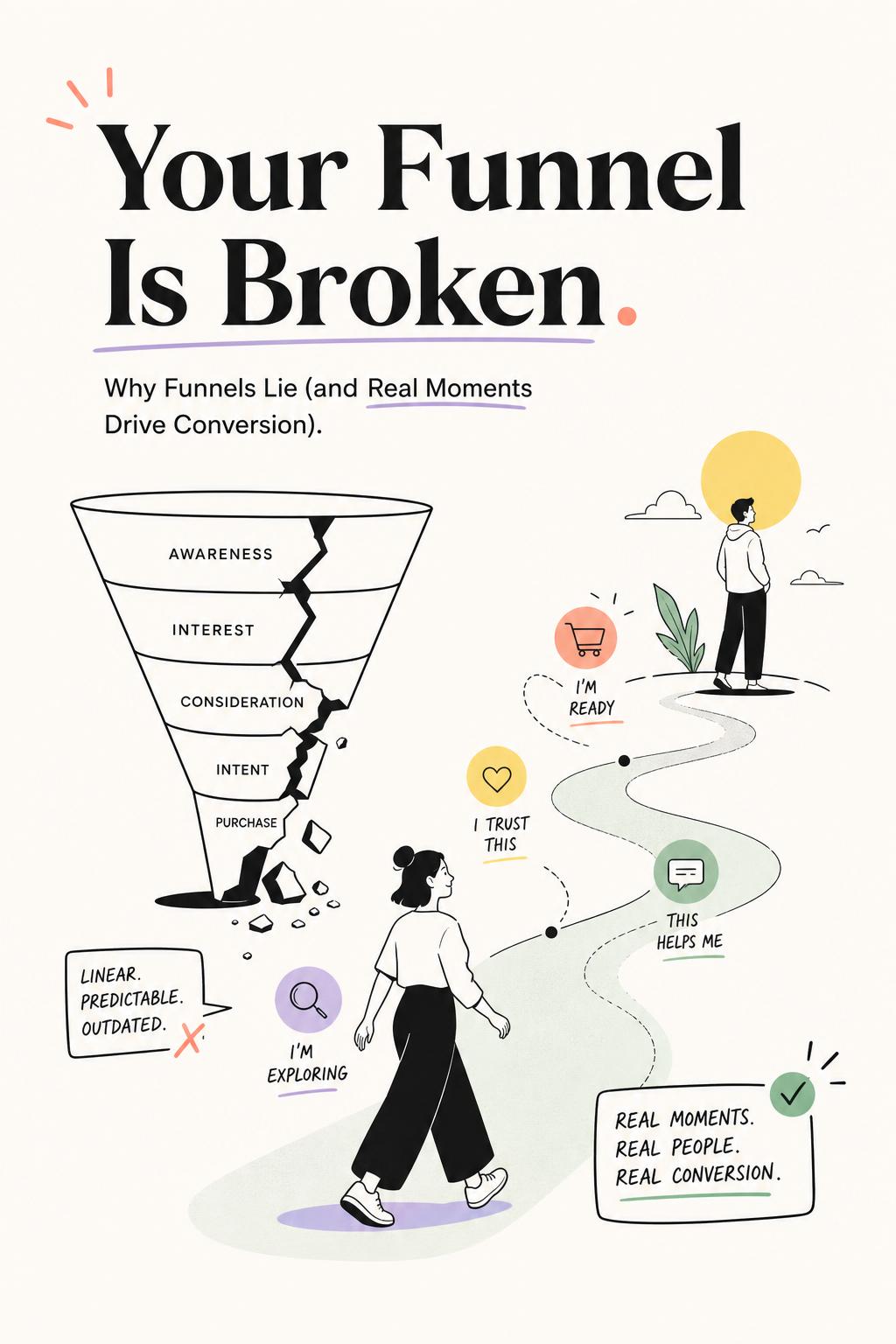
The traditional model—awareness, consideration, decision—feels clean. It’s also dangerously misleading.
Funnels describe business stages. They do not describe how decisions actually happen.
In reality, customers loop, stall, and regress. They revisit earlier assumptions. They compare options multiple times. They involve other people late in the process. And most importantly, they abandon decisions long before your analytics say they did.
Here’s where most teams go wrong:
The result? You end up fixing symptoms instead of causes.
I worked with a SaaS team that spent three months optimizing their pricing page because of a visible drop-off. Interviews revealed something brutal: most users had already decided not to buy before they even reached pricing. The real issue? They didn’t believe implementation would be easy enough.
The pricing page wasn’t the problem. It was just where the decision became visible.
If you want to understand how customers actually decide, stop mapping steps and start mapping decisions under uncertainty.
Every meaningful customer journey moves through four critical questions:
Most teams obsess over “why this option.” That’s your messaging, positioning, and features.
But in practice, decisions are far more sensitive to the other three.
If there’s no urgency, nothing happens. If risk feels high, nothing converts. If the current solution feels “good enough,” customers stay put.
This is why so many well-designed products struggle to grow: they solve for preference, not for hesitation.
After hundreds of interviews across SaaS, fintech, and consumer products, I’ve found that every customer decision journey can be broken into three forces:
This is not your product’s value proposition. It’s the customer’s underlying motivation.
For example:
If you don’t understand this context, you’ll misread every decision they make.
This is where most journeys break—and where most teams lack visibility.
Friction isn’t just UX issues. It includes:
I once ran interviews for a company with strong product-market fit but low conversion. The insight was painfully simple: buyers weren’t worried about the product—they were worried about explaining the decision internally. The company had built a product, but not a defensible narrative.
This is where most companies underinvest.
Proof isn’t generic testimonials or logos. It’s specific evidence that addresses specific risks.
For example:
When proof aligns with friction, decisions accelerate. When it doesn’t, even great products stall.
Not every touchpoint matters. In fact, most don’t.
The customer decision journey is shaped by a handful of high-leverage moments where uncertainty spikes or resolves:
If you’re not studying these moments directly, you’re guessing.
This is where tools like UserCall become critical. Instead of relying on delayed surveys or post-hoc assumptions, you can intercept users exactly when these moments happen—during a stalled trial, right after viewing pricing, or when they abandon a key flow—and run AI-moderated interviews with full researcher control. That gives you something analytics never will: decision context in real time.
And that’s the difference between knowing what happened and understanding why.
Analytics are necessary—but dangerously incomplete.
They show behavior, not reasoning. And in decision journeys, that distinction matters.
A drop in conversion might mean confusion. Or it might mean clarity that led to rejection.
More time on page might mean engagement. Or it might mean unresolved doubt.
I worked with a team that celebrated increased engagement on their product comparison page. Sessions were longer, interactions were higher. But conversions didn’t move.
When we interviewed users, the insight was blunt: “I spent more time because I couldn’t figure out if this would work for my use case.”
What looked like engagement was actually friction.
If you want something actionable, here’s the exact approach I recommend:
One of the most effective questions I use in interviews is: “When did this go from ‘interesting’ to ‘something you might actually choose’?”
That single moment often reveals the trigger, the stakes, and the decision criteria all at once.
Use this to pressure-test your current understanding:
If your answers rely on guesses like “pricing” or “UX improvements,” you’re still looking at the surface.
The most important shift you can make is this:
Customers don’t choose the best product. They choose the option that feels least likely to fail.
That’s the customer decision journey.
It’s not linear. It’s not clean. And it’s not captured in your funnel.
But once you understand where risk appears—and what proof removes it—you stop guessing. You stop over-optimizing the wrong pages. And you start influencing the moments that actually matter.
That’s where real growth comes from.
If you're ready to replace funnel guesswork with a mapping process built on real customer research, read the full Customer Journey Mapping guide for a step-by-step approach. Usercall can help you run the interviews that surface these decisive moments at scale, without months of manual coordination.
Related: find the hidden moments where customers decide to leave · map the decisions that make users leave, not just touchpoints · why most touchpoint maps fail to drive decisions
